The physical relocation of eleventh-century textiles across geopolitical borders is not a mere exhibition event; it is a complex risk-management and diplomatic operation. When a historic asset of international significance—such as the embroidered narrative of the Norman Conquest—moves from a permanent municipal repository in France to an institution like the British Museum, the process exposes a friction point between political signaling and conservation science. The decision to execute a loans-based transfer of this magnitude requires balancing bilateral state objectives against the strict physical tolerances of medieval linen and wool.
Understanding the mechanics of this operation requires deconstructing the transfer into three core operational phases: diplomatic underwriting, environmental micro-climate control, and transit security architecture.
The Underwriting Framework of International Cultural Loans
The transfer of state-owned cultural assets between sovereign nations operates under a legal and financial framework designed to mitigate catastrophic loss while fulfilling diplomatic objectives. The primary mechanism governing these agreements is the state indemnity scheme, which substitutes commercial insurance policies with government-backed guarantees.
Commercial insurance providers cannot efficiently price the risk of an irreplaceable medieval artifact. A total loss scenario would require a payout that disrupts standard actuarial models. Therefore, the receiving nation’s government assumes direct financial liability for the agreed valuation of the asset during transit and exhibition. This liability framework demands absolute compliance with specific security and environmental protocols dictated by the lending institution and its national regulatory bodies.
The diplomatic utility of these loans serves as a non-verbal channel for bilateral alignment. By initiating a high-profile cultural transfer, sovereign states signal historical interconnectedness and mutual trust. The asset functions as a form of sovereign collateral; the lending nation demonstrates goodwill, while the receiving nation validates its operational capacity and security infrastructure on a global stage.
Environmental Control Engineering and Micro-Climate Stability
The primary risk vector during the physical relocation of ancient textiles is environmental instability. Medieval linen and crewel wool embroidery are highly hygroscopic materials, meaning they continuously absorb and desorb moisture from the surrounding atmosphere to reach equilibrium with their environment.
Fluctuations in Relative Humidity (RH) and temperature initiate mechanical stresses within the fibers. High humidity triggers fiber expansion and encourages microbial proliferation, while excessively dry conditions induce brittleness, accelerating the crystallization of degradation products within the historic flax.
To neutralize these risks, the transport architecture relies on passive and active micro-climate conditioning.
[Ambient Environment] -> [Insulated Shipping Container] -> [Buffer Material: Silica Gel] -> [Hermetically Sealed Art Crate] -> [Artifact Core]
The stabilization process follows a strict containment logic:
- Environmental Baseline: The artifact must be stabilized within a constant RH band of 50% to 55%, with an allowable variance of no more than ±2% within any 24-hour period. Temperature must be maintained at 18°C to 22°C (64.4°F to 71.6°F).
- Buffering Agents: Pre-conditioned silica gel cassettes are integrated into the inner transport casing. These cassettes absorb or release moisture mechanically to counteract external thermal shifts.
- Hermetic Isolation: The inner casing is sealed against atmospheric pressure changes, preventing the ingress of pollutants, particulate matter, or gaseous contaminants during transit.
The physical format of a long, continuous textile presents an engineering bottleneck. Unlike framed canvas paintings, a continuous narrative cloth measuring approximately 70 meters cannot be transported in a rigid, flat configuration without risking structural failure along existing fold lines or weak points. The object must either be rolled onto large-diameter, acid-free cylinders lined with inert barrier films or transported in custom-fabricated, segmented crates that prevent any compression of the embroidery.
Transit Security Architecture and Intermodal Friction
The secret transit of a high-value historical asset across the English Channel introduces significant security and logistical vulnerabilities. The movement protocol requires absolute operational security (OPSEC) to mitigate the risks of targeted theft, geopolitical vandalism, or transit accidents.
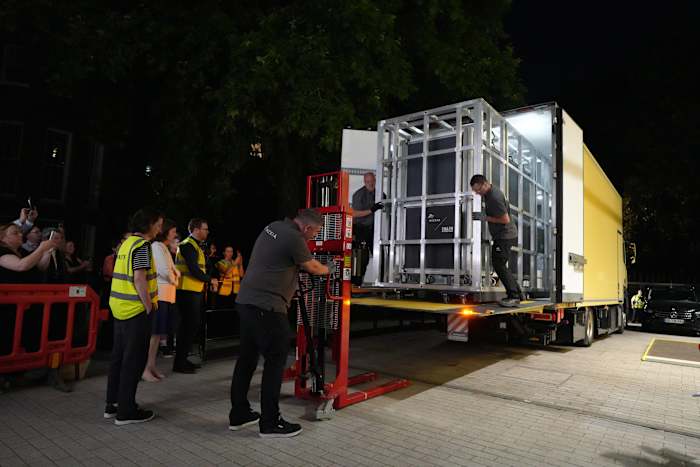
The transport operation minimizes these variables through a multi-tiered security apparatus. The route planning avoids predictable transit hubs and public timetables. Instead, the asset moves via a closed logistics chain utilizing unmarked, climate-controlled transport vehicles equipped with pneumatic suspension systems to dampen vibrational frequencies that could loosen fragile medieval stitching.
The crossing from France to the United Kingdom introduces a specific operational bottleneck: the maritime or sub-maritime transition. Whether utilizing the Eurotunnel or a dedicated sea vessel, the vehicle encounters varying barometric pressures and vibrational signatures. The transport casing must absorb these low-frequency shocks. Continuous telemetry tracking monitors real-time changes in three axes of movement ($x$, $y$, and $z$), alongside internal temperature and humidity sensors. This data streams via encrypted satellite links to a central command team, enabling immediate intervention if any environmental parameter breaches the established threshold.
Upon arrival at the British Museum, the asset cannot be immediately unpacked. The crate must undergo an acclimatization period of 24 to 48 hours within the secure gallery space. This phase allows the internal temperature of the container to equalize gradually with the museum’s HVAC ecosystem, preventing the thermal shock and condensation that occurs when a sealed unit is opened prematurely.
Conservation Limitations and Structural Risks
While the diplomatic and educational yields of an international loan are substantial, the structural trade-offs for the artifact are permanent. Every movement phase inflicts cumulative mechanical stress on ancient fibers.
The weight of the textile itself presents a long-term conservation challenge. When displayed horizontally, gravity exerts uniform pressure across the support structure. However, if displayed at an incline or vertically to optimize visitor sightlines, the load-bearing capacity of the upper linen threads is tested. Over time, the tension causes micro-tears in areas where the linen base has been weakened by historical handling, insect damage, or chemical degradation from early conservation treatments.
Furthermore, exposure to artificial lighting during public exhibition accelerates photochemical degradation. Even when filtered to eliminate Ultraviolet (UV) and Infrared (IR) spectra, visible light breaks down the molecular bonds of natural dyes, such as madder, woad, and weld, leading to irreversible color shifting and fiber embrittlement. Museum protocols restrict light exposure to a maximum of 50 lux, with total cumulative exposure strictly capped over the duration of the loan.
Strategic Operational Protocol
Institutions managing the cross-border movement of foundational cultural assets must prioritize structural preservation over political expedience. The execution model must decouple the artifact from geopolitical timelines, ensuring that transit occurs only when environmental models indicate optimal seasonal stability. Future loan agreements must mandate the integration of fiber-optic strain sensors within the mounting substrates to provide real-time structural health data during both transport and public display, shifting the conservation paradigm from reactive monitoring to predictive mitigation.