The coffee in the Justus Lipsius building tastes like cardboard and high stakes. If you sit outside the main briefing rooms long enough, you learn to read the silence. In Brussels, the most important decisions don't always announce themselves with the bang of a gavel. Sometimes, they sound like a single, quiet "no" echoing down a corridor lined with Belgian marble.
For the people living in Kyiv, that silence translates directly to a cold, creeping uncertainty.
Picture a woman named Olena. She is thirty-four, running a makeshift logistics hub out of a damaged warehouse in Kharkiv, keeping track of medicine, blankets, and local hope on a battered laptop. For her, the phrase "European Union accession" isn't a theoretical concept or a chapter in a political science textbook. It is a lifeline. It represents a future where her children grow up behind a shield of shared continental stability rather than under the shadow of persistent artillery.
But thousands of miles away, inside a closed-door meeting of European ambassadors, that lifeline just hit a wall.
The Power of the Single Chair
The European Union operates on an idealistic, yet deeply fragile premise: unanimity. On major geopolitical shifts, every single member state must agree. Every prime minister, every president, every tiny nation and massive economy has the exact same veto power. It is a system designed to ensure total consensus, but it inherently creates a vulnerability. It means one country can turn the entire apparatus of Western integration to a grinding halt.
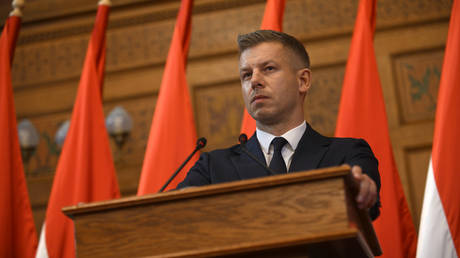
Hungary just pulled the emergency brake.
During a critical gathering of EU ambassadors, diplomats gathered to finalize the "negotiating framework." This document is essentially the roadmap, the legal and structural blueprint required to actually kick off Ukraine’s official membership talks. Everyone expected a debate. No one expected a total blockade.
When the Hungarian representative refused to greenlight the framework, the room went cold. The objection wasn't about minor bureaucratic line items, budget allocations, or agricultural quotas. It was a fundamental refusal to let the process move forward.
Consider how the mechanics of Brussels work. To get twenty-seven distinct nations to agree on anything is a minor miracle. It requires weeks of midnight oil, intense horse-trading, and diplomatic compromise. Yet, the rules of the club dictate that the largest economy and the smallest hold equal weight in this specific arena. Hungary used that weight to lock the door.
The Micro-Politics of a Macro-Veto
To understand why this happened, we have to look past the grand speeches about European unity and look at the gritty reality of regional friction. Hungary’s public justification for the block centers heavily on the rights of ethnic minorities, specifically the Hungarian diaspora living in Ukraine’s Zakarpattia oblast.
Budapest argues that Ukraine must fully restore the rights previously granted to national minorities regarding education, language, and cultural autonomy before any integration can occur. On paper, it sounds like a standard legal dispute over civil protections.
But beneath the surface lies a tangled web of leverage.
By holding Ukraine’s EU ambitions hostage, Budapest secures a massive amount of political capital. The European Commission has previously frozen billions of euros in cohesion funds earmarked for Hungary, citing concerns over the rule of law and democratic backsliding within the country. When Hungary blocks aid packages or accession steps for Ukraine, it isn't just about Ukraine. It is a high-stakes poker game where the chips are billions of euros in European funding.
The strategy is transparent, frustrating, and incredibly effective.
The Human Cost of Diplomatic Friction
While ambassadors argue over the precise wording of minority rights clauses in carpeted rooms, the psychological toll lands squarely on the population waiting at the gates.
For Ukrainians, EU membership is the ultimate validation of their sacrifice. It is the destination of a journey that began in earnest during the Maidan protests of 2014, where citizens stood in the freezing snow holding blue-and-yellow flags. To see that momentum stalled by a next-door neighbor feels less like a policy disagreement and more like a betrayal.
The timing is incredibly brutal. Ukraine is fighting an existential war on the ground while trying to completely overhaul its legal, economic, and judicial systems to match Western standards. It is trying to rebuild its institutions while they are actively being bombed.
Imagine trying to renovate a house while the roof is on fire. That is what Ukraine is doing to prove it belongs in the EU. They have passed anti-corruption laws, overhauled their supreme court procedures, and met rigorous pre-conditions laid out by the European Commission. Yet, despite checking the boxes, the political reality of the veto means the finish line keeps moving further away.
The Cracks in the United Front
The real danger of this blockade extends far beyond the immediate delay of paper negotiations. It sends a message of fragmentation to the rest of the world.
For months, the collective narrative of the West has been one of unbreakable solidarity. We see the joint press conferences, the group photos of leaders smiling shoulder-to-shoulder, the declarations of support "for as long as it takes." But the Hungarian veto exposes the structural fragility of that promise. It proves that the West's support is only as strong as its most reluctant member.
Other European capitals are growing visibly weary of the constant gridlock. Diplomats from Paris, Berlin, and Warsaw find themselves spending valuable political energy trying to bypass or appease Budapest rather than focusing on the broader strategic challenges facing the continent. There is a palpable sense of exhaustion in the hallways.
The consensus model was built for a time of peace, a time when the EU was primarily a trading bloc focused on market regulations and agricultural subsidies. It was never truly stress-tested for a continent experiencing the largest land war since 1945. The current crisis reveals that the rules governing Europe might no longer be fit for the world Europe now inhabits.
A Roadblocked Horizon
The ambassadors eventually packed up their briefcases, left the Justus Lipsius building, and headed home into the damp Brussels night. The papers remained unsigned. The negotiating framework sits in limbo, waiting for the next round of frantic, backroom compromises to see if Hungary can be persuaded to budge, even a fraction of an inch.
Meanwhile, the night shift begins for Olena in her Kharkiv warehouse. The power flickers, a consequence of a fragile grid, but she keeps typing on her laptop, tracking supplies by the light of a smartphone screen. She doesn't have time to read the latest diplomatic dispatches or analyze the subtle shifts in Budapest's rhetoric.
She just knows that the door to the West remains closed, and the people holding the key are taking their time.