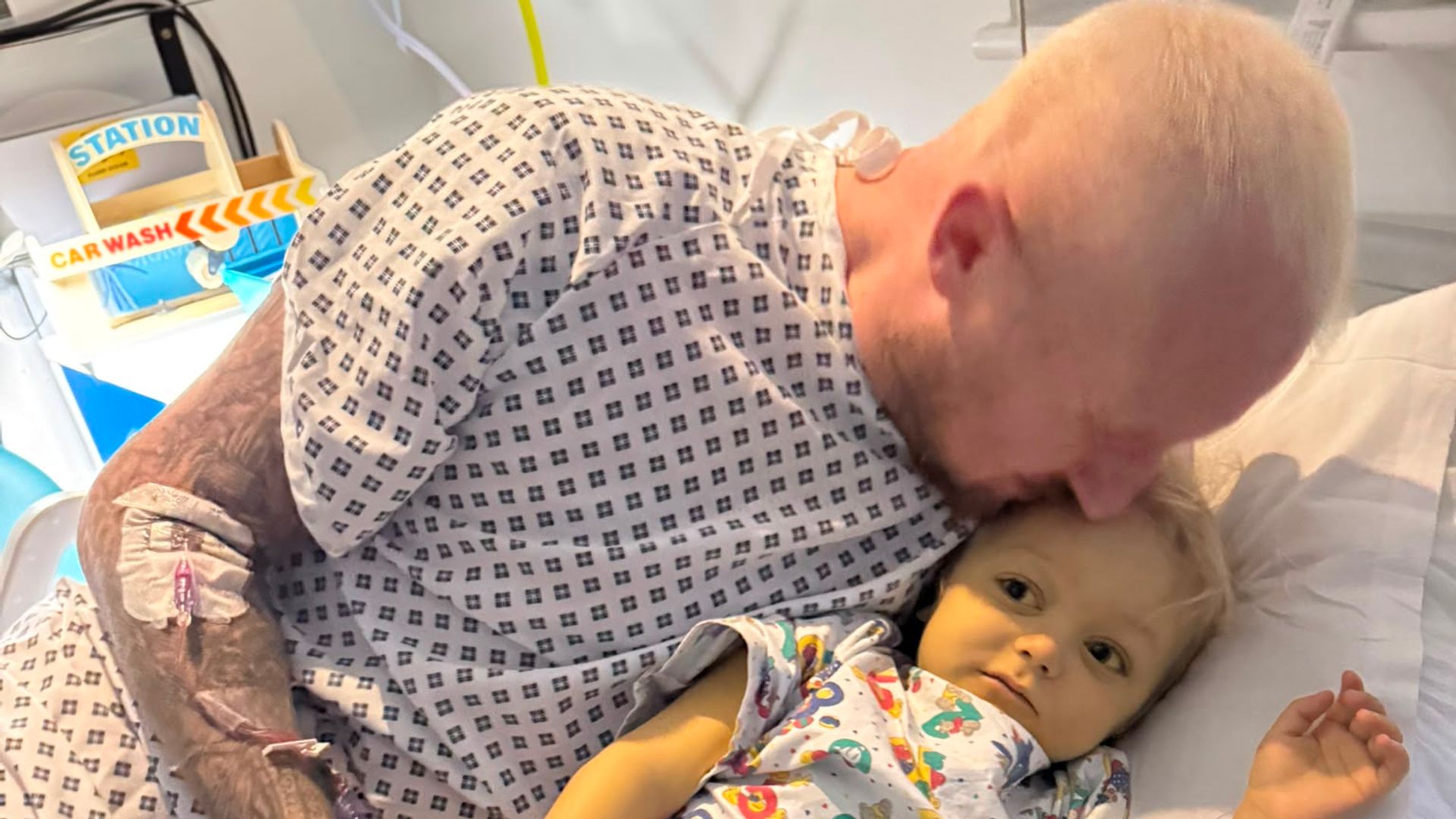
When a father hands over a literal piece of his own anatomy to keep his child breathing, the medical establishment calls it a living donor transplant. The paperwork calls it an elective procedure. The room smells like antiseptic, cold steel, and the distinct, coppery tang of high-stakes surgical theater.
In this specific case, a father did not just surrender a lobe of his liver. He also surrendered a section of his bowel, crossing a threshold that most living donors never face. Multi-organ living donation is rare. It is brutal. It pushes the absolute boundaries of surgical ethics, institutional risk mitigation, and human endurance.
Most people assume organ donation happens in the quiet tragedy of brain death. They picture donor cards and sterile ICUs where families make heartbreaking choices in fluorescent-lit waiting rooms. But living donation flips that script entirely. It introduces a healthy human body into a surgical crossfire. You take a person who walked through the hospital doors under their own power, place them under general anesthesia for hours, and intentionally inflict major trauma upon them. All for the statistical probability of extending someone else's tomorrow.
The Anatomy of a High Risk Procedure
The logistics of a combined liver and bowel transplant from a single living donor represent an administrative and physiological labyrinth.
A standard living-donor liver transplant relies on the organ's staggering capacity for regeneration. Surgeons can harvest the right or left lobe from a healthy donor because the remaining liver tissue will multiply and regrow to nearly full volume within weeks. But adding a bowel segment changes the calculus entirely. The small intestine is not a uniform tube. It is a dense, highly vascularized network packed with immune tissue, lymphatic channels, and a massive resident microbiome.
Vascular precision is the absolute dividing line between success and catastrophic failure here. The surgical team must isolate small bowel segments while preserving the precise arcade of blood vessels feeding that specific loop of tissue. Damage the blood supply by even a millimeter, and the graft dies inside the recipient.
Consider the physical toll on the donor. Recovering from a partial hepatectomy involves weeks of profound fatigue, restricted lifting, and a dull, deep-seated ache in the upper right quadrant. Add a bowel resection to that chart, and you introduce the agonizing process of getting the digestive tract to wake up. Post-operative ileus—where the bowel temporarily paralyzes itself in shock—turns every sip of water into a gut-wrenching gamble.
The Institutional Hesitancy
Hospitals do not rush into these procedures. In fact, transplant ethics boards are structurally paranoid, and for good reason.
The primary mandate of medicine is simple: do no harm. When a surgeon operates on a healthy donor, they are violating that core tenet by inflicting intentional harm to benefit a third party. To justify this, transplant centers use independent donor advocates. These are physicians and social workers whose only job is to protect the donor, completely insulated from the pressure of saving the recipient. If a donor shows a flicker of coercion, if they hesitate, if their psychological clearance wobbles, the entire operation halts.
Multi-organ living donation stretches those ethical guardrails to their snapping point. The risk profile compounds.
- Donor mortality rates for standard living liver donations hover around two-tenths of one percent.
- Morbidity rates—meaning complications ranging from bile leaks to incisional hernias—sit anywhere between twenty and forty percent.
- Adding a bowel component introduces risks of chronic bowel obstruction, short bowel syndrome if margins are miscalculated, and heightened infection risks due to the luminal nature of the organ.
Why take that risk? Because deceased donor waiting lists are killing fields of attrition. Thousands of patients die every year waiting for organs that arrive too late, or never arrive at all. For a child with acute liver failure or catastrophic intestinal failure, time is measured in hours, not months. The deceased donor pool cannot keep pace with pediatric need, particularly for tiny infants or children with rare anatomical requirements. Living donation is often the only escape hatch from a terminal diagnosis.
The Psychological Aftermath
We romanticize the heroism of the donor. We write headlines about selflessness and love that defies biology. But we rarely talk about the silence that follows the discharge paperwork.
The physical scars fade into thin silver lines across the abdomen. The psychological scars are entirely different. What happens when the recipient rejects the organ? What happens if the child suffers chronic complications despite a technically successful surgery? The donor carries a physical reminder of a gamble that didn't pay off, housed permanently within their own altered body.
Conversely, if the surgery succeeds, a strange dynamic settles over the household. The recipient is walking around with pieces of their parent's internal organs. Holidays carry a bizarre subtext. Every milestone birthday is a direct mathematical consequence of an operating room in 2026.
Independent psychological monitoring for living donors is mandatory, yet the long-term support infrastructure remains patchy. Hospitals track rejection rates and graft survival in recipients down to the decimal point. Tracking the long-term quality of life, chronic pain syndromes, and economic loss of living donors over a twenty-year horizon is an epidemiological blind spot. Donors take time off work, absorb medical debt for follow-up care that insurance sometimes disputes, and navigate a healthcare system ill-equipped to treat former patients who are now permanently altered chronic care risks.
The Future of Synthetic and Xenotransplantation
Living donation remains a desperate workaround for a broken biological bottleneck. The ultimate goal of modern regenerative medicine is to render living human donors entirely obsolete.
Researchers are pushing forward on three distinct fronts to replace human-to-human organ transfer.
- Bioartificial organs seeded with a patient's own stem cells aim to grow replacement tissue on natural extracellular scaffolds.
- Gene-edited porcine organs are moving closer to clinical reality, designed to bypass hyperacute human immune rejection.
- 3D bioprinting continues to advance from laboratory novelty toward functional vascularized tissue construction.
Yet these innovations remain years, if not decades, away from routine pediatric application. Until bioengineering catches up with clinical need, families will continue to make the ultimate anatomical trade. They will step onto the operating table, offer up their livers, their kidneys, and their bowels, and trade their own physical wholeness for the simple, desperate chance to watch another generation grow old.
The scalpel descends. The monitors beep in steady, rhythmic indifference. And somewhere in the sterile quiet, biology makes its final, unforgiving calculation.