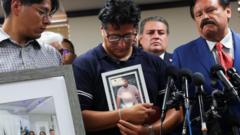
On July 7, 2026, Lorenzo Salgado Araujo, a 52-year-old homebuilder who had lived in the United States for 35 years, was shot and killed by Immigration and Customs Enforcement agents during an early morning traffic stop in Houston. He was not the person federal authorities were looking for. The Department of Homeland Security later acknowledged that agents were conducting surveillance on a completely different address, chasing a tip regarding two Guatemalan nationals, when they intercepted Salgado Araujo's white van simply because it resembled a vehicle noted weeks prior.
The killing has ignited an immediate crisis of accountability for federal law enforcement. Within 48 hours, the official narrative shifted from a justified stop of an undocumented target to an admission of mistaken identity. For those watching the escalation of federal immigration enforcement over the past year, the incident represents something far more systemic than a single operational failure. It highlights a recurring pattern where aggressive field tactics, lack of transparency, and an absence of basic monitoring equipment combine with fatal results. Discover more on a related topic: this related article.
The Blueprint of a Fatal Mistake
Before dawn on a Tuesday morning, Salgado Araujo followed a routine he had maintained for decades. He climbed into his white work van to pick up his construction crew, including his brother, to drive to a homebuilding site in the Houston suburbs. He was a small business owner, a father of three who had built a quiet life without ever accumulating a criminal record. He was also in the middle of navigating the backlogged federal bureaucracy to secure a formal work permit, having already submitted biometric data and fingerprints earlier in the year.
At the same time, an ICE enforcement team was positioned near a property in East Houston. They were acting on a tip regarding two men from Guatemala. According to internal DHS accounts later released under intense public pressure, agents had noted two white vans parked at the target property during surveillance weeks earlier. When Salgado Araujo drove past the area in a similar vehicle, officers initiated a stop. More analysis by BBC News highlights related views on the subject.
What happened next is a matter of fierce dispute, obscured by the deliberate choices of the agency involved.
Federal officials claim Salgado Araujo ignored multiple verbal commands, rammed an ICE vehicle, and weaponized his van in a manner that forced an officer to fire in self-defense. He was struck in the abdomen and later died at a local hospital.
The men sitting in the back of the van tell a completely different story. Speaking through legal counsel from an immigration detention facility where they were promptly taken after the shooting, the survivors state that a federal officer opened fire almost immediately after stepping out of an unmarked vehicle. They maintain that Salgado Araujo never veered toward the officer or attempted to use the van as a weapon.
The terror of the moments leading up to the gunfire cannot be separated from the tactics utilized by federal teams. The vehicles pursuing the construction crew were unmarked. They bore no emblems, no agency logos, and no flashing emergency lights. In a city like Houston, where crews carrying thousands of dollars in commercial tools are frequent targets for highway robberies, a driver faced with aggressive, unidentified vehicles blocking his path faces a terrifying calculation. His family asserts that if he attempted to maneuver away, it was because he believed he was about to be hijacked by criminals looking to steal his livelihood.
The Evolution of the Official Narrative
The initial press releases from the Department of Homeland Security framed the incident with a familiar boilerplate. They initially justified the stop by stating Salgado Araujo was targeted because he was present in the country without legal permission. This initial framing weaponized his immigration status to retroactively justify an enforcement action that had no legal basis at its inception.
By Thursday, that narrative dissolved. Faced with inquiries from local congressional representatives and civil rights organizations, DHS admitted that the enforcement team was looking for someone else entirely. The man they killed was a bystander to an operation that missed its actual target by blocks and identities.
This trajectory follows a well-documented script within federal immigration enforcement. When a field operation turns lethal, the first instinct of the institutional apparatus is to insulate itself by emphasizing the undocumented status of the victim, effectively betting that public sympathy will erode. Only when forced by external scrutiny do the operational errors come to light.
Veteran investigators recognize this pattern from previous high-profile tragedies. Earlier encounters during intense enforcement campaigns in cities like Minneapolis and Portland featured nearly identical claims of self-defense involving vehicles. In the case of Renee Good in Minnesota, federal officials insisted that the deployment of lethal force was an instantaneous reaction to an imminent vehicular threat. Bystander video later emerged that directly contradicted the official timeline, forcing an administrative retreat.
In Houston, however, the agency has managed to restrict the flow of objective data. The physical positioning of the ICE vehicles and the construction van effectively blocked the line of sight for nearby neighborhood security cameras, leaving the public dependent on the accounts of detained witnesses who face immediate deportation.
The Blind Spot of Federal Accountability
The most glaring failure of the Houston operation is the total absence of body-worn cameras. At a time when local police departments across the country are mandated to record every civilian interaction, federal immigration agents continue to operate in an information vacuum.
When questioned about the lack of recording devices, a DHS spokesperson deflected blame toward Capitol Hill, citing back-to-back legislative funding lapses and government shutdowns that supposedly delayed the procurement and distribution of body cameras to the Houston field office. To an industry analyst, this defense rings hollow. ICE commands a multibillion-dollar budget. The decision to deploy tactical teams into dense residential neighborhoods without basic recording equipment is an operational choice, not a budget constraint.
The absence of body cameras serves a dual purpose for an agency under pressure. It protects individual officers from immediate accountability while allowing the institution to control the narrative through heavily curated public statements. If a local police officer involved in a shooting claimed a funding shortage prevented them from wearing a camera, the justification would be rejected by prosecutors and the public alike. Yet, federal entities routinely operate under a separate standard of immunity.
The oversight of this incident has been handed to the Department of Homeland Security Inspector General, alongside an FBI probe focused on the alleged assault on a federal officer. History suggests that internal investigations within the federal immigration apparatus move at a glacial pace, often concluding long after public outrage has subsided. The three witnesses who could provide definitive testimony remain locked inside an immigration detention center, isolated from independent investigators and facing the threat of removal from the country before a full deposition can be taken.
The Broader Machinery of Escalation
Salgado Araujo's death is not an isolated administrative error. It marks a clear milestone in an ongoing, aggressive domestic enforcement campaign that has seen an escalation in fatalities across the country over the last eighteen months. As federal mandates demand higher arrest metrics, the margin for error in the field shrinks, and the pressure on field agents to execute quick apprehensions increases.
When operations prioritize speed and volume over rigorous verification, the intelligence supporting those operations degrades. Relying on a weeks-old tip about the color of a vehicle to execute a high-risk vehicle intercept in the dark is a failure of basic police tradecraft. It transforms routine immigration enforcement into a game of high-stakes probability where the costs are borne entirely by civilians.
The diplomatic fallout is already fracturing relations across the southern border. The Mexican government issued a sharp rebuke following the admission of mistaken identity, stating intention to pursue formal legal actions and demanding a transparent review of the rules of engagement governing federal stops.
Meanwhile, local leaders find their hands tied. Houston officials previously attempted to pass ordinances limiting local municipal cooperation with federal immigration sweeps, only to face immediate retaliation from state executives who threatened to sever over 100 million dollars in public safety funding. This political leverage ensures that local communities must tolerate high-risk federal operations in their neighborhoods, even when those operations bypass the safety protocols established by local police departments.
The tragedy leaves a family to pick up the pieces of an American dream that was shattered in seconds on a Texas street. Salgado Araujo's oldest son is a schoolteacher; his younger sons are pursuing engineering degrees. They represent the exact trajectory of stability and integration that multi-generational immigrant families strive to achieve.
The homebuilder who spent his life erecting structures in the suburbs was reduced to a compliance statistic before the government admitted they had the wrong man. The broken machinery of federal enforcement remains in place, unchanged by the blood on the pavement, waiting for the next white van to cross its path.