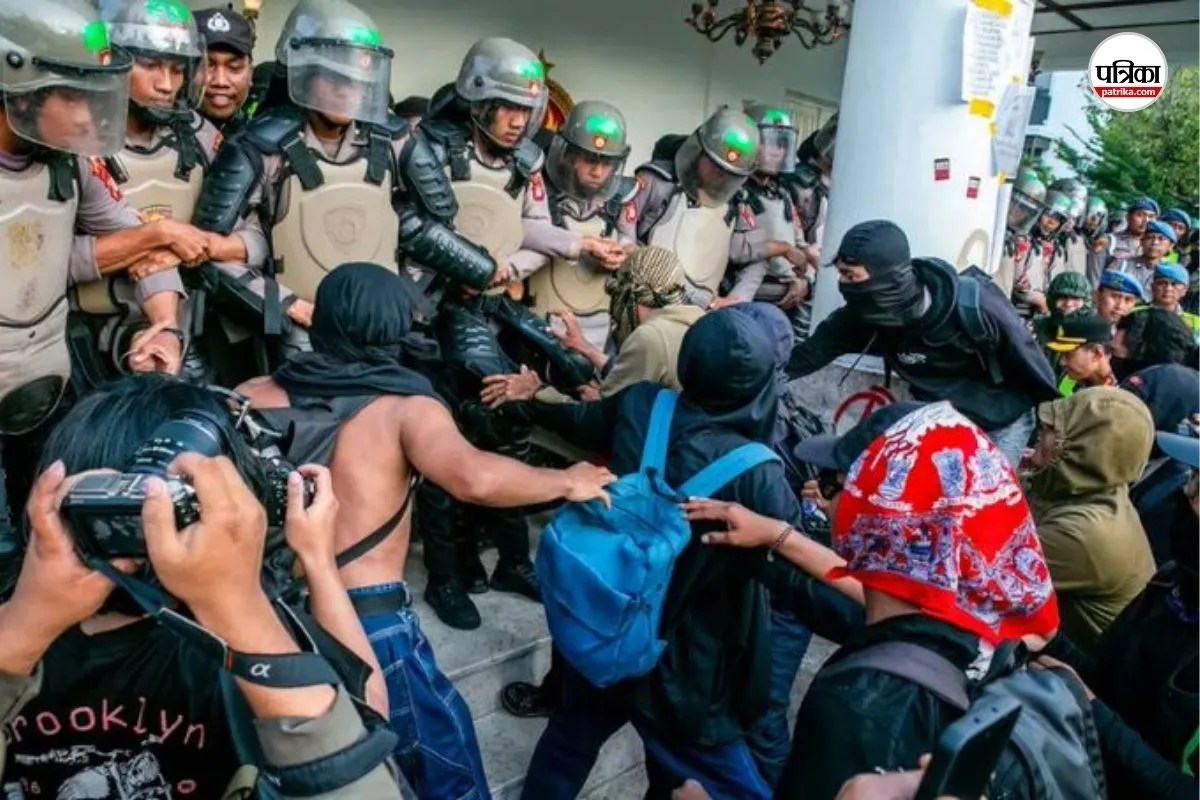
Chalk dust. That is the first thing you notice when a university campus turns into a flashpoint. It clings to the hems of cheap polyester trousers, settles into the creases of rolled-up banners, and tastes dry at the back of your throat after hours of shouting in tropical heat.
Across continents, a quiet fracture has been widening between the people who draft budgets in climate-controlled offices and the young people who have to survive the math behind them. We have watched this tension spill onto streets in Albania, across neighborhoods in France, and through squares in Italy. Now, the spotlight has turned toward Indonesia, where university students have stepped out from beneath ceiling fans and lecture notes to question the policies of President Prabowo Subianto’s administration.
A standard news report will give you the sequence of events like a train timetable. It will name the capitals, count the protesters, summarize the ministerial statements, and move on to the next dispatch by evening. Numbers are neat. Timetables are tidy. Neither one tells you what it feels like to sit in a crowded room with a calculator, realizing that the future you were promised has been repriced while you weren't looking.
To understand why these demonstrations keep echoing from Tirana to Paris to Rome and Jakarta, we have to look past the headlines and listen to the people carrying the signs. Because protests rarely start over an abstract decree on page forty-two of a policy brief. They start when a young person tries to buy lunch, pay rent, or plan a life five years ahead and discovers the floor has shifted.
The Math Behind the March
Policy debates can feel like fog from the outside. Terms like fiscal reallocation, subsidy reform, state spending priorities, and administrative restructuring sound technical, almost bloodless, as if moving numbers from one column to another leaves human lives untouched.
It does not.
Consider a hypothetical student—let’s call her Sari, studying economics in Jakarta. Sari is not an archetype from a textbook; she is a stand-in for millions of young adults trying to stitch together adulthood out of part-time shifts, family sacrifices, and fragile hopes. In this hypothetical scenario, Sari wakes up before dawn, checks her phone for transit updates, and goes over her monthly ledger before she even brushes her teeth. A slight shift in public subsidies, a tightening in household support, or a sudden jump in everyday costs does not look like a macro-economic chart to her. It looks like skipping dinner twice a week so she can afford printing costs for her thesis and fare to get across town.
I know that particular knot in the stomach. Years ago, during a stretch of economic turbulence in my own life, I learned how quickly ordinary anxieties turn sharp. You stop looking at price tags as numbers and start seeing them as countdowns. Every rise in basic expenses shrinks your margin for error until one unexpected bill feels like a cliff edge. That lived memory makes it impossible for me to treat policy shifts as mere ink on paper.
When students in Indonesia question the policies of President Prabowo’s government, they are asking a question that goes straight to that nerve: who absorbs the shock when a state reshapes its priorities?
A useful analogy here is a family home undergoing major renovation. Maybe the new administration wants to reinforce the foundation, build a stronger defense, or overhaul how rooms are funded and managed. Those ambitions can be argued on their merits. Yet if the contractors tear up the kitchen floorboards while the family still has to cook breakfast every morning, people are going to complain about the dust and the missing stove, no matter how grand the blueprint looks on the wall.
Students are uniquely sensitive to those renovations because they live right on the seam between dependence and independence. They are old enough to feel the weight of economic pressure, young enough not to have savings cushions, and close enough to one another in dorms, cafes, and campus courtyards to compare notes in real time. One person’s private worry quickly becomes a shared chorus.
Echoes Across Borders
Why does Indonesia’s unrest feel so familiar to observers who have been watching Albania, France, and Italy?
Because the grievances rhyme even when the languages, histories, and political systems do not.
In different corners of Europe, young people and working families have pushed back against governments over cost-of-living pressures, public spending choices, labor realities, and a perceived gap between official assurances and daily survival. Sometimes the spark is tuition or housing. Sometimes it is fuel, groceries, or pensions. Sometimes it is the sense that decisions affecting an entire generation are being made behind closed doors with too little room for dissent.
Now watch what happens next when that same friction meets Indonesia’s scale and energy. Indonesia is a vast archipelago of hundreds of millions of people, a rising power with huge ambitions and equally huge expectations. When students there challenge President Prabowo’s policies, they are not operating in a vacuum. They are part of a global mood in which young citizens are refusing to be polite spectators to their own economic fate.
Still, I want to be honest about where my certainty ends. Tracing parallels between protests in Albania, France, Italy, and Indonesia is tempting, yet over-simplifying them into a single global script would be a mistake. Each country carries its own political scars, economic constraints, and cultural rhythms. A student march in one capital does not mean the exact same thing as a student march in another, and predicting how any government will respond—through dialogue, concession, or crackdown—is genuinely uncertain. Anyone who claims to know for sure how these stories will end is selling confidence they haven't earned.
What we can see clearly is a pattern in how authority and youth collide. Governments often speak in the language of stability, long-term vision, and order. Protesters often speak in the language of immediacy, fairness, and dignity. When those two languages stop translating into each other, streets fill up.
What People Actually Want to Know
When news breaks that students are protesting President Prabowo’s administration—and that similar waves of frustration have surfaced in places like Albania, France, and Italy—readers usually carry a cluster of urgent questions beneath the headline.
First, they want to know what triggered it. Rarely is there a single switch flipped overnight. Usually, it is a stacking effect: lingering post-pandemic price shifts, tightening household budgets, debates over where public money should go, and frustrations over governance or economic fairness. Policies aimed at reshaping state priorities or streamlining programs inevitably collide with constituencies that rely on existing support or fear losing ground.
Second, readers wonder why students are so often at the front of these movements. History offers a clear explanation. Students have fewer locked-in career obligations than middle-aged workers, strong social networks built right into campus life, and an acute awareness that today’s policies will shape the next forty years of their working lives. When young people look at entry-level wages, living costs, and political responsiveness and feel the math doesn't work, they tend to say so loudly.
Third, people ask whether these demonstrations actually change anything. Sometimes the immediate answer is frustratingly little, at least on paper. Bills pass. Speeches are delivered. Life resumes. Yet protests also shift what is politically mentionable. They force officials to defend assumptions that might otherwise go unchallenged, expose fault lines inside coalitions, and leave a memory that lingers long after the tear gas clears or the barricades come down.
The Invisible Stakes
Strip away the slogans and you find something quieter and heavier: trust.
Trust is like glass. Once a generation feels that institutions are ignoring their strain—or treating their questions as mere noise—putting those pieces back together takes years of patient, unglamorous work.
Imagine a hypothetical young graduate—let’s call him Dimas—standing near the edge of a crowd in Indonesia, watching peers argue passionately about government policy and economic direction. Dimas isn't throwing anything. He isn't trying to overthrow the republic. He just wants to know if hard work still leads somewhere fair, whether public funds are reaching the places that lift ordinary families up, and whether his voice counts for anything beyond election day.
That feeling is not radical. It is deeply human.
When leaders hear criticism from campuses and streets, they face a fork in the road. One path treats dissent purely as a threat to manage, a public-relations headache to wait out until exams start or fatigue sets in. The harder, more durable path treats dissent as diagnostic data—an uncomfortable signal that real people are hurting or feeling sidelined by the pace and direction of change.
From Albania to France, from Italy to Indonesia, the underlying test for governments is remarkably similar. Can you govern with resolve while still listening to the people who bear the cost of your choices? Can you talk about national strength without making everyday citizens feel expendable?
The tension builds in every chapter of this story because the stakes are real on both sides. Leaders worry about chaos, budget limits, and governing a complex nation. Citizens worry about eroding opportunity, rising pressure, and being left behind by decisions made far above street level.
Release comes only when real conversation replaces posture—when policies are explained plainly, adjusted honestly where they harm vulnerable households, and debated in good faith rather than met with dismissal.
A lone student holds a hand-painted sign in the late afternoon sun, sweat dark along her collar, eyes fixed not on a camera lens, but on the road ahead where her future is supposed to begin.


