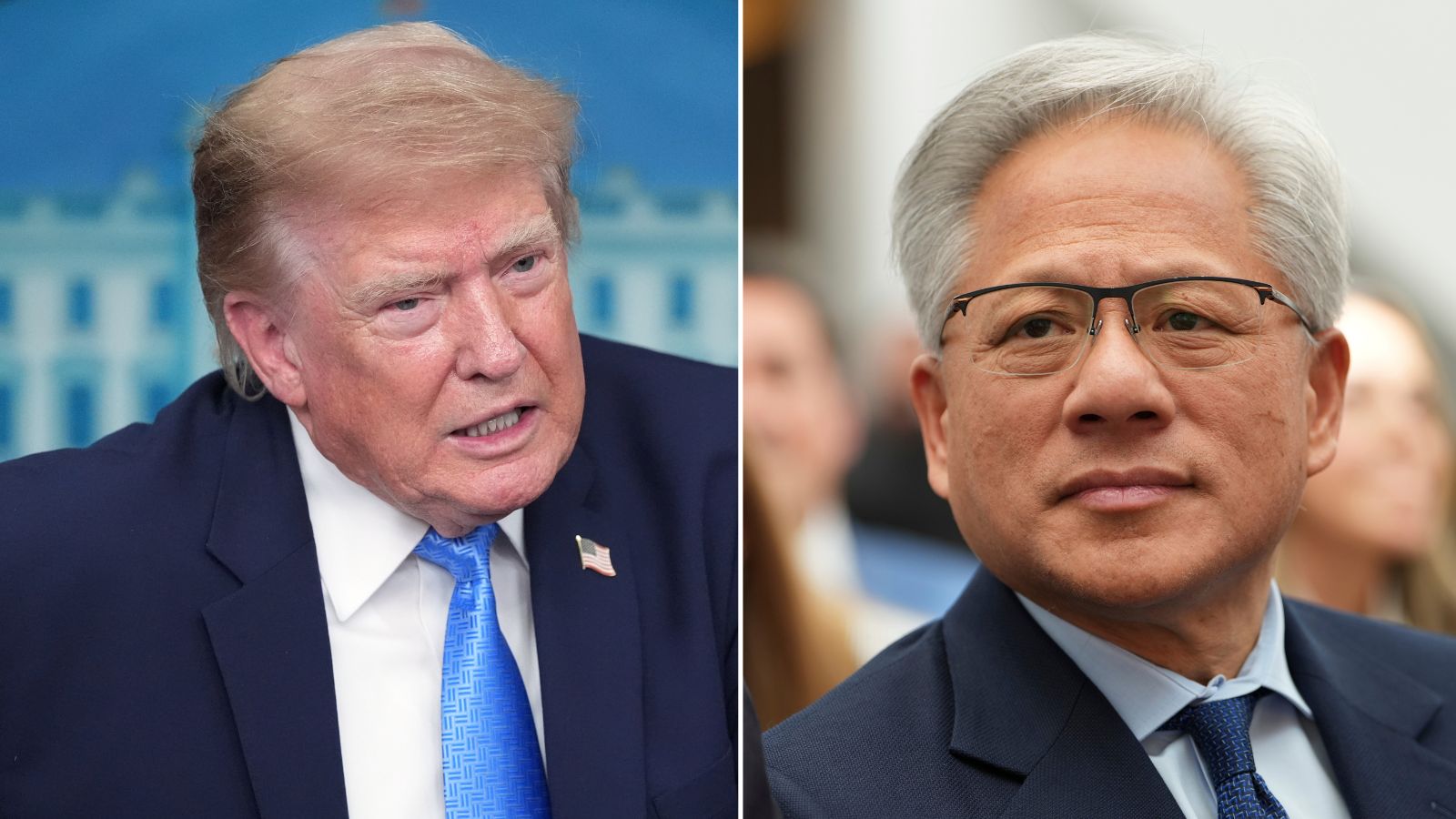
The black leather jacket has become an international uniform.
When Jensen Huang walks onto a stage, twenty thousand engineers lean forward as if a rock star just plugged in an amplifier, waiting for the founder and chief executive of Nvidia to unveil the tiny, impossibly dense squares of silicon that now power the modern economy. He smiles easily. He tells self-deprecating jokes about washing dishes at Denny’s as a teenager. He looks like the ultimate American success story—an immigrant kid from Taiwan who built a three-trillion-dollar colossus out of graphics cards and stubbornness.
Behind closed doors in Washington, however, that smile triggers a very different reaction.
For years, a quiet panic has been building in the windowless briefing rooms of Capitol Hill, where lawmakers stare at supply chain maps that look less like business charts and more like battle plans. At the center of that anxiety sat Marco Rubio, then a Florida senator and vice chair of the Senate Intelligence Committee, long before he stepped into the role of Secretary of State. Rubio looked at Nvidia’s dizzying ascent and saw something far more unsettling than a tech rally. He saw a national security vulnerability disguised as a market miracle. And when he brought those warnings directly to Donald Trump, arguing that Nvidia’s ecosystem and leadership had become dangerously entangled with Chinese intelligence interests, the collision between Washington’s hawks and Silicon Valley’s kingmaker became unavoidable.
To understand what actually happened next—and why a warning about espionage turned into a high-stakes standoff over export controls, backdoor access, and the future of artificial intelligence—you have to look past the press releases. You have to look at the invisible architecture of the chips themselves.
A Room Full of Maps and Ghosts
Imagine, for a moment, a hypothetical mid-level intelligence analyst sitting in a secure facility in Northern Virginia at two in the morning. Let’s call him David. David isn’t looking at satellite photos of missile silos or intercepted radio chatter from submarines. He is staring at customs manifests, academic co-authorship networks, and shell company registrations in Shenzhen and Hong Kong.
On David’s screen, the threat doesn’t wear a trench coat. It wears a corporate lanyard.
This is the reality of modern espionage, and it is the exact terrain where Marco Rubio spent years sounding the alarm. In the old Cold War, stealing secrets meant photographing blueprints hidden inside a hollowed-out coin. Today, the blueprint is the compute power itself. Artificial intelligence models—whether they are diagnosing cancer, writing propaganda, or guiding autonomous drone swarms—require tens of thousands of advanced graphics processing units, or GPUs, working in unison. Nvidia controls roughly eighty to ninety percent of that global market.
Rubio’s warning to Trump wasn’t born out of a personal vendetta against a tech billionaire. It grew out of a pattern that intelligence officials have documented for over a decade: Beijing’s "Military-Civil Fusion" strategy. Under Chinese law, there is no true wall between a private tech firm, a university research lab, and the People’s Liberation Army. If a company in Shanghai buys high-end American semiconductors, Beijing can legally compel that company to share the hardware, the data, and the resulting breakthroughs with state security apparatuses.
When Rubio raised the alarm about potential Chinese espionage links surrounding Nvidia’s orbit and Huang’s relentless push to keep selling into the Chinese market, he was pointing to a terrifying asymmetry. Every time Nvidia engineered a slightly watered-down chip to slip beneath U.S. export restrictions—like the A800 or the H20—American policymakers felt like they were playing whack-a-mole against their own brightest engineers.
But the real problem lies elsewhere. It isn’t just about the physical chips crossing a border in a cargo container. It is about the software layer, the joint research initiatives, and the human networks that bind Silicon Valley to Beijing.
The Architecture of Dependence
Think of an Nvidia chip not as a brick, but as a violin.
A brick is dumb matter; once you sell it, the buyer can stack it however they want, and your relationship ends. A Stradivarius violin, on the other hand, requires specific strings, specialized rosin, and years of classical training to produce music. In the world of artificial intelligence, Nvidia’s proprietary software platform—known as CUDA—is the musical language that millions of developers speak. Nearly every major AI breakthrough of the last decade was written on CUDA.
I remember sitting in a cramped server room in Austin three years ago, listening to the deafening whine of cooling fans blowing across a rack of enterprise GPUs. The heat coming off those machines felt physical, almost biological, like standing next to a jet engine idling on a tarmac. An engineer beside me pointed to a blinking green LED and said, half-joking, "If Nvidia turns off software support for this cluster tomorrow, we basically own a very expensive space heater."
That is the leverage Jensen Huang holds. And it is precisely what terrified Washington.
During the first Trump administration and into the Biden years, the U.S. government began tightening the screws on semiconductor exports to China, trying to freeze Beijing’s AI capabilities in place. Yet Nvidia kept finding ways to stay in the game. China accounted for roughly a fifth of Nvidia’s data center revenue—billions of dollars that funded the next generation of American chip design. Huang argued, with fierce conviction, that cutting off China entirely would simply force Chinese firms like Huawei to build their own domestic alternatives, eroding American technological dominance forever.
Rubio saw the exact opposite danger. To him, keeping the pipeline open meant subsidizing the very apparatus trying to outmaneuver the United States. In briefings and public letters, Rubio and fellow China hawks scrutinized Nvidia’s partnerships, its R&D presence in China, and the ease with which sanctioned Chinese entities acquired restricted chips through intermediaries. When Rubio brought his concerns about Chinese intelligence infiltration and espionage risks tied to Nvidia’s ecosystem to Trump, the message was blunt: you cannot trust a corporate giant to police national security when its stock price depends on the adversary’s checkbook.
What Happened When the Warning Hit the Oval Office
So what happened next? Did Trump banish Jensen Huang from Washington? Did federal agents raid Nvidia’s Santa Clara headquarters?
No. What unfolded was far more complicated, pragmatic, and revealing about how power actually operates in America.
Trump listens to national security hawks like Rubio, whose deep familiarity with intelligence committees made him one of Trump’s most trusted voices on Beijing—so much so that Trump tapped him to run the State Department. Trump’s instinct on China has always been confrontational, rooted in tariffs, decoupling, and economic nationalism. When Rubio laid out the intelligence risks—how Chinese state-linked entities exploit corporate partnerships, talent recruitment programs, and supply chain loopholes—Trump didn’t dismiss it. He absorbed it as ammunition.
Yet Trump is also a businessman who worships market dominance and hates seeing American champions kneecapped while foreign competitors catch up. When Huang eventually sat across from Trump to make his case in person, the dynamic shifted from an abstract intelligence briefing to a negotiation between two alpha dealmakers.
Huang didn’t walk into that room waving white papers about academic freedom. He spoke Trump’s language. He talked about American manufacturing, about bringing chip packaging and supercomputer assembly back to U.S. soil, and about keeping the global AI standard strictly American rather than handing the keys to Huawei. He framed Nvidia not as a vulnerability, but as America’s sharpest weapon.
The result wasn’t a clean victory for either side. It was a tightening vise wrapped in a handshake.
Instead of shutting Nvidia down or branding Huang a security risk, the administration doubled down on a dual-track strategy that reflected both Rubio’s paranoia and Huang’s pragmatism:
- Ruthless enforcement on the hardware frontier. Rather than trusting corporate self-policing, federal authorities intensified crackdowns on smuggling networks in Singapore, Malaysia, and the Middle East that were funneling restricted Nvidia chips into mainland China. Export rules were rewritten to close the loopholes that allowed Nvidia to design custom "China-safe" chips just below performance thresholds.
- Onshoring the physical crown jewels. Nvidia committed to massive domestic infrastructure investments, partnering with manufacturers like TSMC and Foxconn to build AI supercomputers directly in Texas and Arizona, insulating the supply chain from a potential blockade in the Taiwan Strait.
- Heightened counterintelligence scrutiny. Intelligence agencies ramped up monitoring of foreign talent pipelines and joint ventures involving U.S. semiconductor firms, treating intellectual property leakage not as a civil trade dispute, but as active espionage.
The Invisible Stakes We All Carry
It is easy to read headlines about senators, presidents, and tech billionaires and feel like a spectator watching gods throw lightning bolts from Mount Olympus. The numbers are too big to feel real. Trillions of dollars. Nanometers. Exaflops.
Pause for a second. Look at the phone sitting on your desk or the car parked in your driveway.
The battle between Rubio’s warnings and Huang’s ambitions isn’t an abstract Washington turf war. It determines who writes the operating system of the twenty-first century. If Beijing’s intelligence services successfully siphon off the architectural secrets of advanced silicon—or use American compute power to train models that outpace Western cyber defenses—the consequences won’t stay locked inside a classified briefing room. They will show up in the resilience of our electrical grids, the security of our hospital networks, and the balance of military deterrence in the Pacific.
At the same time, if Washington strangles its own innovators with clumsy regulations, starving them of the capital they need to out-invent the rest of the world, we lose the race before the starting gun even finishes echoing.
I’ll admit something that most policy analysts won’t: nobody knows for sure where the exact line sits between healthy global commerce and suicidal naivety. The technology is moving faster than the laws written to contain it. Even the engineers building these systems sometimes struggle to explain how a million interconnected processors arrive at a specific conclusion, let alone how to guarantee that a rogue state isn't quietly siphoning insights from the edge of the network.
That uncertainty is what makes this moment so electric—and so dangerous.
The Weight of the Jacket
Months after those tense warnings echoed through Washington, Jensen Huang stepped onto another stage under blinding blue spotlights. The leather jacket was still there. The crowd still roared. Behind him, a massive screen illuminated the circuitry of a next-generation processor so complex it looked like an aerial photograph of a sprawling metropolis at night.
He talked about the future of robotics, about digital twins of the Earth, about a new industrial revolution powered by intelligence.
Somewhere across town, in quiet offices lined with safes and secure phone lines, analysts were still tracing shipments, auditing shell companies, and watching every move that metropolis of silicon made across the Pacific. The warning had been delivered. The bargain had been struck. And every single chip rolling off the assembly line now carries two invisible stamps: one from the engineers who built it to conquer the market, and another from a government determined to make sure it never conquers us.