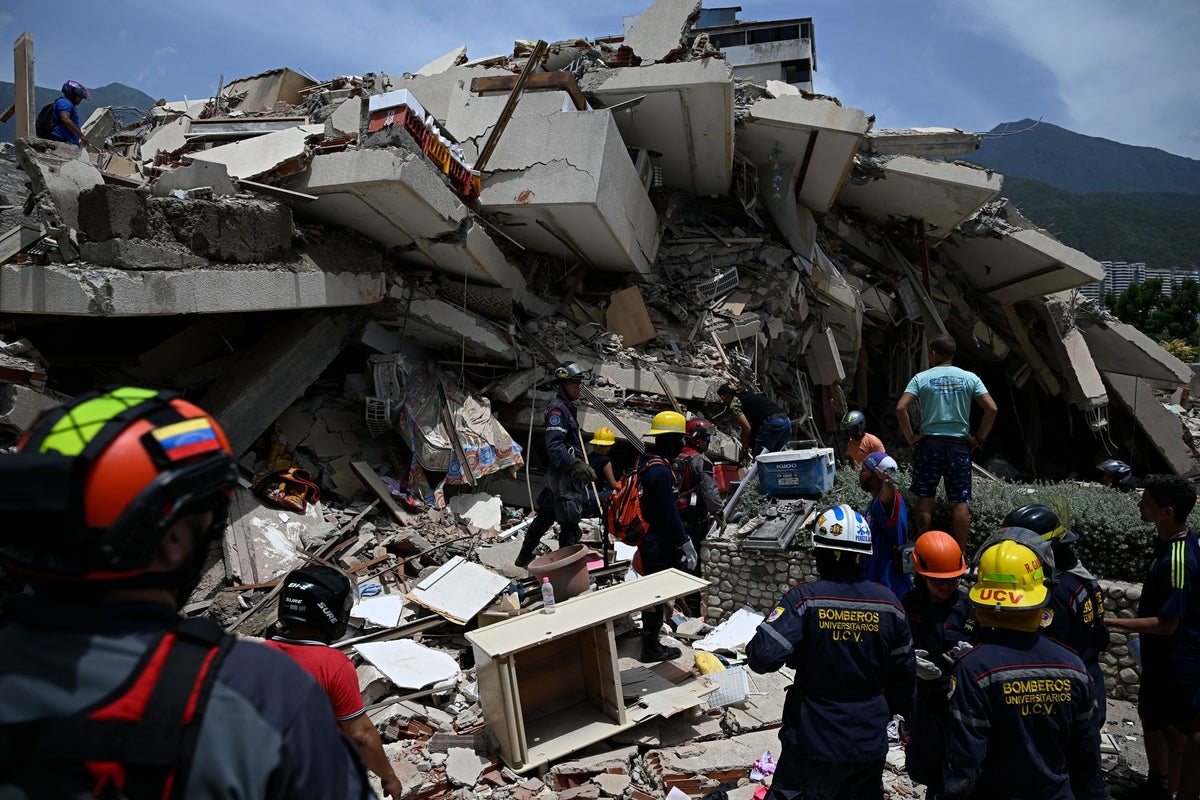
A horrific one-two punch just changed Venezuela's reality in under a minute. On Wednesday evening, a magnitude 7.2 earthquake rattled the northern coast. While terrified residents were still trying to figure out if the shaking had stopped, a massive magnitude 7.5 monster struck exactly 39 seconds later.
This isn't your typical mainshock-and-aftershock scenario. Geologists call it a doublet, a rare phenomenon where two distinct earthquakes of similar size tear through a fault system in rapid succession. With the death toll already past 180 and climbing as rescue crews dig through the rubble of flattened high-rises in Caracas and La Guaira, the disaster shines a brutal spotlight on a deeper reality. Latin America sits on some of the most volatile tectonic boundaries on Earth, and many of its cities are ticking time bombs.
The Anatomy of a Seismic Trap
What happened along Venezuela's coast reveals the complex mechanics of the plate boundary where the Caribbean and South American tectonic plates grind past each other horizontally. According to the U.S. Geological Survey (USGS), this boundary slips at about two centimeters a year, a speed comparable to California's infamous San Andreas Fault.
The Wednesday double-strike occurred along the Bocono fault system, which cuts a 300-mile path along the Venezuelan Andes. Doublets happen when the earth's crust fractures in one spot, but instead of releasing all the built-up strain, the displacement instantly transfers immense stress onto a neighboring fault segment that is already primed to snap.
The first quake basically acted as a trigger for the second. Because the seismic waves from the initial 7.2 shock were still rolling through the ground, the structural integrity of buildings was already compromised when the stronger 7.5 hit. It’s a worst-case scenario for engineers. Structures can often withstand a single big hit, but a second severe shaking right away leaves absolutely no room for recovery.
A Century of Heavy Shocks
This doublet isn't an isolated fluke. It’s the latest entry in a long, violent history of Latin American seismicity. The region is shaped by giant plate boundaries, particularly the Pacific Ring of Fire and the subduction zones running down the western coast of South America, which have produced some of the worst natural disasters in human history.
- Valdivia, Chile (1960): The granddaddy of them all. At magnitude 9.5, it remains the most powerful earthquake ever recorded. It killed thousands and triggered a massive Pacific-wide tsunami, proving that Chile sits directly over a giant subterranean engine of destruction.
- Ancash, Peru (1970): A magnitude 7.9 quake that triggered a catastrophic avalanche of ice and rock, burying the entire town of Yungay. Over 67,000 people lost their lives, making it one of the deadliest seismic events in the Americas.
- Port-au-Prince, Haiti (2010): A shallow magnitude 7.0 quake that killed an estimated 200,000 to 300,000 people. It wasn't the biggest quake technically, but poor building construction turned it into an unprecedented humanitarian apocalypse. Haiti suffered again in 2021 when a 7.2 magnitude quake hit its southern peninsula, killing over 2,200 people.
- Pedernales, Ecuador (2016): A magnitude 7.8 subduction earthquake that devastated coastal towns, killing more than 670 people and causing billions in structural damage.
The Building Code Divide
When you look at these numbers, a striking pattern emerges. The size of an earthquake doesn't always dictate the death toll. Infrastructure does.
Take Chile's 2014 earthquake in Iquique. It was a massive magnitude 8.2 offshore shock. Yet, only six people died. Why? Because Chile enforces some of the strictest seismic building codes in the world. They design structures to sway and crack without collapsing, giving people time to run.
Venezuela actually used to have robust engineering standards back when its oil economy was booming. But a decade of severe economic crisis, hyperinflation, and political instability has gutted enforcement. When builders cut corners, use subpar concrete, or ignore zoning laws, people die. The collapse of multiple apartment buildings in La Guaira during this latest doublet is the tragic, direct result of structural neglect.
Worse, Venezuela lacks an automated early warning system. In places like Mexico or Japan, sensors detect the fast-moving but less destructive P-waves and automatically send alerts to smartphones, giving people precious seconds to get outside. In Caracas on Wednesday, residents got zero warning. They only knew the disaster was happening when the ground literally dropped out from under them.
Real Steps for Personal Protection
You can't predict when a fault line will rupture, and you definitely can't rely blindly on aging urban infrastructure. If you live in a seismically active zone anywhere in Latin America, you have to take structural safety into your own hands.
First, check your living space. Heavy furniture, bookshelves, and appliances must be bolted securely to the walls. In a major shake, flying objects cause a massive percentage of non-fatal injuries.
Second, ditch the old myth of running outside while the ground is actively moving. Unless you live in a flimsy single-story structure, trying to run down stairs or use elevators during a quake is incredibly dangerous. The golden rule remains: Drop, Cover, and Hold On. Get under a sturdy table or desk to protect yourself from falling debris and ceiling tiles.
Finally, keep a dedicated emergency bag near your exit door. It needs to hold at least three days of water, non-perishable food, a flashlight, first-aid supplies, and copies of essential documents. When the grid goes dark and phone lines drop—just like they did across Caracas this week—that bag is your lifeline. Don't wait for a disaster to force your hand.