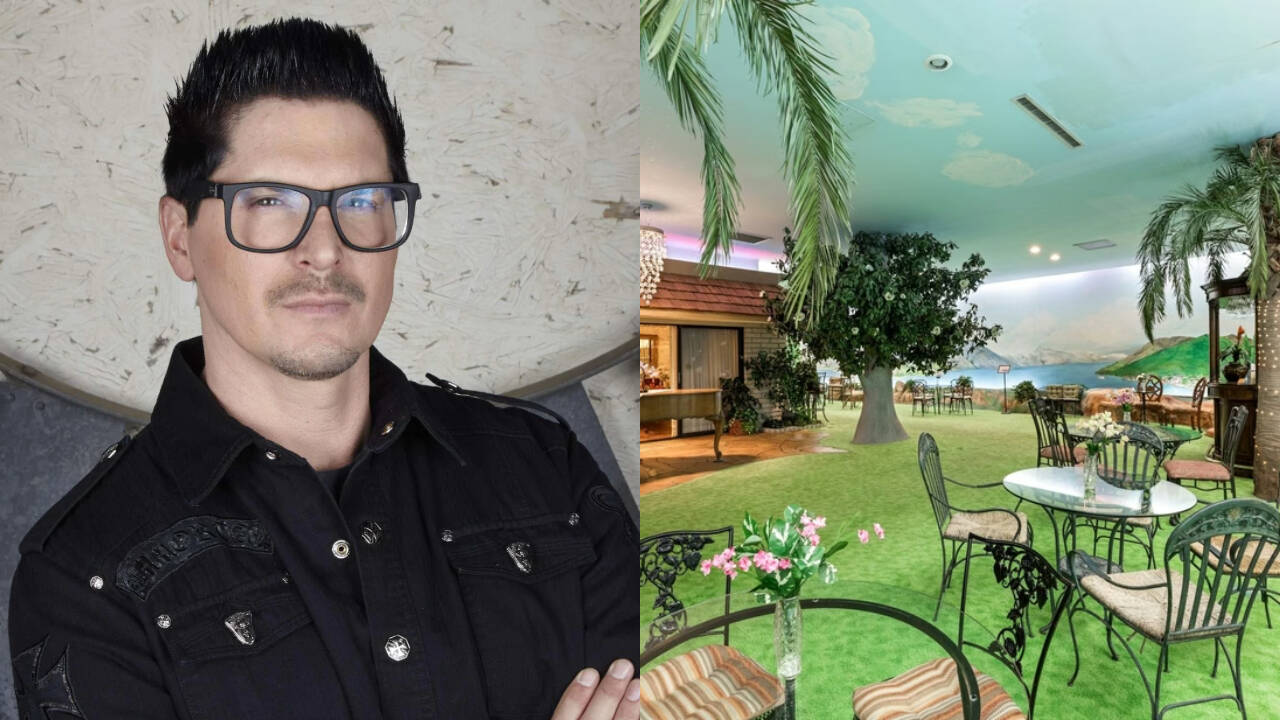
The media wants you to believe Zak Bagans dropped $4.55 million on a subterranean Cold War bunker at 3970 Spencer Street purely because he smells ghosts. Headlines breathlessly frame the acquisition of the 16,936-square-foot underground time capsule as another quirky sideshow attraction for the paranormal tourism circuit.
That narrative is lazy. It ignores the cold, hard mechanics of distressed luxury asset acquisition and commercial real estate valuation.
When a property crashes 75 percent from an $18 million peak listing down to a $4.55 million execution price, the story is not about spooky vibes. It is about a calculated distress play on a completely unmarketable architectural anomaly.
The Myth of the Paranormal Premium
For years, real estate analysts watched the Jerry Henderson underground house languish. Built in 1978 twenty-six feet below the desert surface complete with fake painted skies, plastic trees, and a pool, it was treated as a white elephant. Brokers tried to pitch it as a billionaire survivalist bolt-hole or an ultra-exclusive novelty pad. Those pitches failed because normal high-net-worth buyers do not want to live in a concrete box buried under three stories of dirt without natural ventilation or sunlight.
The lazy consensus is that Bagans bought it as a haunted house extension. The reality is that he secured a massive commercial footprint blocks from the Las Vegas Strip for roughly $268 per square foot. In modern Clark County commercial zones, obtaining a heavily fortified, structurally sound compound with custom subterranean infrastructure at that price point is an outright steal.
The Economics of Adaptive Reuse
Commercial operators understand a fundamental rule. Specialized architecture with zero comparable sales is worth precisely what a motivated buyer with a cash-flow thesis is willing to wire.
An underground bunker with simulated outdoor patios, a dance floor, and multiple spas cannot be valued using standard residential metrics. Traditional lenders hate them. Appraisers scratch their heads. Zoning boards create administrative nightmares.
By stepping in at $4.55 million, Bagans bypassed the catastrophic depreciation suffered by the previous sellers who aimed too high for a residential exit. He is executing a classic adaptive reuse strategy. Converting a vacant, tax-draining white elephant into a ticketed public museum shifts the asset from a cash sinkhole to a high-margin tourism generator.
Imagine a scenario where a standard commercial developer attempted this. They would have bulldozed the 1970s retro-futuristic kitsch to build a strip mall or a parking deck. The historical architecture would have been lost to generic urban sprawl. Instead, keeping the subterranean structure intact preserves a unique piece of Cold War paranoia engineering while establishing a defensible economic moat. No competitor can easily replicate a 26-feet-deep underground estate with a painted horizon.
The Brutal Truth About Niche Assets
Critics often argue that niche tourist attractions face severe ceiling limits on repeat visitors. That critique applies to standard museums, but it misjudges the Las Vegas entertainment engine. Vegas thrives on spectacle, oddities, and industrial-scale curiosity.
Properties with bizarre provenance do not play by normal real estate rules. They function as organic marketing engines. The media buzz surrounding the sale generated millions of dollars in free impressions before a single permit for public entry was even filed.
Stop viewing celebrity real estate moves through the lens of eccentricity. Look at the balance sheet. Buying a massive subterranean compound for pennies on the dollar of its original vanity valuation is not about chasing ghosts. It is high-level asset accumulation disguised as pop-culture theater.