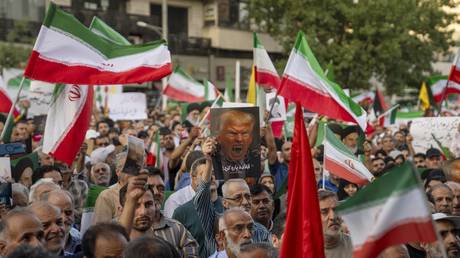
The targeted elimination of Supreme Leader Ali Khamenei via a joint US-Israeli kinetic operation effectively dissolves the foundational "Strategic Patience" doctrine that has governed Iranian foreign policy since 1989. This action shifts the regional engagement from a managed proxy conflict to an unhedged existential struggle. The subsequent Iranian missile salvos directed at Israel and Gulf Cooperation Council (GCC) states represent a desperate attempt to re-establish a deterrence threshold that was functionally obliterated by the strike. Analysis of the current escalatory spiral reveals that the conflict is no longer defined by territorial disputes or ideological friction, but by a systemic collapse of the regional security architecture.
The Triad of Iranian Retaliatory Logic
Iran’s decision to broaden its target set beyond Israeli military infrastructure to include Gulf energy hubs and urban centers follows a specific three-part operational logic. Understanding this framework is essential for predicting the duration and intensity of the current exchange.
- Deterrence Restoration through Mass Volume: By launching sophisticated ballistic and cruise missiles in high-saturation waves, the Islamic Revolutionary Guard Corps (IRGC) seeks to identify the physical limits of the "Arrow-3" and "David’s Sling" interceptor inventories. The goal is not necessarily 100% impact, but the forced depletion of high-cost interceptors with lower-cost offensive assets.
- Horizontal Escalation as a Survival Mechanism: Targeting the Gulf states—specifically the UAE and Saudi Arabia—serves to "socialize" the risk. Tehran is signaling that if its regime is slated for destruction, the global energy supply and the economic stability of Western-aligned neighbors will be liquidated simultaneously.
- Command and Control Continuity Signaling: The speed of the missile response is a performance of state resilience. In the wake of Khamenei’s death, the IRGC must prove to both domestic hardliners and the "Axis of Resistance" that the chain of command remains intact and capable of executing complex, multi-front operations.
The Cost Function of Regional Missile Defense
The efficacy of the response to Iranian missile barrages depends on an asymmetric economic reality. The cost-exchange ratio heavily favors the aggressor in the current technological environment.
- Interceptor Scarcity: Each SM-3 or Arrow interceptor costs between $2 million and $15 million. Iran’s indigenous "Fattah" or "Khorramshahr" variants, while less sophisticated, can be produced at a fraction of that cost.
- The Saturation Threshold: Every air defense system has a finite "leakage rate." If Iran launches 400 projectiles simultaneously, a 95% interception rate—historically considered elite—still allows 20 warheads to reach their targets. In a nuclear-ambiguous environment, a 5% failure rate is strategically unacceptable.
- Geographic Vulnerability: The proximity of GCC energy infrastructure to Iranian launch sites reduces "burn time" for detection and interception. For targets in the Eastern Province of Saudi Arabia, the decision window for interceptor engagement is less than four minutes.
The Vulnerability of the Abraham Accords Architecture
The strike on Khamenei and the ensuing Iranian response have placed the signatories of the Abraham Accords in an impossible strategic position. The "Neutrality Trap" has become a primary feature of the conflict.
The GCC states face a binary risk profile. Providing airspace access or intelligence to the US and Israel grants them protection but confirms their status as legitimate targets in the eyes of the IRGC. Conversely, denying access risks a total withdrawal of the US security umbrella at the moment they need it most.
The Iranian targeting of Gulf states is designed to shatter this nascent alliance. By demonstrating that Israel and the US cannot fully protect Riyadh or Abu Dhabi from a sustained missile campaign, Tehran intends to force a diplomatic pivot toward a new, Iran-centric regional settlement.
The Mechanics of the "Ring of Fire" Activation
With the central authority in Tehran in flux, the decentralized nature of the "Axis of Resistance" becomes the primary driver of volatility. The "Ring of Fire" strategy—utilizing Hezbollah in Lebanon, the Houthis in Yemen, and various militias in Iraq and Syria—is no longer a coordinated tool of statecraft but a series of autonomous "dead man's switches."
- The Lebanese Front: Hezbollah’s massive rocket and missile inventory serves as the primary check against a full-scale Israeli ground invasion of Iran. If Hezbollah perceives that the Iranian state is collapsing, they face a "use it or lose it" dilemma regarding their long-range precision assets.
- The Red Sea Chokepoint: The Houthis provide Iran with the capability to impose a global economic tax. By targeting commercial shipping in the Bab el-Mandeb, they force a reallocation of US naval assets away from the Persian Gulf, thinning the defensive screen around Israel.
- Iraqi Proxy Mobility: Pro-Iranian militias in Iraq represent the "land bridge" threat. Their proximity to US bases in the region creates a persistent tactical threat that prevents the US from dedicating its full electronic warfare and kinetic capacity to the primary Iranian theater.
The Intelligence Paradox and the Vacuum of Power
The success of the strike on Khamenei reveals a catastrophic intelligence breach within the highest echelons of the Iranian security apparatus. This creates a "Paranoia Feedback Loop."
The remaining Iranian leadership must now operate under the assumption that all communication channels are compromised. This leads to several dangerous operational shifts. First, "Launch on Warning" protocols become more decentralized, increasing the risk of accidental escalation or the firing of missiles based on false telemetry. Second, internal purges within the IRGC and the Ministry of Intelligence will likely distract from external defense, creating windows of tactical opportunity for further Israeli operations.
The power vacuum left by Khamenei’s death does not have a clear constitutional remedy that accounts for the current state of war. The Assembly of Experts is theoretically responsible for choosing a successor, but in a kinetic environment, the IRGC will likely seize de facto control. This transition from a clerical-led state to a direct military autocracy will fundamentally change how Iran signals its intentions to the world, moving from nuanced theological-political rhetoric to purely militaristic postures.
The Energy Market as a Kinetic Theater
Global markets have historically priced in "geopolitical risk" with a temporary spike followed by a correction. However, the current targeting of Gulf states breaks the standard model.
- Production Capacity Destruction: Unlike previous conflicts where tankers were the primary targets, the current Iranian strategy focuses on fixed assets: desalination plants, refineries, and gathering centers. These assets have long lead times for repair.
- Insurance and Logistics: The "War Risk" premiums for shipping in the Strait of Hormuz will eventually reach a level that constitutes a de facto blockade, even if Iran does not physically close the strait.
This is an intentional "Economic Scorched Earth" policy. If Iran’s ability to export oil is neutralized by sanctions or kinetic strikes, they will ensure no other regional power can fill the supply gap.
The Structural Limits of US Intervention
The US involvement in the Khamenei strike signals a definitive end to the "Pivot to Asia" as a short-term reality. The Pentagon is now forced into a high-intensity Middle Eastern commitment that depletes specific munitions—specifically the PAC-3 and SM-6 families—that are critical for any potential conflict in the Indo-Pacific.
This creates a "Global Resource Bottleneck." The industrial base of the United States is currently not configured to support a high-intensity missile defense campaign in the Middle East while simultaneously arming Ukraine and maintaining a credible deterrent in the South China Sea. Iran and its allies are aware of this constraint and will likely attempt to extend the duration of the conflict to force a depletion of US precision stockpiles.
The Strategic Path Forward
The conflict has moved beyond the point where "de-escalation" is a viable diplomatic term. The primary objective for the US-Israeli alliance must now shift to the total degradation of the IRGC’s "Second Strike" capability.
This requires a systematic dismantling of the Iranian drone and missile manufacturing complex, located primarily in the underground facilities of the "Missile Cities." A failure to neutralize these sites during this window of Iranian leadership instability will allow the regime to reconstitute and launch a second, potentially more coordinated wave of attacks against regional infrastructure.
The military objective is now inextricably linked to the political objective: the collapse of the IRGC’s ability to project power beyond its borders. Any ceasefire or pause that leaves the IRGC’s missile production intact will merely serve as a regrouping period for a more lethal iteration of the current conflict. The alliance must prepare for a multi-month campaign focused on deep-structure penetration and the systematic decapitation of the IRGC's regional command nodes. Would you like me to map the specific geographical coordinates of Iran's "Missile Cities" and their proximity to critical GCC energy infrastructure to assess the impact zones of a sustained counter-battery campaign?