The Sovereignty Myth and the Art of the Soundbite
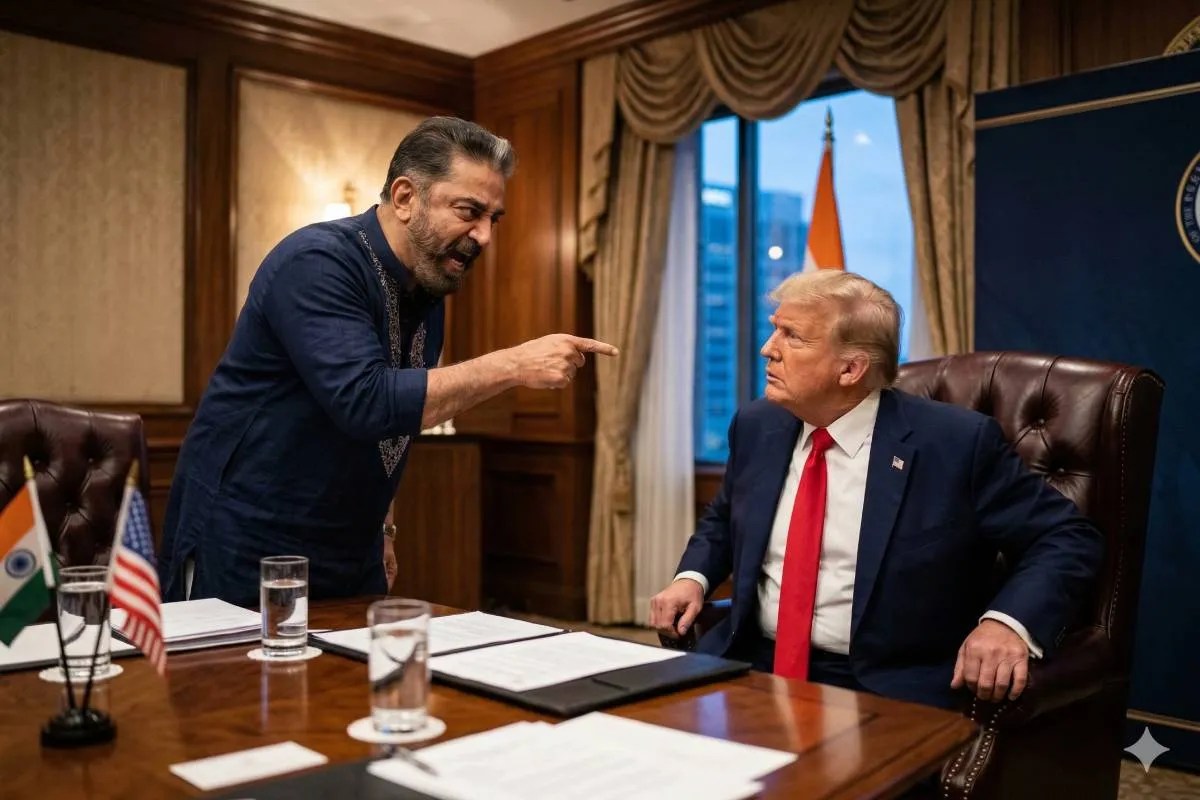
The headlines are screaming about Kamal Haasan "threatening" or "warning" Donald Trump. "Mind your own business," he says. "India is no longer a slave." It is the kind of rhetoric that sets social media on fire, triggers a thousand patriotic WhatsApp forwards, and ultimately accomplishes absolutely nothing.
The lazy consensus among commentators is that this is a bold stand for Indian sovereignty. They see a cinematic icon transitioning into a political heavyweight by taking a swing at a global superpower. They are wrong. This isn't a diplomatic maneuver; it’s a distraction.
When a veteran actor-turned-politician uses the language of anti-colonialism to address 21st-century geopolitics, he isn't protecting the nation. He is playing to the gallery. To suggest that a comment from a U.S. President—regardless of how erratic or interventionist that president might be—constitutes "slavery" is a gross misunderstanding of how modern power functions.
The Geopolitical Reality Kamal Ignores
Sovereignty isn't maintained through aggressive press releases. It is maintained through trade balances, technological autonomy, and military deterrence.
Let’s dismantle the "Slave" rhetoric. India is a nuclear-armed state with the world's fifth-largest economy. Using the term "slave" in response to diplomatic friction isn't just hyperbole; it’s a regression. It signals a deep-seated insecurity rather than the confidence of a rising power.
I have seen political movements spend years building a brand on "standing up" to the West, only to quietly sign the same bilateral agreements they publicly condemned. This is the "Grandstanding Trap." Haasan is leveraging a populist sentiment that views international relations as a schoolyard brawl rather than a complex web of $interdependence$.
If we look at the actual mechanics of Indo-US relations, the noise from celebrities is irrelevant. The real work happens in the $Civilian Nuclear Deal$ frameworks and the $iCET$ (Initiative on Critical and Emerging Technology). Trump’s rhetoric on tariffs or immigration isn't an attack on India’s soul; it’s a negotiation tactic. Responding with "we aren't slaves" is bringing a script from a 1980s masala movie to a high-stakes poker table.
The Problem with Celebrity Diplomacy
We have entered an era where "clout" is mistaken for "policy."
People ask: "Should Indian icons speak up against foreign leaders?"
The answer is yes, but only if they have something more substantial to offer than a history lesson. When Haasan tells Trump to "mind his own business," he ignores the fact that in a globalized economy, everything is everyone’s business.
- Supply Chains: If US policy shifts, Indian manufacturing feels the heat.
- H-1B Visas: This isn't "interference"; it’s a labor market reality that affects millions of Indian families.
- Regional Security: What happens in Washington impacts the stability of the Indo-Pacific.
To tell a global leader to stay in their lane is to misunderstand that there are no lanes anymore. There is only a shared, congested highway. By framing the conversation as a battle for "independence," Haasan prevents a more mature discussion about how India can strategically leverage (yes, the term applies to the US, not just AI) American volatility for its own gain.
The Nuance the Media Missed
The competitor articles are busy dissecting the "bravery" of the statement. Let’s look at the timing. Haasan’s political vehicle, Makkal Needhi Maiam (MNM), has struggled to find a solid foothold in the dense political thicket of Tamil Nadu.
When local relevance fades, you go global.
By picking a fight with the most recognizable man on the planet, Haasan achieves instant national visibility. It is a classic "pivot to the center." If you can’t win the local municipal debate, start a fight with the White House. It makes you look bigger than the office you are actually seeking.
This is the "David vs. Goliath" tactic, but in this version, David is wearing a designer suit and has a film crew. It is performative defiance.
The Cost of Populist Rhetoric
There is a downside to this contrarian approach that I must acknowledge: it is boring. It doesn't get the clicks. It doesn't make people feel a rush of nationalistic pride. But it is the truth.
The danger of Haasan’s rhetoric is that it encourages a "Fortress India" mindset. It suggests that any external critique or policy shift is a personal affront to our history. This is a fragile way to run a country. True power doesn't need to remind people it isn't a slave. True power simply acts in its own interest, often silently.
Imagine a scenario where an Indian leader responded to a Trump tweet with a detailed proposal on semiconductor cooperation instead of a lecture on colonialism. That would be a true "disruption." It would signal that India is not just a former colony, but a future boss.
Stop Falling for the Script
We need to stop treating every celebrity outburst as a seismic shift in foreign policy. Haasan is a master of the craft; he knows how to deliver a line so it sticks in your gut. But a "line" is all it is.
The premise of the "Trump vs. Haasan" narrative is flawed because it assumes they are playing the same game. Trump is playing for electoral college votes and trade leverage. Haasan is playing for mindshare and a political legacy that has yet to manifest in actual votes.
The real threat to Indian sovereignty isn't a loudmouth in Washington. It’s the inability to distinguish between effective diplomacy and effective acting.
Next time an actor tells a superpower to "back off," ask yourself: What legislation are they proposing? What economic metric are they trying to move? If the answer is "none," then you aren't watching a political movement. You're watching a trailer for a movie that will never be released.
Stop cheering for the dialogue. Start looking at the data.
The world doesn't care if you're offended. It only cares if you're indispensable. Use that as your north star, and leave the theatrical warnings to those who have nothing left but their voice.
The era of the "angry hero" is dead in cinema. It should be dead in our foreign policy analysis too.