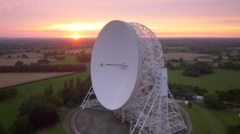
The headlines are predictable, lazy, and engineered for maximum digital outrage. Every time the UK Treasury sharpens its pencil, a chorus of academic traditionalists starts screaming that the sky is falling on our national heritage. The latest target of this manufactured panic is the iconic Jodrell Bank telescope, supposedly facing the axe amid looming science budget cuts.
Save the dish! Protect our astronomical crown jewel! You might also find this similar story useful: Why Politicians Reading ChatGPT Prompts Proves They Have No Clue How Power Works.
Spare me the melodrama.
I have spent two decades watching research institutions burn through public capital while clinging to sentimental brick-and-mortar monuments that long ago ceased to justify their keep. Jodrell Bank is a magnificent piece of engineering history. The Lovell Telescope is an architectural marvel that defined mid-century radio astronomy. But sentimentality is not a scientific strategy. When funding crunches hit, the instinct is always to circle the wagons around legacy infrastructure, protecting the things that look good on a brochure while starving the agile, distributed networks actually doing the work. As discussed in recent coverage by Gizmodo, the implications are worth noting.
We need to stop treating historic science facilities like sacred cows that are immune to economic reality.
The Fallacy of the Heritage Budget
Let us address the core misconception driving this entire debate: the belief that cutting funding to a legacy installation equals an assault on scientific progress.
This is a category error of the highest order. Science is a method, not a museum. When a telescope built in 1957 consumes millions in operational overhead and specialized maintenance just to keep up appearances, that capital is being stolen from high-throughput, modern data pipelines that operate at a fraction of the cost and deliver a thousand times the analytical yield.
I have seen research boards blow millions keeping geriatric infrastructure alive simply because the institution's brand identity is tied up in a giant steel dish. It is the academic equivalent of keeping a steam locomotive on the main commuter line because it looks charming puffing smoke through the station.
Jodrell Bank is an incredible educational tool and a vital hub for the Jodrell Bank Centre for Astrophysics. Nobody is arguing that its intellectual output is zero. But physical size does not equal utility in modern astrophysics. The future of radio astronomy belongs to interferometry arrays, distributed computing grids, and projects like the Square Kilometre Array (SKA), where computing power and global collaboration replace massive, single-point-of-failure monuments.
When budgets contract, we should be doubling down on the future, not paying a premium to preserve the past.
Why the Lazy Consensus is Killing Innovation
The media narrative surrounding these cuts relies on a comforting fiction: that government spending on science is a monolith, and any reduction represents a direct blow to our collective intellectual capability.
That is flatly false.
The UK science budget is finite. Every pound poured into rust remediation, structural reinforcement, and legacy maintenance at a mid-20th-century site is a pound diverted from quantum sensors, AI-driven astronomical classification, and next-generation lab space. By framing the issue as an existential crisis for British science, defenders of the status quo manage to avoid the uncomfortable question: Is this specific facility still the most efficient allocator of research capital?
The answer, if you look at the balance sheets without wearing rose-tinted spectacles, is frequently no.
Let us look at the mechanics of how these budgets actually function. Funding bodies are risk-averse. They fear the political backlash of shuttering an iconic site far more than they fear the slow, invisible suffocation of emerging research groups who cannot secure seed capital. Politicians love a photo op in front of a giant radio dish. Nobody ever won an election by cutting ribbon on a server rack running machine-learning algorithms to parse gravitational wave data.
This is the tyranny of the visible. We protect the things we can see and touch, while sacrificing the invisible architecture of future discovery.
The Uncomfortable Trade-Offs Nobody Wants to Discuss
If you challenge the preservationists, they accuse you of being anti-science. Let us flip that script. Continuing to fund legacy monoliths at the expense of agile, modern science is what is truly anti-science.
Imagine a scenario where the budget is flatlined for the next decade. You have two choices:
- Spread the pain equally, keeping Jodrell Bank fully operational while starving fifty smaller university labs of doctoral stipends and equipment upgrades.
- Cut the legacy overhead, redirect funds to distributed digital infrastructure, and let the historical site transition into a pure educational museum and heritage trust.
The first option protects a tourist attraction and a nostalgic landmark. The second option keeps the UK at the bleeding edge of global research.
You cannot have both when the coffers are tight. Pretending otherwise is an insult to the intelligence of anyone who understands resource allocation.
The truth is that Jodrell Bank's scientific relevance has shifted. Its primary value now lies in its role within the European Very Long Baseline Interferometry Network and outreach, both of which can be maintained at a fraction of the cost if the operational model is modernized. But modernization requires breaking the taboo against downsizing historical institutions.
The Real Crisis in Research Funding
The real story here is not that Jodrell Bank faces an existential threat from treasury cuts. The real story is that our funding models are completely broken because they are anchored to twentieth-century geography.
We fund places instead of projects. We fund concrete and steel instead of talent and velocity.
When an institution becomes too big to fail and too culturally significant to touch, it becomes a structural drag on the entire ecosystem. It absorbs oxygen that smaller, hungrier, and infinitely more innovative teams need to breathe.
If we want a resilient scientific sector, we have to embrace creative destruction. We have to allow monuments to age, transition, or downsize without treating it as a national tragedy.
Stop mourning the potential loss of a steel dish and start asking why our entire funding apparatus is so terrified of the future.
Let the heritage sector fund the heritage sites. Keep public science money where the discoveries are actually being made.