Eleven days. That's all it took for Jensen Huang to go from resigning in disgrace to walking back through Nvidia's front doors as CEO, president, and board director.
Wall Street loved it. Nvidia's stock jumped more than 31% on November 23, 2026, pulling the S&P 500 out of a brutal seven-day losing streak. Yet while traders popped champagne in New York, Washington erupted into rare bipartisan outrage.
Democrats and Republicans rarely agree on anything these days. Somehow, Nvidia's board managed to unite them in anger. Both sides are demanding answers about how a CEO who resigned over an extramarital affair with a suspected Chinese intelligence asset got his job back before the national security investigation even finished.
What Actually Happened During Those Eleven Days
If you missed the chaos in mid-November, the timeline reads like a political thriller mixed with a corporate soap opera.
On November 12, Huang stepped down after reports surfaced about multiple extramarital affairs, including relationships with two Nvidia employees and Alice Huang, a former executive at Singapore-based data center company Megaspeed International. U.S. intelligence officials suspect Alice Huang had ties to China's Ministry of State Security, though Beijing has denied the allegations.
Nvidia named Chief Financial Officer Colette Kress as interim CEO. Less than a week later, during an earnings call on November 17, board chair Harvey Jones told investors flatly that the board did not intend to bring Jensen back. Kress echoed that exact line on CNBC the very same day.
Then the stock market started tanking.
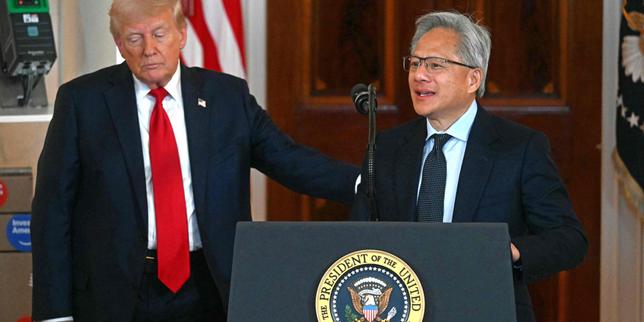
Tech stocks bled value for seven straight sessions, dragging the broader market into correction territory and sparking fears of an AI-driven economic slump. Behind the scenes, President Donald Trump stepped in. Trump told CNBC he spoke directly and indirectly with Nvidia's board and pushed hard for Huang's reinstatement, later admitting that the market's steep drop "probably" influenced his thinking.
By November 23, Nvidia's board reversed course completely. They reinstated Huang to all three of his roles, claiming they were satisfied with his candor and had received input from senior U.S. officials indicating his return posed no national security risk.
Why Republicans Are Breaking With Trump Over Nvidia
Usually, GOP lawmakers fall in line when Trump backs a major corporate move. Not this time.
National security hawks in the Republican Party view advanced AI chips as the single most important strategic asset in the rivalry with Beijing. To them, putting Huang back in charge while federal probes are still open looks like putting stock prices ahead of national defense.
Sen. Tom Cotton, the outgoing Senate Intelligence Committee chairman, didn't mince words. He called the Megaspeed controversy "just the tip of the iceberg" and made clear that Huang getting his job back doesn't resolve a thing. Cotton is pushing his Chip Security Act, which would require physical location verification mechanisms on advanced chips so they can't be quietly diverted to restricted buyers.
Other Republicans piled on quickly.
- Sen. John Cornyn of Texas publicly questioned Nvidia's claim that there was no security risk, asking on X whether the FBI had even conducted a defensive briefing with Huang before the board made its call.
- Sen. John Curtis of Utah demanded to know which exact government officials weighed in and what information they gave Nvidia's directors.
- Rep. Don Bacon of Nebraska pointed out the obvious contradiction, stating that America can't claim it wants to win the AI race while handing China its best technology.
- Sen. Jim Banks of Indiana joined forces with Democratic Sen. Elizabeth Warren earlier in November to pressure the Commerce Department over export licenses, warning that Huang's confirmed relationship with a suspected Chinese spy made national security concerns urgent.
Even Attorney General Todd Blanche added fuel to the fire. During a Fox News appearance, Blanche refused to answer whether Huang had actually been cleared of legal violations or national security risks prior to his return. For GOP lawmakers, that silence spoke volumes.
Democrats See National Security and Corruption Colliding
If Republicans are furious about export controls, Democrats are zeroing in on both national security and political favoritism.
With Democrats preparing to take over congressional committee gavels in January following the midterm elections, Nvidia just rocketed to the top of their oversight target list. Senate Democratic Leader Chuck Schumer accused Huang of violating U.S. export control laws and promised Democrats would use their full power to investigate anyone "selling out our national security for financial gain".
Sen. Ron Wyden, who serves on the Senate Intelligence Committee and is set to chair the Senate Finance Committee, put it even more bluntly, arguing the reinstatement proves that under the current administration, "our national security is for sale".
Democrats are pulling on several specific threads that go way beyond an office romance.
- The $25 million donation. Rep. Raja Krishnamoorthi pointed out that Trump's assurances can't be taken at face value, especially after Nvidia donated $25 million toward Trump's White House ballroom project.
- Stock trading before the announcement. Sen. Ruben Gallego called for an investigation into what stock positions were taken right before Nvidia announced Huang's return, noting that a 31% single-day jump creates massive windfalls for anyone with advance knowledge.
- Unfinished investigations. Both Nvidia's internal probe and federal inquiries are still active. Rep. Jim Himes of the House Intelligence Committee stated lawmakers want to know exactly what information Huang shared with Alice Huang and what influence flowed in the other direction.
The Megaspeed Connection and How Chips Reach China
To understand why Capitol Hill is panicking, you have to look at Megaspeed International.
Washington banned the sale of Nvidia's top-tier AI processors to Chinese companies years ago to slow down Beijing's military and AI development. Yet Chinese labs have repeatedly managed to access restricted computing power through third-party data centers in Southeast Asia.
Megaspeed, headquartered in Singapore, sits right at the center of those concerns. U.S. authorities have been investigating whether Megaspeed acted as a conduit to route advanced Nvidia chips or remote computing access to Chinese entities. Just hours after Nvidia reinstated Huang, the Commerce Department's Bureau of Industry and Security finally placed Megaspeed International and six other Southeast Asian firms on its Entity List trade blacklist.
Think about the optics of that timing. On the exact same day Nvidia brought back the CEO who had a personal relationship with a former Megaspeed executive, the U.S. government officially blacklisted Megaspeed as a national security threat.
Meanwhile, the Securities and Exchange Commission is running its own civil investigation into Nvidia. According to reporting from the Wall Street Journal and Reuters, the SEC is examining potential accounting issues and whether Nvidia misled investors after the company changed how it reports international chip sales and stopped breaking out revenue tied to Singapore.
Why Nvidia's Board Caved Anyway
From a pure corporate governance standpoint, Nvidia's board looks completely compromised.
In his internal disclosures before being rehired, Huang admitted to additional affairs beyond what had initially been reported, and the board explicitly concluded he had violated Nvidia's code of conduct. Normally, violating company ethics rules while under federal espionage and SEC investigations gets a CEO permanently blacklisted from public boards.
Instead, Nvidia tried to patch the governance hole by announcing two half-measures. First, the board created a new National Security and Export Control Committee made up of independent directors. Second, the company started searching for a new Chief Compliance Officer.
Corporate governance experts aren't buying it. Kathleen Day, a lecturer at Johns Hopkins Carey Business School, compared the reinstatement to "wallpapering over mold," arguing the board prioritized a short-term stock bounce over long-term institutional integrity.
Honestly, the board felt trapped by key-person risk. Nvidia isn't just another chipmaker; its market value and AI dominance are tightly bound to Huang's personal relationships with cloud giants, sovereign wealth funds, and hardware suppliers. When he left, investors panicked that the AI boom might stall out. When the President of the United States tells your board to bring the founder back to save the stock market, saying no takes more spine than most directors possess.
What Happens Next on Capitol Hill and Wall Street
Huang's victory lap is going to be short-lived.
He is scheduled to sit for closed-door transcribed interviews with three House committees on Tuesday, followed by a high-stakes public hearing before the Senate Banking Committee on Thursday. Every word he says under oath will be scrutinized by lawmakers who already believe he got a free pass from the White House.
If you're an investor, a tech worker, or someone watching the AI sector, don't mistake a 31% stock rally for the end of the crisis. Watch these three concrete developments over the coming weeks:
- Senate Banking Committee testimony. Pay close attention to how Huang answers questions about Megaspeed and Singapore revenue. Any contradiction between his testimony and the SEC's accounting review will trigger immediate legal fallout.
- Bipartisan export control legislation. With Sen. Cotton and Democratic leaders aligned on tightening chip tracking, expect strict new hardware verification laws to advance in Congress regardless of White House pushback.
- The internal board investigation. Nvidia insists its independent directors are still investigating the espionage allegations. If that probe uncovers any direct transfer of technical data to Alice Huang, even a presidential intervention won't keep Huang in the corner office.
Nvidia proved this week that a company can become too big to fail in the eyes of Wall Street and the White House. Now Congress is about to test whether one CEO is also too big to hold accountable.