The sea does not care about geopolitics. To a merchant sailor standing on the bridge of a massive container ship, the water is just a series of calculations: fuel consumption, swell height, and the rhythmic thrum of engines that sound like a heartbeat. But lately, that heartbeat has been skipping.
Down in the galley of a cargo vessel currently navigating the peripheries of the Gulf, a cook watches a bowl of soup slide an inch to the left, then back to the right. He is thinking about his daughter’s tuition in Manila. He is not thinking about the Iranian Revolutionary Guard or the tactical deployment of the U.S. Fifth Fleet. Yet, his life—and the lives of thousands of others—now hangs on a silent, digital tug-of-war playing out across the waves.
In a span of just forty-eight hours, nine ships were turned back.
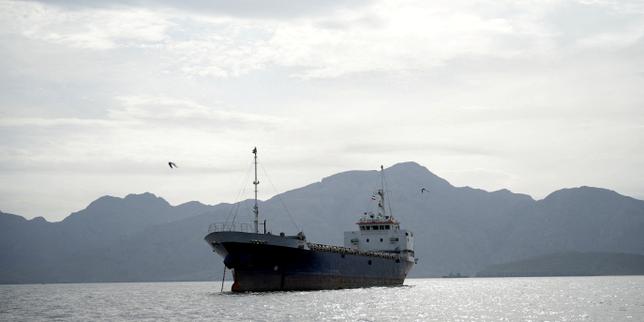
Nine steel giants, carrying everything from grain to microchips, were forced to pivot. They didn’t hit an iceberg. They weren’t struck by missiles. Instead, they encountered an invisible wall maintained by a fleet of American warships. The U.S. military calls it a maritime blockade; the sailors call it a dead end.
The Friction of Distance
When we talk about global conflict, we usually focus on the explosions. We look for the fire and the smoke. But the most profound impacts of the current Middle Eastern crisis are often found in the things that don’t happen. The ships that don't arrive. The cargo that doesn't move. The silence of a radar screen when a vessel is ordered to come about.
The United States has effectively drawn a line in the salt. By intercepting these nine vessels, the military isn't just moving chess pieces; they are altering the chemistry of global trade. Imagine a nervous system where the synapses suddenly stop firing. The brain—the global market—starts to panic.
The ships turned away weren't just random wanderers. They were part of a complex logistical ballet intended to bypass sanctions or deliver resources that fuel the machinery of a regional shadow war. When a destroyer like the USS Carney or a similar Arleigh Burke-class vessel intercepts a freighter, the conversation is brief. It is clinical. It is backed by the weight of several thousand tons of weaponry.
"Identify your cargo and your destination."
The response is often a lie. Or a half-truth. But the sensors don't lie.
The Steel Gatekeepers
Modern naval warfare is less about broadsides and more about data. A commander sitting in a darkened Combat Information Center (CIC) sees the world as a series of glowing icons. Each icon represents hundreds of millions of dollars. Each icon represents a potential threat or a potential tragedy.
During those 48 hours of high-tension maneuvers, the American presence in the region functioned as a sentient filter. They are looking for the "dark fleet"—vessels that turn off their transponders to vanish from public tracking systems. These ships move like ghosts, carrying Iranian oil or hardware, hoping that the sheer volume of global traffic will provide cover.
It didn't work.
Consider the logistics of a U-turn for a ship the size of the Empire State Building. It is a slow, agonizing process. It is the physical manifestation of a failed policy. As these nine ships retreated, they left behind a wake of uncertainty that stretches all the way to your local grocery store.
We live in a world of "Just-In-Time" delivery. We have been conditioned to believe that the things we want will always be there because the ocean is a highway. We forgot that highways can be closed.
The Human Cost of a Red Line
Let’s look at a hypothetical officer on one of those turned-back ships. We'll call him Elias.
Elias has been at sea for six months. He is tired. He is sun-bleached and salt-crusted. When the order comes to change course because a grey hull appeared on the horizon with its guns uncovered, Elias doesn't think about the grand strategy of Washington or Tehran. He thinks about the extra two weeks of fuel he’ll have to burn. He thinks about the volatile cargo sitting beneath his feet. He thinks about the fact that he is a pawn in a game played by people who will never smell the diesel fumes of a dead-ended freighter.
This is the friction of the blockade. It is the exhaustion of crews caught in the middle of a maritime staredown.
The American military’s justification is rooted in the prevention of escalation. By stopping these ships, they argue, they are cutting off the oxygen to a fire that threatens to consume the entire Middle East. If the weapons don't reach the ports, the missiles don't fly. It is a preventative medicine administered with a heavy hand.
But every action has a ghost. For every ship turned back, a supply chain somewhere else begins to fray. The "invisible stakes" aren't just about who controls the Strait of Hormuz. They are about the stability of an interconnected world that wasn't built for walls.
The Tech Behind the Tension
The reason the U.S. was able to go nine-for-nine in such a short window isn't just luck. It’s the result of a massive, interconnected web of surveillance. Satellite imagery, signals intelligence, and drone reconnaissance create a persistent eye over the water.
The ocean used to be a place where you could get lost. No more.
Every heat signature is logged. Every radio burst is triangulated. The Iranian attempt to push these nine ships through was a test of that eye. They wanted to see if the U.S. had the stomach to actually stop them, or if the Americans would merely observe. The answer came in the form of a physical blockade.
This isn't a "game-changer"—to use a tired term—it's a return to an older, more primal form of power. It is the realization that despite all our digital advances, physical presence still dictates the terms of reality. You can have all the bitcoin and cloud data in the world, but if you can't move a crate of beans from Point A to Point B, you are powerless.
The Rhythm of the Standby
The news cycles will move on. They will focus on the next political speech or the next tactical strike. But out there, in the humid, heavy air of the Gulf, the standoff continues.
The nine ships that were refouled are likely sitting at anchor somewhere now, their captains waiting for new instructions, their owners calculating the daily loss in revenue. They are symbols of a world that is shrinking. The open sea is becoming a series of gated communities.
There is a specific kind of dread that comes with being stopped at sea. It’s the realization that the horizon is no longer an escape; it’s a boundary. The U.S. military has signaled that they are willing to maintain this wall indefinitely, but walls require constant maintenance. They require men and women to sit in those dark rooms, staring at those glowing icons, waiting for the tenth ship, the twentieth, the hundredth.
The real story isn't the number nine. It’s the fact that we have reached a point where the flow of the world can be throttled by a few well-placed hulls. We are rediscovering the fragility of our foundations.
As the sun sets over the water, the silhouette of a destroyer remains etched against the orange sky. It is a silent sentinel, a reminder that the peace we take for granted is often just a byproduct of someone else's strength. The ships are gone, for now. The water has smoothed over their wakes. But the tension remains, vibrating through the hull of every vessel that dares to cross the line.
The bowl of soup in the galley stays still for a moment. Then, the ship turns again, and the sliding begins anew.