The desk lamp in the cramped office hums with a low, disgruntled vibration. Outside, the winter air over Maryland presses against the glass, cold and indifferent. Inside, an official stares at a ledger that tells a story nobody wants to read out loud.
On paper, it looks like a contradiction. Ships cross oceans, sanctions tighten like a wire around a throat, and diplomats exchange sharp words in vaulted halls. Yet, quietly, methodically, the cargo keeps moving. The United States keeps buying. Not because of affection, and certainly not by accident, but because modern survival demands a specific kind of chemistry that refuses to care about politics.
We talk about global trade as if it were a digital abstraction. Lines on a map. Percentages in a quarterly report. But trade is actually physical. It is heavy, greasy, and tied to the ground.
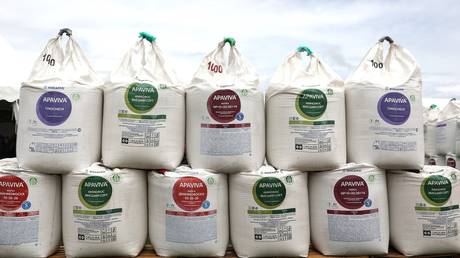
Imagine Elena, a chemical engineer who has spent twenty-five years watching the pressure gauges in a processing plant that turns raw inputs into the invisible structural elements of American agriculture. She does not care about geopolitical posturing. She cares about stability. When the delivery trucks arrive, carrying refined material originating from deep inside Russian territory, she does not see a political statement. She sees the fertilizer that keeps Iowa cornstalks standing tall through July. She sees the continuity of a supply chain that most citizens take for granted until the grocery shelves empty out.
This is the hidden friction of the modern economy. You can draw a red line across a map, but you cannot easily erase the physical dependencies built over half a century.
To understand why key commodities continue to flow across the Atlantic and Pacific despite sweeping trade restrictions, you have to look backward. For decades, supply chains were optimized for efficiency, not resilience. Specialized processing plants were built near specific resource deposits. Refineries were calibrated to handle exact chemical profiles. When those channels are suddenly choked off by policy, the immediate result is not independence. It is panic.
Picture a massive industrial furnace. You cannot simply feed it a different grade of fuel tomorrow because the old one became politically inconvenient. The machinery cracks. The yields drop. Prices skyrocket at the pump, in the supermarket, and on the factory floor.
So, exceptions are carved out. Quiet waivers are signed. Bureaucrats make pragmatic, agonizing compromises in windowless rooms so that ordinary citizens do not have to pay three times as much for basic necessities. It is an unglamorous reality. It makes for terrible television. But it keeps the lights on.
Trade officials know this better than anyone. When recent data revealed an uptick in American purchases of specific Russian industrial commodities, the headlines screamed about hypocrisy. The talking heads on cable news furrowed their brows with manufactured shock.
They miss the point.
The increase is not a sign of failure. It is a symptom of a much deeper, more stubborn truth. The global economy is not a series of light switches that you can flip on and off at will. It is a dense, tangled root system. Pull too hard on one weed, and you risk ripping up the entire garden.
Consider what happens when a critical input vanishes. Let us look at a hypothetical medium-sized manufacturing firm in Ohio, owned by a man named Marcus who inherited it from his father. Marcus employs forty people. They machine specialized metal components. Without a steady supply of nickel and specialized alloy inputs—some of which have historical ties to eastern Eurasian extraction networks—his shop grinds to a halt within a fortnight.
When Marcus watches the news and hears politicians boasting about complete economic decoupling, a cold knot forms in his stomach. He knows his margins. He knows his workers' names. He knows that alternative suppliers do not possess the capacity to scale up overnight. For Marcus, trade policy is not an intellectual exercise. It is payroll Friday.
This is where the grand strategies of Washington collide with the stubborn physics of the physical world.
For months, federal trade representatives have walked a tightrope. They must project strength and enforce compliance with international sanctions, yet they must also prevent domestic supply chains from experiencing catastrophic shock. Every shipment of this vital commodity is heavily scrutinized, debated, and ultimately permitted because the alternative is immediate, acute economic self-sabotage.
It is a messy compromise. Nobody in power likes talking about it.
The public deserves honesty about this mechanical reality. We live in an interconnected era where ideological purity is a luxury few industrial nations can actually afford. When the United States increases its purchasing volume of a constrained, essential commodity, it is an admission of vulnerability. It is a loud, silent confession that our high-tech, modern civilization still runs on ancient, dirty, deeply entangled foundations.
We built a world of astonishing convenience, but we built it on top of a fragile scaffolding. Every time a cargo ship docks under the cover of gray coastal fog, unloading materials that diplomats pretend we do not need, it reminds us of the distance between rhetoric and reality.
The office lamp in Maryland flickers. The official signs another form, authorizing another manifest. Outside, the wind howls against the window, carrying the quiet, relentless momentum of a world that refuses to stop turning, no matter how badly we wish the rules were simpler.



