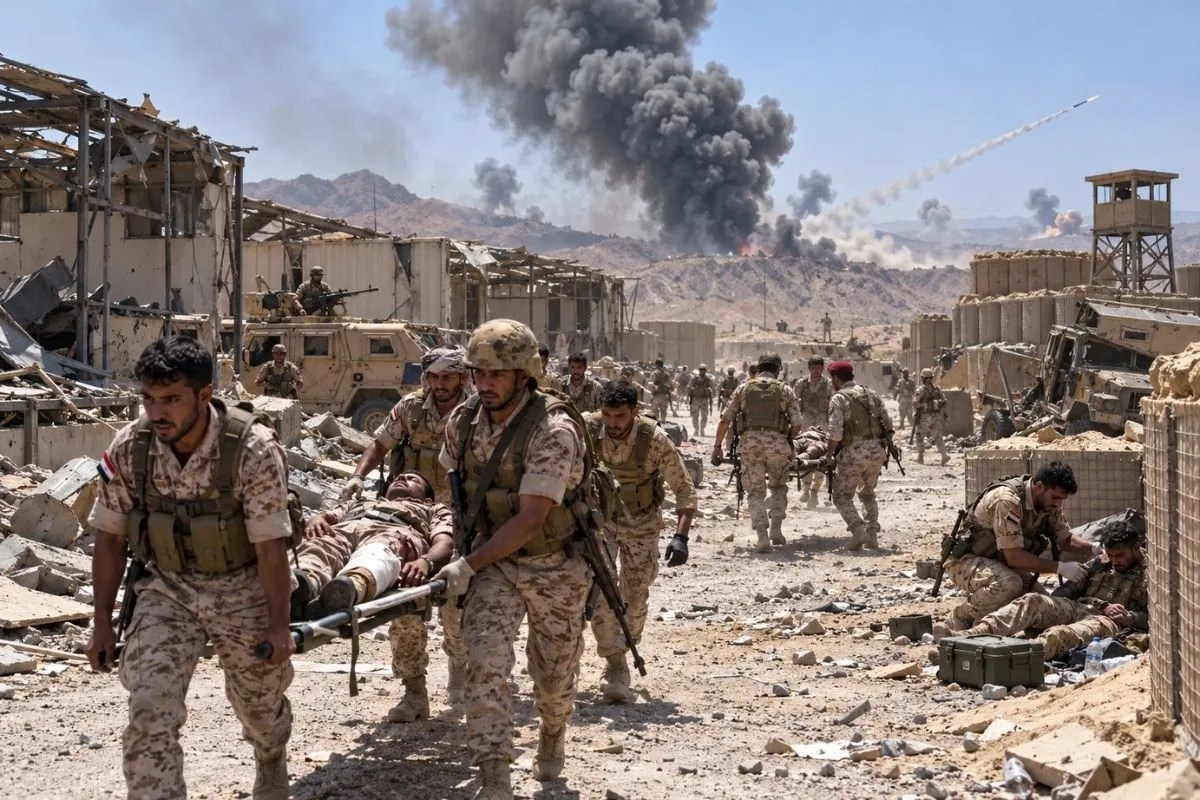
Two airstrikes on a Yemen oil facility left three civilians injured and sparked immediate accusations against the Saudi-led coalition, reopening a volatile chapter in a conflict where energy infrastructure doubles as both a wartime weapon and a lifeline for survival. On the surface, a pair of strikes hitting an oil site with three wounded civilians reads like another routine dispatch from a grinding war. Look closer at the mechanics of Yemen's fuel economy, coastal logistics, and rival attribution claims, and a much sharper picture emerges of why these targets keep getting hit and why civilian casualties keep following.
http://googleusercontent.com/lmdx_content/gzGCNBrlvJMtZPPhRoPdjKKITsqGGIkLZqACZBqdgDHFoNaFeSIeoISqjPppGqxWfpcZDqVXxnxubrdHvmPvJbybuSCEfTtbGDeclIxsPZclOFHZVTUqgPpyIZinWIyrCNdxFzTnzDkXgEGi1188149 If you found value in this article, you might want to check out: this related article.
I have watched conflict dispatches out of the Arabian Peninsula for decades, and the pattern is painfully consistent. A brief wire report names the target, counts the wounded, and assigns blame according to who is speaking first. What gets lost in that rush is how fuel actually moves inside a fractured state, how dual-use storage terminals sit beside residential neighborhoods, and how every strike alters who controls daily life.
Why Oil Facilities Remain High-Value Targets in Yemen
Fuel in Yemen is not an abstract commodity traded on a screen. It is the oxygen of daily survival. For another angle on this event, refer to the latest update from TIME.
Without diesel and petrol, water pumps stop pulling groundwater in parched districts, hospital generators run dry, bakeries stall, and trucks carrying food between provinces sit idle. Whoever controls fuel import terminals, storage tanks, and distribution networks holds quiet leverage over millions of people who have no practical alternative.
Strikes on a Yemen oil facility rarely happen by accident or out of mere spite. Military planners and rival factions treat fuel depots as chokepoints because degrading fuel supply restricts movement, strains municipal services, and pressures rival authorities economically without requiring a massive ground push. In a war marked by shifting frontlines, economic attrition often matters more than seizing another ridge.
Consider a hypothetical example of how that pressure plays out on the ground. Suppose a coastal fuel depot supplies diesel to inland transport trucks and local power stations. Two targeted hits on storage infrastructure or pumping gear do not need to level an entire city to bite; even partial damage can tighten supply, spike black-market prices within days, and force local administrators into expensive rationing.
The Attribution Trap Around Saudi Coalition Accusations
Whenever a strike hits an energy site in Yemen, accusations against the Saudi coalition surface almost immediately. Sometimes those claims point directly to coalition air operations. Other times, they reflect a broader information war where every explosion is pulled into an existing political narrative.
Verifying responsibility in Yemen is notoriously difficult. Independent ground access is uneven, debris and crater analysis rarely reach the public quickly, and multiple actors have operated aircraft, drones, or missiles across the region over the years. Even when a coalition is accused, attribution in modern regional conflicts often involves overlapping rivalries, proxy dynamics, and contested intelligence rather than a neat, single-actor story.
In wars fought across fragmented territory, the first claim of responsibility is usually a political move, while independent proof lags far behind.
There is also a structural trap in how these incidents are framed. Accusing the Saudi coalition fits a familiar wartime script that many readers already recognize. Yet treating blame as settled on day one obscures important questions: Was the strike aimed at storage tanks, loading jetties, or nearby military logistics? Did a single operational account get echoed across outlets before independent verification caught up?
A clear-eyed analyst has to hold two realities at once. The coalition has a documented history of air campaigns in Yemen with serious humanitarian costs, which makes accusations carry immediate weight. At the same time, assuming every strike automatically confirms the first accusation—or dismissing every accusation out of hand—replaces investigation with habit.
How Civilian Injuries Happen Around Energy Sites
Three injured civilians can sound small in a conflict that has seen far larger tragedies. It is not small to the people in the blast zone or to the clinics trying to treat burns, shrapnel, and respiratory distress with strained supplies.
Energy facilities sit right in the path of everyday life. Many Yemeni ports, coastal hubs, and inland depots developed near towns, workers' quarters, markets, and main roads. When two airstrikes hit an oil site, the danger rarely stops at the perimeter fence.
Several physical and operational factors turn strikes on fuel sites into civilian hazards:
- Proximity to communities and transit routes: Fuel terminals and depots frequently sit close to port workers, nearby neighborhoods, and highways where drivers and bystanders pass at all hours.
- Fire, smoke, and secondary hazards: Hydrocarbon fires produce thick, toxic smoke and intense heat that can injure people outside the initial impact point and complicate emergency response.
- Fragile medical capacity: Even a small number of severe burn or trauma cases can stretch local clinics when fuel shortages already limit ambulance movement and generator power.
That is why counting only fatalities or treating a three-civilian injury toll as minor misses the broader human cost. Injury in a conflict zone with damaged infrastructure can mean long-term disability when specialized care is scarce.
What Standard Breaking News Misses
Short breaking reports usually stop at the headline facts: two strikes, an oil facility, three injured, and accusations aimed at the Saudi coalition. That format tells you an event happened. It rarely explains why the event mattered or what comes next.
First, standard coverage often treats oil infrastructure as a monolith. A crude export terminal, a refined-fuel import depot, a storage farm, and a local distribution yard serve very different functions. Hitting refined fuel storage affects immediate domestic availability and prices, whereas damage to export gear hits state or faction revenue streams. Without distinguishing the type of facility, readers cannot tell whether the blow is aimed at domestic fuel supply or export revenue.
Second, breaking reports rarely trace the supply-chain ripple. Fuel moves in chains—from ships or pipelines to storage tanks, tankers, local vendors, and households. A disruption at one link ripples outward into water trucking, food transport, and small-business power generation.
Third, the human side is often flattened into a number. Behind a figure like three injured civilians are specific questions about who they were—facility workers, nearby residents, or passersby—and whether local responders had enough gear and power to treat them safely.
| Reporting Angle | Typical Breaking Wire | Deeper Investigative Lens |
|---|---|---|
| Target function | Calls the site an oil facility | Distinguishes storage, refining, export, or distribution roles |
| Blame and proof | Repeats initial accusations quickly | Separates credible claims, contested narratives, and verified facts |
| Human impact | Lists the count of injured civilians | Examines blast proximity, secondary hazards, and local care limits |
| Economic effect | Mentions the strike in isolation | Tracks fuel prices, transport costs, and essential services |
The Bigger Regional Stakes Beneath a Local Strike
A strike on a Yemen oil facility never stays strictly local for long. Yemen sits beside vital maritime routes connecting the Red Sea, the Bab el-Mandeb strait, and the Gulf of Aden to global trade. Even when a specific strike hits a domestic or coastal energy site rather than a ship in the fairway, instability around energy assets keeps regional risk high.
For neighboring powers, including Saudi Arabia, Yemen remains a security and diplomatic fault line where border stability, regional deterrence, and political negotiations constantly collide. Escalation around energy sites can harden positions overnight, making quiet de-escalation harder to sustain and raising the odds of retaliatory moves.
For ordinary Yemenis, regional strategy feels very distant compared to the price of a jerrycan of fuel. When supply tightens, families pay more for basic goods, water becomes harder to get, and economic recovery slips further out of reach. Every strike on energy infrastructure widens the gap between geopolitical maneuvering and everyday survival.
Practical Ways to Read Future Strike Reports Critically
You do not need insider access to read coverage of Yemen energy strikes with sharper judgment. A few disciplined habits can keep you from getting pulled into one-sided spin.
- Check the exact facility type: Look for details showing whether the site handled crude, refined fuel, storage, or transport, since operational impact depends heavily on function.
- Track who makes each claim: Note whether responsibility is asserted by local officials, rival factions, coalition statements, or independent monitors, and watch how those claims evolve over the next 48 to 72 hours.
- Look for secondary effects on daily life: Pay attention to reporting on fuel queues, local prices, power outages, and hospital strain, which often reveal the real impact better than initial damage estimates.
- Separate humanitarian harm from strategic intent: A strike can be framed around military or economic objectives while still causing real civilian injury and community disruption.
Wars rarely end on a single dramatic day. They grind on through pressure points like fuel, ports, and blame—and that is where the real story usually hides.


