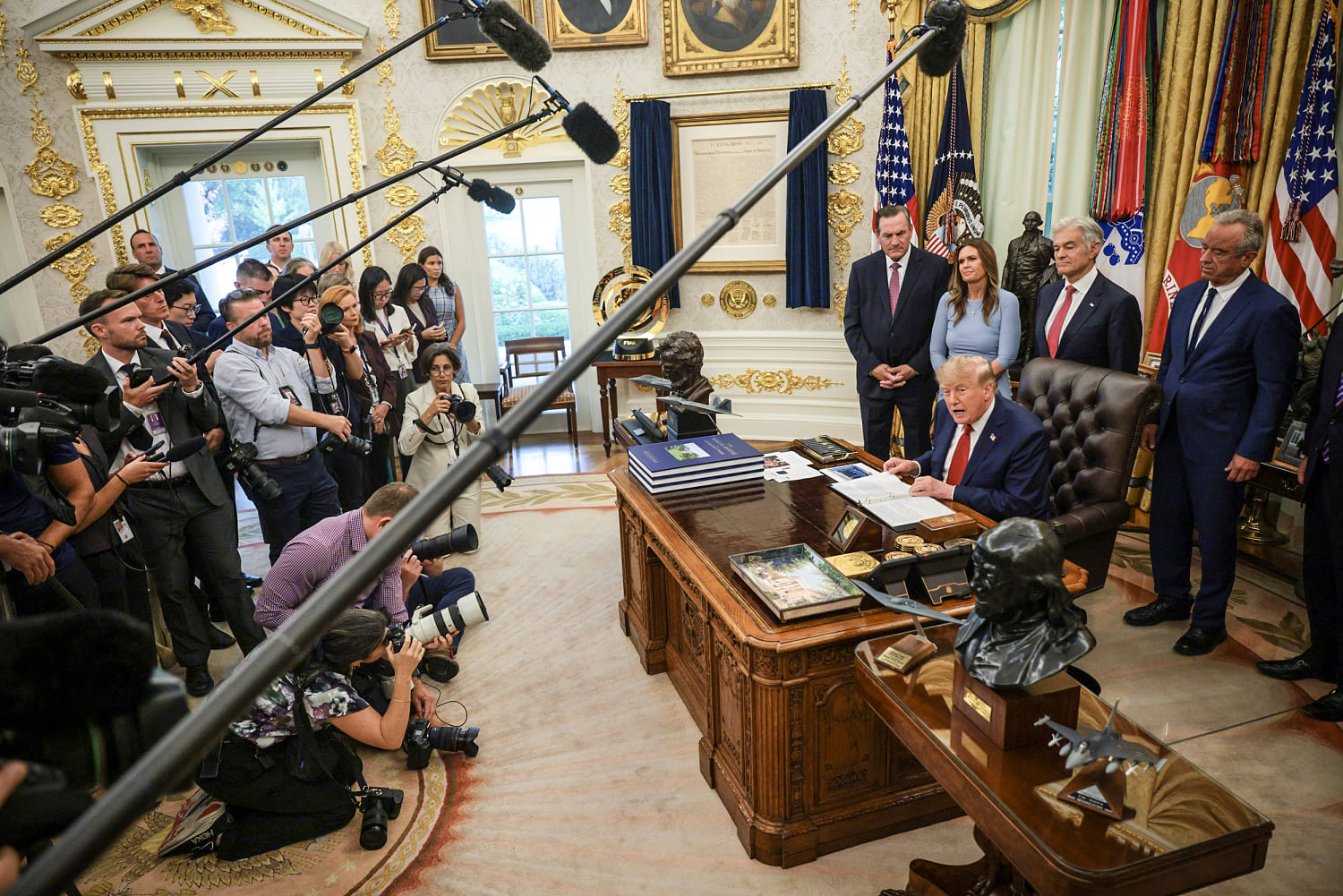
The White House press pool functions as a small, rotating collective of journalists chosen to represent the broader media corps inside confined spaces like the Oval Office or aboard Air Force One. Because physical square footage in the West Wing cannot accommodate hundreds of credentialed reporters at once, this operational compromise ensures that text dispatches, television feeds, and photographs reach the wider world without turning a presidential meeting into a stadium event.
For generations, the mechanics of this system operated on a quiet, internal understanding. The White House Correspondents' Association managed the rosters, arbitrated who stood in the wire slot, and distributed pool reports to outlets locked out of the room. That buffer zone between the executive branch and the Fourth Estate is no longer a silent administrative detail. It has transformed into a high-stakes arena where who gets to ask a question determines the boundary between independent oversight and managed information.
The Mechanics of Proximity
Consider how an ordinary Tuesday unfolds for a pool reporter assigned to the print rotation. Call time arrives before dawn. The reporter joins a tight cluster of colleagues representing wire services, major newspapers, and specialty outlets, all waiting for movement. When the president steps into the Rose Garden or boards Marine One, this designated handful acts as the eyes, ears, and recording devices for an entire global industry.
The resulting dispatch must be comprehensive, fast, and stripped of editorial bias. If the president stumbles over a statistic during a brief question-and-answer session in the Cabinet Room, or if a foreign leader offers a cold handshake on a tarmac, the pool notes capture the micro-expressions and verbatim quotes that feed the historical record.
Yet this physical proximity creates an inherent vulnerability. When access depends entirely on the goodwill of the administration in power, the friction between reporting facts and maintaining credentials becomes constant.
The Breakup of the Traditional Buffer
For over a century, the institutional arrangement between the White House and reporters relied on self-regulation. The Correspondents' Association decided the rotation schedules, insulating day-to-day news gathering from the political whims of changing administrations. That autonomy faced severe stress tests as political polarization deepened and digital outlets fractured the media ecosystem.
When executive offices attempt to curate who enters the rotation—handpicking compliant outlets or excluding organizations whose coverage draws disfavor—the function of the pool shifts. Instead of serving as a neutral proxy for the public, the pool risks becoming an instrument of state public relations. Legal battles over press credentials, temporary restraining orders issued by federal judges, and retaliatory bans underscore a fundamental truth: control the room, and you control the narrative.
When independent outlets are sidelined or threatened with exclusion, the immediate casualty is verification. The historical purpose of the pool is to prevent information monopolies. If the executive branch dictates who stands in the back of the Oval Office, the dispatches cease to be independent accounts and begin to resemble authorized transcripts.
Beyond the Briefing Room Walls
The public often mistakes the televised spectacle
Inside the Machine The Real Power Dynamics of the White House Press Pool
news, politics
The White House press pool is a tight, permanent rotation of journalists physically embedded inside the executive mansion to ensure the executive branch is never unobserved. At its core, the pool is a logistical necessity born of physical space constraints, but it functions as the primary gatekeeper for the modern American presidency. When a president boards Marine One, travels abroad, or convenes an emergency meeting in the Situation Room, the entire global news apparatus cannot fit into the hallway. Instead, a micro-society of reporters from wire services, television networks, print publications, and digital outlets represents the broader media corps, sharing reports in real-time through internal pool feeds.
Understanding how this mechanism actually operates requires stripping away the polished exterior of televised press briefings and looking at the raw, exhausting, and often compromised reality of institutional access.
The Physical Realities of the West Wing Beat
Space dictates power in Washington. The White House press area is notoriously cramped, famously housed in what was once President Richard Nixon's swimming pool, now converted into a low-ceilinged briefing room with assigned seats that journalists fight over for decades.
Sitting in the front row carries elite status, controlled strictly by the White House Correspondents Association rather than government officials. This distinction matters. If the executive branch controlled seating, reporters would face constant incentives to temper coverage to secure better physical placement.
Behind the briefing room sit the cramped work spaces of the press corps. Rows of desks stacked with wire machines, coffee cups, and half-eaten sandwiches form an environment resembling a frantic newsroom bullpen rather than a temple of statecraft.
When a breaking news event occurs, the pool springs into action with military precision. A television camera operator, a still photographer, a radio reporter, a print reporter, and wire service representatives form the core unit that trails the president into restricted areas.
Every word uttered by the president during pool-sprayed photo opportunities must be transcribed verbatim by the print pooler on duty. This system prevents administration officials from disputing what was said behind closed doors.
Yet, this proximity breeds a dangerous comfort. When you share the same tarmac, hotel elevators, and secure briefing rooms with the people you are supposed to hold accountable, professional boundaries inevitably blur.
The Access Economy and Its Discontents
Access remains the ultimate currency inside the West Wing, and the administration knows how to spend it. Reporters face a constant psychological pressure cooker. Push too hard on a sensitive national security leak or press aggressively during a photo spray, and your outlet risks being frozen out of the next foreign trip rotation.
This dynamic creates self-censorship without a single explicit threat ever being uttered by a press secretary.
Consider the mechanics of the foreign pool. When an American president flies to a summit in Europe or Asia, seats on Air Force One are allocated to a select group of journalists. The news organizations pay commercial-equivalent rates for these seats, but the logistical footprint is entirely managed by the White House travel office.
If an organization relies heavily on continuous access to break stories or maintain readership, its reporters learn quickly which questions will get them blacklisted from the rotation and which questions serve as acceptable filler.
The structural dependency goes deeper. Modern journalism business models reward speed and breaking content above deep investigative grit. The pool feed acts as an endless firehose of immediate updates.
A reporter sitting at a desk thousands of miles away can rip quotes straight from the pool report within seconds of a president speaking on a tarmac in Ohio. This efficiency feeds the 24-hour news cycle, but it strips away context.
Instead of independent analysis, the entire media ecosystem often reacts simultaneously to the exact same curated snippet of conversation captured by a single pool reporter standing three feet from the presidential podium.
The Illusion of Transparency
Press briefings are frequently analyzed as intellectual sparring matches between sharp-witted reporters and evasive spokespeople. In practice, they are often elaborate theater designed to manage headlines rather than illuminate truth.
A press secretary steps behind the podium equipped with binders of talking points, deflection strategies, and targeted leaks designed to shift the national conversation. Reporters come armed with questions shaped by their network's editorial priorities or audience metrics.
The result is a highly predictable ritual where both sides play assigned roles. The administration projects control and openness while revealing very little, and the press corps demonstrates aggressiveness for the cameras without necessarily extracting accountability.
When major crises erupt, the limitations of the pool system become glaringly apparent. During rapid-fire developments, the physical pool is swept into secure holding rooms or isolated vans where internet connectivity can be spotty or intentionally restricted by security protocols.
Journalists find themselves entirely dependent on official handlers for updates while major policy decisions are finalized behind locked doors elsewhere in the building.
The democratization of media through independent digital platforms, independent newsletters, and direct-to-consumer social media broadcasts has challenged the monopoly of the traditional press pool.
Presidents now bypass the traditional gatekeepers entirely, dropping major policy announcements on digital platforms or holding rallies where pool reporters are marginalized into a central riser surrounded by hostile crowds.
Yet, digital independence cannot replace physical presence. An independent creator sitting in a home office cannot shout a follow-up question when a motorcade departs unexpectedly, nor can they independently verify whether a foreign leader is present in a bilateral meeting room.
The White House press pool remains a flawed, necessary mechanism. It is an imperfect bridge between an extraordinarily powerful executive branch and a public that deserves to know what happens behind closed doors.
The system survives not because it is pure or flawless, but because without it, the executive branch would operate in complete darkness, turning the presidency into an unchecked monarchy protected by the very walls that house it.
Until news organizations are willing to accept the financial cost of wholesale boycotts when access is restricted, and until journalists prioritize systemic truth over immediate headline velocity, the dance inside the briefing room will continue exactly as it has for decades.