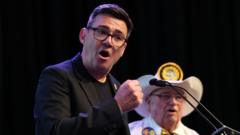
Andy Burnham has secured a stunning 9,231-vote victory in the Makerfield by-election, capturing over 50% of the total vote and clearing a decisive path to challenge Sir Keir Starmer for the leadership of the Labour Party. By crushing Nigel Farage’s Reform UK and the hardline Restore Britain party in a seat where Labour had recently collapsed, Burnham did not just win a seat in Parliament—he triggered an immediate, existential crisis at the absolute top of British governance. This was the explicit goal of the engineered vote, which occurred after sitting Labour MP Josh Simons stepped aside specifically to let the Greater Manchester Mayor mount a run for No. 10.
Burnham’s victory speech contained a blunt warning to his own high command. This is a final chance to change, he declared to a packed count room at 3 a.m., warning that the public would offer no second chances if Westminster continued to ignore communities outside the capital.
The immediate dilemma now shifts to Downing Street. Over the coming days, Starmer must choose between fighting a bitter internal rebellion or negotiating an orderly transition of power to a man who spent a decade building an alternative power base in the north.
The Blueprint of an Engineered Insurgency
This was no ordinary democratic contest. The entire mechanism of the Makerfield by-election was structured as a soft coup against a prime minister holding some of the lowest popularity ratings of any modern British leader.
When Josh Simons vacated his incredibly safe seat, the Labour apparatus in London was forced to accept Burnham’s candidacy. The mayor’s team understood that to mount a credible challenge for the premiership, he needed a mandate grounded in the very communities Labour has spent the last decade losing to right-wing populism. Makerfield provided the perfect laboratory.
"Voters told me they felt neglected, that the country works for other people and other places but not for here. That changes tonight." — Andy Burnham, Makerfield Victory Speech
The strategy worked because Burnham ran against his own party’s national record as much as he ran against the opposition. By explicitly disavowing four decades of failed neoliberal economics—a system that both traditional Labour and Conservative governments spent forty years upholding—Burnham positioned himself as an outsider despite his decades in the cabinet. He managed to pull back working-class voters who had defected to Reform UK by offering local economic protectionism instead of culture-war rhetoric.
The numbers reveal the sheer scale of the consolidation. While Reform UK secured a strong second place with 15,696 votes, the right-wing surge was blunted by the emergence of Rupert Lowe’s Restore Britain party. The two populist groups split the anti-establishment vote, while progressive voters from the Liberal Democrats and the Greens tactically collapsed their own campaigns, polling fewer than 500 votes combined to ensure Burnham’s path to London remained clear.
The Constitutional Void in Greater Manchester
While the media focuses entirely on the upcoming drama in Westminster, a secondary crisis is unfolding across the northwest. Burnham’s return to Parliament has instantly decapitated the regional government he spent nine years constructing.
Under existing British constitutional law, a strategic authority mayor who is elected as a Member of Parliament is immediately disqualified from holding mayoral office. The seat of the Greater Manchester Mayor is now officially vacant.
This creates a dangerous administrative vacuum for a region of nearly three million people. The current deputy mayor must take temporary control of the combined authority, but by law, a fresh mayoral by-election must be triggered within 35 working days.
This leaves Labour in an incredibly fragile position. The political coalition that has governed Greater Manchester for nearly a decade was never truly a Labour coalition; it was a personal brand built entirely around Andy Burnham. In the 2024 mayoral election, Burnham won 214 out of 215 electoral wards across the region. There is absolutely no guarantee that this immense personal popularity will transfer to a replacement candidate.
Furthermore, any upcoming mayoral by-election will be conducted under the newly reinstated Supplementary Vote system. This system allows voters to log a first and second preference, giving minor parties significantly more leverage. Labour faces a grueling, expensive defense of its northern heartland at the exact moment its leadership is tearing itself apart in London.
The Inevitable Battle for No. 10
Behind the scenes in Westminster, the machinery of a leadership challenge is already moving. Allies of Burnham, including prominent figures like Louise Haigh, are already publicly calling on Starmer to accept reality and agree to a managed exit before the autumn party conference.
The parliamentary numbers are turning rapidly. Insiders report that coordinated factions have already prepared the 81 MP signatures required to formally trigger a leadership contest if the prime minister refuses to step aside voluntarily.
| Potential Contender | Power Base | Key Vulnerability |
|---|---|---|
| Andy Burnham | Northern regional authorities, municipal unions, working-class left | Out of Parliament for nearly a decade; unformed national shadow cabinet |
| Yvette Cooper | Centrist PLP establishment, home affairs apparatus | Deeply tied to the current failing status quo |
| Wes Streeting | Modernizing right, media elite | Highly polarizing among traditional party members |
The transition will not be smooth. A significant portion of the Parliamentary Labour Party was elected after Burnham left Westminster in 2017. These newer MPs do not know him, do not owe him loyalty, and are deeply terrified of the electoral chaos that a mid-term leadership transition always inflicts on a ruling party. Cabinet ministers are already warning that forcing Starmer out will lead to immediate, overwhelming demands from the public for an early general election—a contest that Labour, in its current state, would struggle to survive.
The Illusion of Unity
In his early-morning speech, Burnham spoke heavily of building a new politics based on unity and hope, explicitly warning against the hyper-polarized style of politics currently dominating the United States. It is a compelling narrative, but it ignores the brutal reality of how he arrived at this point.
His entire path back to Parliament was built on division. He used the genuine, deep-seated anger of northern communities toward London to build a personal fiefdom. He consistently positioned himself against the national party leadership to maintain his local popularity.
Now, he must attempt to lead the very machine he spent years criticizing from afar. The "Makerfield test" he promised to bring to the heart of British politics requires a complete overhaul of how public money is distributed and how regional infrastructure is funded. If he succeeds Starmer, he will inherit an economy with almost zero fiscal headroom and a civil service deeply resistant to the radical devolution of power.
The victory in Makerfield was the easy part. The real crisis begins on Monday morning, when Burnham walks back into the House of Commons not as a regional champion, but as an open insurgent targeting the prime minister.