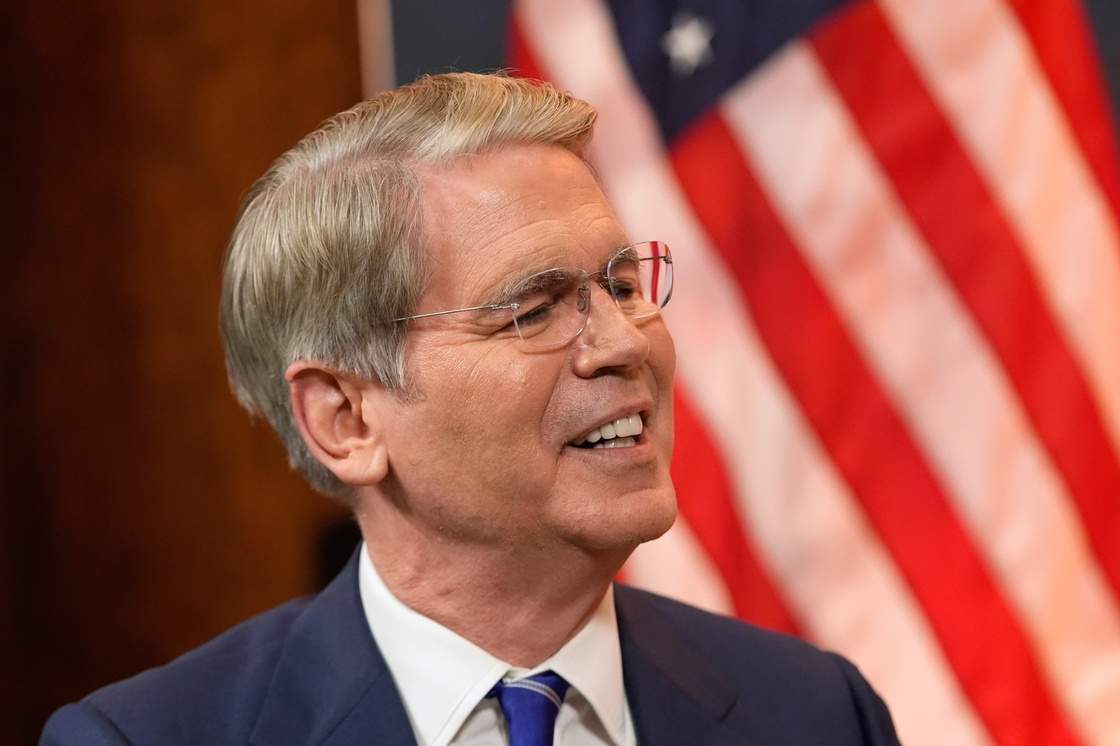
Treasury Secretary Scott Bessent and legendary investor Stanley Druckenmiller are locked in a public turf war over U.S. government debt, turning a quiet technical disagreement into an open ideological brawl. At the heart of the clash is a fundamental question: Should the world's most powerful financial authority manipulate borrowing costs to soothe market nerves, or let long-term yields act as an unvarnished warning siren for federal overspending?
The friction escalated after the Treasury doubled the maximum size of long-duration bond buybacks from two billion to four billion dollars and floated potential strategies to tap the trillion-dollar Treasury General Account. These maneuvers arrived just as thirty-year yields touched multi-decade highs. Bessent defended the moves as necessary housekeeping to maintain market fluidity, pushing back against critics who claim the administration is engaging in backchannel price controls.
Druckenmiller fired back through a high-profile critique arguing that suppression of yield signals short-circuits critical economic feedback loops. He noted that a rising yield is not a crisis to be managed away, but rather an invoice for chronic fiscal indiscipline. Bessent dismissed the broadsides with characteristic bluntness, pointing out the impressive performance of domestic government paper since the administration took office and noting that his former associate's timing would have lost him money on the day of publication.
The irony of this friction is thick enough to cut with a trading floor blotter. Decades ago, both men sat on the same side of the table. During the historic currency battles of September 1992, they worked alongside George Soros to break the British pound out of the European Exchange Rate Mechanism. Back then, they operated as the ultimate market fundamentalists. They proved that no sovereign government can permanently fix a price that contradicts economic gravity.
Now, the student has taken the helm of the world's largest issuer of debt, while the mentor operates from the sidelines as a private capital allocator. The roles have inverted. Bessent finds himself defending the administrative machinery of the state against speculative pressure, while Druckenmiller champions the unyielding purity of market signals.
The Anatomy of a Treasury Intervention
To understand why Wall Street is hyperventilating over a few billion dollars in buybacks, one must look past the dry accounting jargon. Standard bond buybacks allow the government to swap older, less liquid securities for fresh paper, keeping the plumbing of the financial system clear. They are supposed to be boring operations executed behind the scenes.
When the Treasury scales up those operations in the absence of actual market seizure or failed auctions, the intent changes. It signals to primary dealers and institutional asset managers that Washington is uncomfortable with the clearing price of debt.
Consider a hypothetical example. Suppose a corporate treasurer tries to float commercial paper during a credit crunch, but buyers demand double-digit interest rates. If the company steps in under the guise of general liquidity management to buy its own paper and force the yield down, lenders immediately recognize an artificial floor.
The moment a government begins managing prices rather than managing liquidity, it invites a game of chicken. Professional macro funds do not ignore state intervention; they map it. Every basis point of artificial yield suppression tells macro traders precisely where the political pain threshold lies.
The Shadow of the Fiscal Deficit
The underlying pressure driving this conflict is the sheer scale of American liabilities. With total national debt hovering near forty trillion dollars and annual deficits running hot at roughly six percent of gross domestic product, the federal government requires a constant, voracious appetite from global debt buyers.
Net interest payments on that debt now eclipse the entire defense budget. Every time long-term yields tick upward, the Treasury's future financing math becomes more punishing.
Bessent faces an unenviable balancing act. He must fund the government without causing a disorderly spike in borrowing costs that could ripple through mortgages, corporate loans, and equity valuations. His supporters argue that targeted interventions prevent panic-driven liquidity evaporation during periods of heavy issuance.
Yet critics contend that suppressing the long bond creates a moral hazard. If politicians know the Treasury will step in to cushion the blow of rising yields, the political price of running massive deficits disappears. The bond market is the only remaining fiscal disciplinarian in Washington. Muzzle the bond market, and there is nothing left to stop the fiscal engine from careening off the cliff.
The Global Chessboard
This domestic tug-of-war is further complicated by international currency dynamics. Just weeks prior to the domestic bond skirmish, U.S. authorities coordinated with Tokyo to support a sliding Japanese yen following its tumble past historic lows against the dollar.
While Washington insisted that intervention was driven by specific systemic needs rather than a shift in long-term exchange rate targeting, global desks took notice. Central bank coordination combined with aggressive domestic debt management creates an impression of heavy-handedness. Markets begin to wonder if major Western economies are entering an era of managed capitalism where price discovery takes a back seat to political stability.
Bessent has publicly maintained that Japan must rely on structural economic policy rather than endless currency intervention to drive domestic strength. Yet his own defense of Treasury market operations suggests a willingness to use state balance sheets to smooth out macroeconomic turbulence.
The Dangerous Game Ahead
History suggests that governments defending an unsustainable price eventually exhaust their ammunition. Whether it is the Bank of England crashing out of the ERM or central banks burning through foreign reserves to defend a currency peg, the market always retains the final word.
By stepping in to manage yields, the Treasury risks establishing an explicit contract with speculators. The market will test that contract. Every auction will be scrutinized for signs of official sponsorship, and every uptick in inflation data will trigger a confrontation between bond vigilantes and government bureaucrats.
Druckenmiller's warning cuts deep because it draws on the very playbook he and Bessent perfected decades ago. They built legendary reputations by betting against entities foolish enough to stand between capital and reality. Now, the Treasury is drawing its own line in the sand, daring the world to cross it.