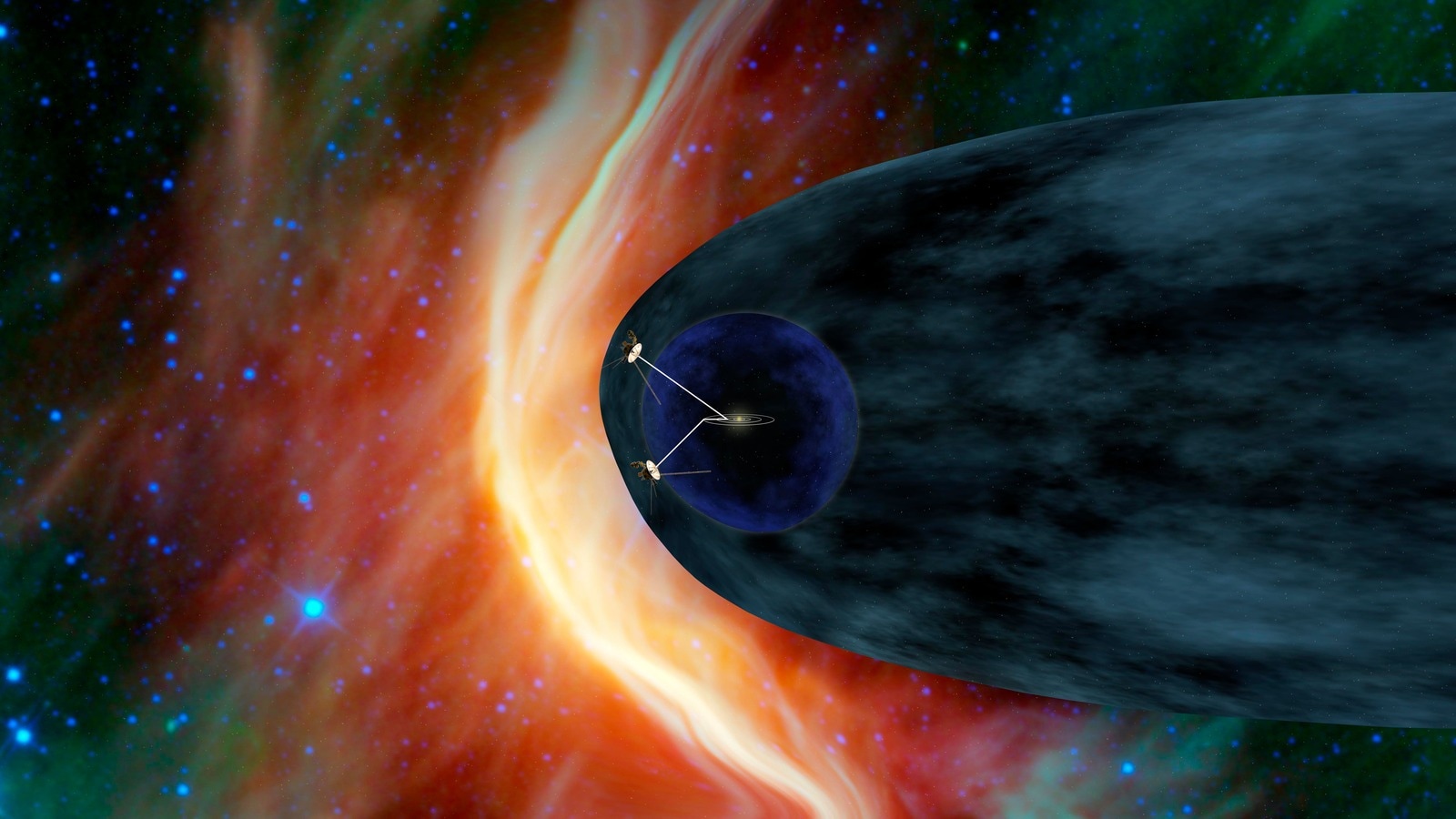
NASA's Voyager 1 spacecraft has crossed a distance of one light-day from Earth, reaching roughly 16.1 billion miles (about 25.9 billion kilometers) away on November 18, 2026, after more than 49 years of continuous flight. At that separation, a radio signal traveling at light speed takes a full 24 hours to make the one-way trip between the probe and Earth.
Press releases love a neat clock-face number. A 24-hour one-way light time feels poetic because it matches our own spinning day.
Engineering reality is far less romantic. Crossing one light-day from Earth does not mean Voyager 1 suddenly moved into a new physical regime on November 18, 2026. It already crossed the heliopause into interstellar space back in 2012. What changed is how long flight controllers at NASA's Jet Propulsion Laboratory have to wait just to learn whether a single command worked—a 48-hour round-trip delay before confirmation comes back across the void.
Why a Light-Day Is a Human Metric, Not a Cosmic Border
Space does not post mile markers at 24 light-hours. A light-day is simply how far a photon travels in one Earth day, a convenient yardstick for deep-space operations rather than a physical boundary like the edge of the heliosphere.
Even so, the scale behind that number is staggering. The Sun sits about 8.3 light-minutes away. Neptune sits around 4.2 light-hours away. By reaching 16.1 billion miles—roughly 173 Astronomical Units—Voyager 1 has put more than 170 times the Earth-Sun distance between itself and home.
Look closely at how that diagram frames the journey. The probe left the solar wind bubble behind years ago, yet everyday communication still depends on line-of-sight radio beams aimed across emptiness from a dish that is slowly losing pointing precision.
- One-way signal wait: 24 hours at light speed.
- Command round-trip loop: 48 hours from transmission to verified telemetry.
- Cruise speed relative to the Sun: Roughly 37,844 mph, fast by human standards yet glacial against light.
- Twin comparison: Voyager 2 trails around 20 light-hours out and will not hit one light-day until roughly 2035.
The Quiet Triage Keeping a 1977 Probe Alive
Celebrations around Voyager 1 often skip the hardest part of the story. The spacecraft is not cruising effortlessly on autopilot; it is surviving on a shrinking electrical budget while its hardware ages past half a century.
Three radioisotope thermoelectric generators (RTGs) power the craft by turning heat from decaying plutonium-238 into electricity. Because plutonium-238 decays steadily over time, available wattage drops every single year. Flight controllers have had to play a long game of power triage, switching off heaters and science instruments one by one so demand never exceeds supply.
A spacecraft can outlive its original mission plan by decades and still die from something as mundane as a cold fuel line or a starving bus.
Recent shutdowns tell the real story of what Voyager 1 sacrifices to keep talking. Its Low-Energy Charged Particles instrument was turned off in April 2026 to save power, following the Cosmic Ray Subsystem in February 2025, the Ultraviolet Spectrometer in 2016, and the Plasma Science instrument back in 2007. Each shutoff trims what science the probe can gather while buying precious margin for core avionics and heaters.
| Subsystem or Metric | Status or Role | What It Means for Operations |
|---|---|---|
| MHW-RTG Power Supply | Slowly declining output | Forces permanent instrument shutdowns to prevent brownouts |
| Low-Energy Charged Particles | Turned off April 2026 | Saves electrical power at the cost of particle data |
| Cosmic Ray Subsystem | Turned off February 2025 | Ends high-energy particle measurements from that sensor |
| 24-Hour Light Time | Reached November 2026 | Doubles the wait for two-way verification to two full days |
The Uncomfortable Truth About Deep-Space Legacy
After decades covering space programs and aerospace contractors, one pattern jumps out immediately. Agencies celebrate long-lived hardware milestones, yet they rarely fund successor missions fast enough to keep institutional memory intact when the pioneers finally go silent.
Counter-argument time. Critics sometimes ask whether nursing a nearly 50-year-old probe for a few extra watts of data is worth Deep Space Network antenna time that newer missions could use. That is a fair question when ground dish hours are scarce and every fraction of a watt matters.
Still, walking away early from the only active probe sampling interstellar space at one light-day from Earth would throw away irreplaceable baseline measurements. Even with fewer active instruments, every clean signal received across that 24-hour light gap tests fault recovery, old memory banks, and deep-space tracking software under extreme conditions.
Consider a hypothetical scenario where a successor interstellar probe launches with modern solid-state processors and high-gain lasers. Even then, mission planners will study how Voyager 1 handled memory corruption, degraded thrusters, and shrinking power budgets across a 48-hour command loop.
What Happens When the Watts Run Out
There is no dramatic explosion waiting at the end of Voyager 1's road. Its trajectory out of the solar system is set, carrying the Golden Record into the dark long after its transmitters go quiet.
The real cliff is electrical, not positional. Once RTG output drops below what is needed to run the remaining heaters and flight computer simultaneously, key systems will start cooling down and shutting off for good.
Watch how engineers manage the final stretch of power margins over the next few years rather than staring only at the distance counter. Every extra month of telemetry from one light-day from Earth is borrowed time bought through disciplined math, stubborn patience, and hardware built before most of today's engineers were born.


