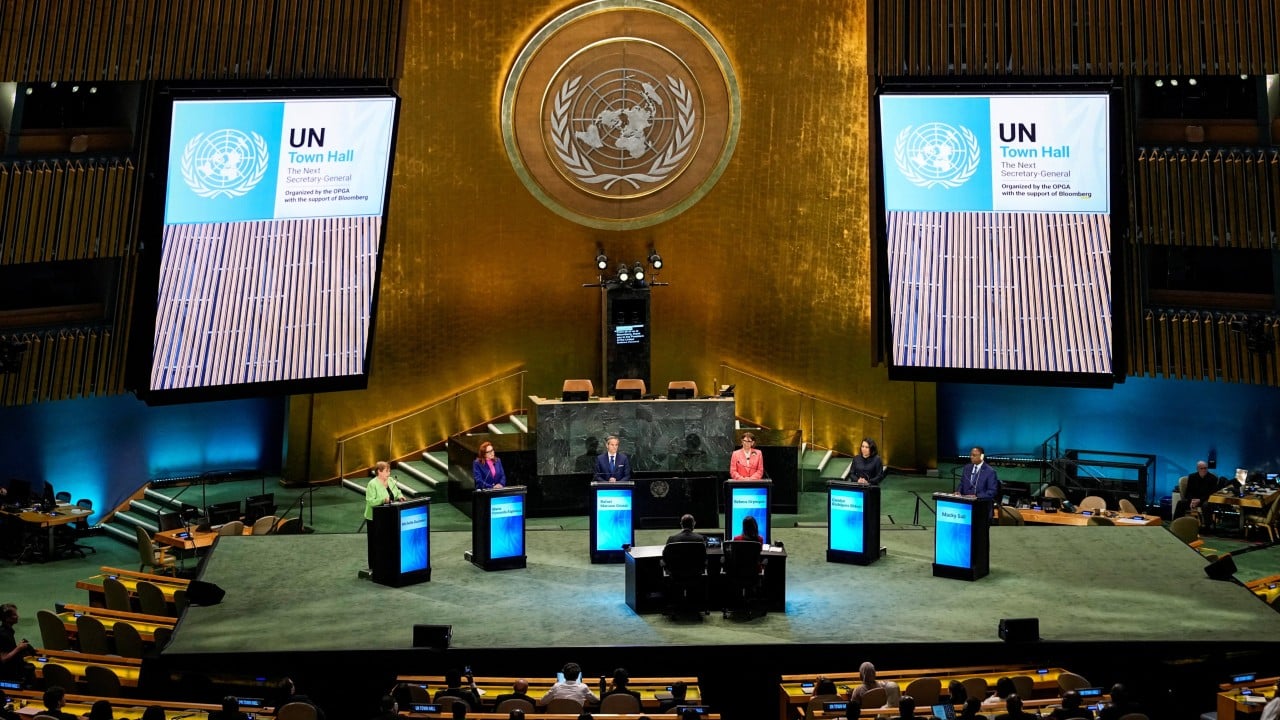
Six diplomats are currently parading through the marble halls of the United Nations headquarters in New York, promising to rescue an eighty-year-old institution from political paralysis and imminent bankruptcy. They deliver sleek vision statements. They participate in public town halls and promise transparency. They tell member states that restoring trust requires swift results and decisive action.
It is a grand spectacle, but it misses the point entirely.
The United Nations is not failing because its chief administrative officer lacks a compelling vision. It is failing because the permanent members of the Security Council designed the role of Secretary-General to be a administrative clerk rather than an independent global executive. As António Guterres prepares to step down, candidates like Rafael Grossi, Michelle Bachelet, Rebeca Grynspan, and María Fernanda Espinosa offer technocratic fixes for a political system that is fundamentally rigged against decisive action.
The Mirage of Open Selection
Public town halls and informal dialogues give the impression of a modern democracy at work. General Assembly debates allow small island nations and developing states to grill candidates on global equity, human rights, and climate action. The public engagement is historically unprecedented.
It is also largely decorative.
Behind closed doors, the real decision remains firmly in the hands of five governments. The United States, China, Russia, the United Kingdom, and France hold absolute veto power over who gets recommended to the General Assembly. Historically, this mechanism guarantees that any candidate with a track record of challenging superpower overreach is quietly discarded before reaching a final vote.
Consider the dynamic at play. Washington demands a candidate who aligns with American strategic interests. Beijing scrutinizes records for any past criticism of its domestic policies. Moscow routinely blocks figures seen as leaning too heavily toward Western security alignment. The result is a selection process that actively filters out strong leaders in favor of candidates who offend the fewest powerful actors.
This structural filter creates a perpetual executive dilemma. To get the job, a candidate must promise the P5 that they will not push too hard. To do the job, they must convince the rest of the world that they possess real authority.
Financial Stragulation as a Tool of Control
The political paralysis inside the Security Council is compounded by a calculated financial starvation. The Secretariat is facing what diplomats internally refer to as a crushing budget emergency. Member states regularly withhold assessed dues or pay them late, forcing the organization to freeze hiring, curtail field operations, and draw down cash reserves just to meet payroll.
This is not an accident of accounting.
Withholding dues is a time-tested lever of geopolitical coercion. When major powers dislike the direction of specific peace missions, human rights reports, or agency initiatives, they simply withhold cash. Washington’s ongoing arrears and threats of further funding cuts leave the international bureaucracy permanently on edge, managing short-term cash flow crises rather than long-term conflict resolution.
Candidates proposing new crisis hubs or administrative overhauls conveniently ignore this structural reality. You cannot build modern operational capacity on a budget that can be cut off at the whim of a single capricious superpower.
The Regional Rotation Paradox
Geopolitical tradition holds that the office should rotate across world regions. With Latin America and the Caribbean next in line, four of the six declared candidates hail from that region. There is also widespread demand across civil society for the first female Secretary-General in the history of the world body.
Yet even regional alignment has become a battleground.
Michelle Bachelet, a former president of Chile and human rights chief, was initially nominated jointly by Brazil, Mexico, and Chile. However, domestic political shifts led Chile to withdraw its official support shortly after her nomination. Former Senegalese President Macky Sall entered the race with a nomination from Burundi because his own home government initially declined to sponsor him.
These diplomatic anomalies reveal a deeper truth. National governments frequently view international leadership not as a shared global responsibility, but as an extension of domestic score-settling and regional influence battles.
Reclaiming the Charter
If the next Secretary-General is to be more than a passive bystander to global conflict, they must reassert the power explicitly granted under Article 99 of the UN Charter. That clause gives the executive the authority to bring to the Security Council's attention any matter that threatens international peace and security.
It is a power rarely invoked.
Most leaders fear the immediate blowback from permanent members who prefer to keep uncomfortable conflicts off the formal agenda. But a Secretary-General who relies solely on quiet diplomacy when major powers violate international norms surrenders the moral authority of the office.
True reform will not come from reshuffling organizational charts or launching new procedural dialogues. It requires a leader willing to use the bully pulpit of the Secretariat to publicly call out Security Council obstructionism, even when that means risking early friction with the powers that appointed them.
Until member states accept that a functional executive requires political independence and guaranteed funding, the race for the top job remains a high-stakes performance. The next Secretary-General will enter an office designed to fail, armed only with the authority that they are brave enough to seize for themselves.
WION's analysis of the UN Secretary General race
This broadcast provides essential context on the historical gender gap in UN leadership and the diplomatic maneuvers currently taking place among Security Council members.


