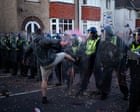
The fatal stabbing of 18-year-old finance student Henry Nowak in Southampton, and the harrowing bodycam footage showing him handcuffed as he bled to death, has triggered violent clashes across the city. While mainstream analysis frames the subsequent riots purely as an outbreak of far-right opportunism, the reality is far more dangerous. The unrest is the direct result of a systemic collapse in public trust, driven by institutional panic and a documented failure in operational policing. By examining how tactical errors were weaponized by political agitators, we see that the crisis in Southampton is not an isolated riot, but a symptom of a policing culture paralyzed by administrative fear.
The standard media narrative focuses heavily on the presence of figures like Tommy Robinson and political groups attempting to capture the public rage. That focus overlooks the structural vacuum that allowed them to do so. The underlying fuel for this explosion was not a sudden surge in extremist ideology, but a specific, devastating policy failure on the streets of Portswood.
The Anatomy of Institutional Paralysis
On December 3, 2025, Henry Nowak was walking home when he encountered 23-year-old Vickrum Digwa, who was armed with a 21cm ceremonial blade. Digwa stabbed the unarmed student five times. When officers from the Hampshire and Isle of Wight Constabulary arrived, Digwa deployed what prosecutors later described as his "trump card". He claimed he was the victim of a racist assault.
What followed was a catastrophic failure of basic triage and common-sense policing.
Officers immediately handcuffed the dying teenager. As Nowak’s lungs filled with blood, he told officers nine times that he could not breathe and had been stabbed. A male officer responded on camera: "Don't think you have, mate."
This response cannot be dismissed as a simple error in judgment. It exposes a profound shift in operational priorities. Confronted with a bleeding victim and a suspect invoking the modern administrative apparatus of hate crime allegations, frontline officers prioritized bureaucratic protocol over basic medical assessment. The fear of mishandling a sensitive racial allegation superseded the duty to check whether a human being was bleeding to death.
How Agitators Steer the Narrative
The weaponization of this failure by the political fringes was entirely predictable. When the bodycam footage was made public following Digwa’s life sentence, it provided undeniable visual proof of a system working in reverse. Agitators did not need to invent a conspiracy; the state had filmed one themselves.
- The Slogan Hijack: The adoption of the chant "I can't breathe" by right-wing demonstrators outside Southampton Central Police Station was a deliberate, tactical inversion. It explicitly weaponized a phrase synonymous with left-wing anti-police protests to mock the political establishment.
- The Institutional Weapon: Political actors quickly framed the event as definitive proof of "two-tier policing." They argued that white victims are treated with immediate suspicion, while minority suspects are granted automatic deference.
- Targeting the Vulnerable: Activists directed hundreds of protesters toward St Denys Road, trying to reach the neighborhood where Digwa’s family lived. This shifted the focus from legitimate institutional critique to raw sectarian intimidation.
By the time riot police deployed shields and pepper spray to protect the neighborhood, the damage to public trust was total. To the crowd, the state appeared fiercely capable of defending the killer's neighborhood, yet utterly incompetent at recognizing a dying boy on the pavement.
The Real Cost of Administrative Fear
The underlying mechanism driving this crisis is a culture of defensive policing. For two decades, British police forces have been conditioned by internal metrics, diversity targets, and oversight bodies to view every incident through the lens of identity politics.
Consider a hypothetical scenario where an officer faces two options: fail to provide immediate first aid, or face a career-ending investigation for failing to handle a racial complaint properly. In a healthy system, saving the life is the singular directive. In an environment dominated by administrative compliance, the priorities blur.
This structural anxiety explains why the officers believed the uninjured killer over the visibly dying victim. Digwa’s narrative fit perfectly into the exact template officers are trained to treat with total sensitivity. The physical reality—a dying student—was completely obscured by the administrative reality.
The political response has been utterly inadequate. Prime Minister Keir Starmer stated he "felt sick" watching the footage, while Home Secretary Shabana Mahmood condemned the "dangerous undercurrent" of the riots. These statements treat the symptoms while ignoring the cause. The state cannot lecture the public on law and order when its own officers are recorded mocking a dying teenager's final breaths.
The Failure of the Institutional Defense
Hampshire Police issued a standard, formulaic apology after the verdict, noting that the Independent Office for Police Conduct is investigating the case. One officer involved has already resigned. These gestures do nothing to calm public anger. The public understands that a resignation is a bureaucratic escape hatch, not a form of institutional accountability.
The fallout from Southampton goes far beyond the city borders. It exposes a deep and growing rift between the working-class population and the institutions tasked with their protection. When a community believes that the law is applied selectively based on administrative caution rather than objective reality, the social contract breaks completely.
If the state wants to neutralize far-right agitation, it must stop providing them with ammunition. That requires a complete dismantle of defensive policing protocols. Frontline training must return to basic, objective tenets: assess the physical scene, preserve human life regardless of initial statements, and treat allegations with professional skepticism until the bodies on the ground are secure. Until policing priorities shift back to physical reality over administrative optics, the streets of towns like Southampton will remain a spark away from total combustion.
Anger over police response to Henry Nowak killing fuels unrest in Southampton
This video coverage provides direct context on the scale of the Southampton protests and includes details regarding the political fallout and the controversial police bodycam footage.