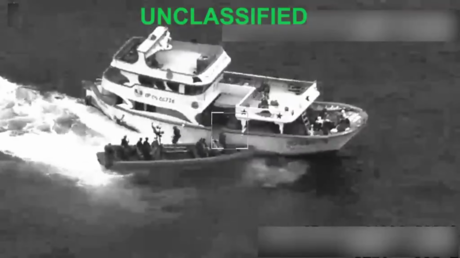
The explosion is captured on high-definition thermal optics, a brilliant flash of white-hot violence blooming across the dark surface of the water. For the public consuming defense agency press releases, the footage of US commandos neutralizing a narcotics vessel offers a neat, cinematic narrative of the war on drugs meeting modern kinetic force. The vessel burns, the illicit cargo sinks, and the threat is theoretically eliminated.
Reality is infinitely messier.
When elite military units turn their direct-action capabilities toward maritime drug interdiction, they operate in a legal, logistical, and strategic gray zone. This is not traditional law enforcement. It is an evolving militarized doctrine that redefines how national security agencies combat transnational cartels. The transformation raises hard questions about escalation, resource allocation, and the long-term efficacy of targeting symptoms rather than systemic root causes.
The Evolution of Maritime Interdiction
Decades ago, stopping drug shipments on the high seas relied primarily on the Coast Guard or specialized customs vessels. Boarding actions were dangerous, often dependent on surprise and compliance, or at least relative cooperation from smugglers operating converted fishing boats or go-fast craft. Over time, cartels adapted. They invested in semi-submersible vessels, heavily armed security details, and sophisticated satellite navigation systems that made standard law enforcement interdiction increasingly hazardous.
Enter the military. By integrating special operations forces into the maritime interdiction architecture, governments shifted the posture from policing to counter-insurgency tactics applied to criminal syndicates. These commandos bring elite insertion techniques, heavy weaponry, and advanced intelligence assets that completely change the dynamic of an intercept.
Yet, applying military-grade kinetic solutions to criminal enterprises creates friction within international law. A coast guard cutter operates under specific maritime law enforcement authorities. A Navy SEAL team or Marine Raider detachment operates under rules of engagement designed for armed conflict against hostile state or non-state combatants. When these operational mandates blur, legal frameworks established by the Geneva Conventions and the Law of the Sea are tested to their absolute limits.
The Intelligence Pipeline That Drives the Strike
Behind every recorded detonation of a suspected smuggling craft lies months of relentless signals intelligence, human intelligence, and aerial reconnaissance. The kinetic strike is merely the final, visible 2 percent of a massive intelligence apparatus.
P-8 Poseidon maritime patrol aircraft, high-altitude drones, and naval intelligence ships continuously sweep vast expanses of the Pacific and Caribbean basins. They look for anomalous patterns. A vessel riding low in the water despite empty fish holds, erratic course changes away from established commercial lanes, and encrypted satellite communication bursts all trigger alarms in intelligence fusion centers.
This surveillance architecture costs millions of dollars per operational hour. Critics point out the staggering disparity between the cost of the military assets deployed and the street value of the intercepted cargo. When a multi-million-dollar aircraft and a surface combatant intercept a vessel carrying a few tons of cocaine, the economic victory belongs entirely to the cartels. They treat these losses as a standard cost of doing business, factoring maritime seizures into their profit margins before the first package is ever loaded onto a hull.
The Cartel Adaptation Cycle
Every time a government deploys heavier force, criminal organizations evolve in response. The proliferation of low-profile vessels and fully submersible craft is a direct consequence of increased aerial and surface surveillance. These vessels are constructed out of fiberglass and wood in hidden jungle shipyards, designed specifically to elude radar detection by riding inches above or completely beneath the waterline.
Furthermore, cartels have militarized their own operations. Crew members on modern drug vessels are often armed with heavy machine guns and rocket-propelled grenades, prepared to fight rather than surrender. This arms race turns routine patrols into naval skirmishes.
The human element inside the cartels is similarly expendable. The individuals manning these vessels are rarely high-level syndicate bosses. They are impoverished fishermen or marginalized laborers hired for a single voyage, promised sums that represent life-changing wealth in their home communities. When a vessel is destroyed, the network suffers zero leadership attrition. Replacements are recruited within hours, while the structural integrity of the transnational cartel remains completely unblemished.
The Strategic Void
The fundamental flaw in relying on kinetic strikes against maritime drug traffic is the absence of a strategic horizon. Stopping a vessel prevents millions of doses from hitting the market, a tangible tactical win. However, it does nothing to alter the economic incentives driving production in source countries or the insatiable consumer demand in destination markets.
As long as the profit margins remain astronomical, the supply chain will find a way through or around any military blockade. Alternative routes emerge through West Africa, shifts occur toward containerized shipping through legal commercial ports, and synthetic opioids reduce the reliance on plant-based narcotics altogether.
True disruption requires tackling the financial architecture that washes billions in illicit capital through global banking systems, dismantling the political corruption that protects cartel infrastructure onshore, and addressing public health crises at home. Blowing up a vessel makes for compelling footage, but it remains a tactical band-aid on a systemic wound. The real war is fought in the boring, unglamorous trenches of forensic accounting and institutional reform, far away from the cameras and the thermal optics.