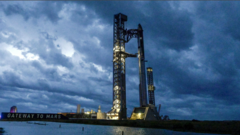
SpaceX has quietly adjusted the launch schedule for its massive Starship rocket system. While armchair aerospace enthusiasts fret over regulatory approvals and technical telemetry, the true pressure points are financial. The company recently filed its highly confidential Form S-1 with the Securities and Exchange Commission, paving the way for a historic public listing under the ticker SPCX. To secure a staggering $1.75 trillion valuation and execute a planned $75 billion capital raise, Elon Musk cannot afford an explosive, high-profile failure on the Texas coastline right as the institutional roadshow begins.
A standard spaceflight delay is about valves, wind shear, or software anomalies. This pause is about Wall Street mathematics.
The financial reality of modern aerospace engineering is brutal. For over a decade, SpaceX operated as an insular, private playground funded by deep-pocketed venture syndicates and periodic internal liquidity rounds. Those days are over. The sheer burn rate of developing Starship, combined with the capital required to scale the Starlink satellite network, has finally forced the company to eye the public markets.
The Trillion Dollar Balancing Act
A close reading of the registration paperwork reveals a deeply divided business model. On one side sits a highly lucrative commercial launch enterprise. The workhorse Falcon 9 rocket family maintains a functional monopoly on global satellite delivery, generating predictable cash flows on government and commercial contracts. On the other side sits a massive cash incinerator.
SpaceX generated $18.67 billion in revenue last year, representing a healthy 35% growth trajectory. The internal ledger shows a painful $4.9 billion net loss over the same period. The financial bleeding is directly tied to Starship construction in Boca Chica and the continuous deployment of heavy orbital hardware.
SPACEX FINANCIAL PROFILE (PRE-IPO DISCLOSURE)
+------------------------+------------------------+
| Metric                 | Financial Performance  |
+------------------------+------------------------+
| Trailing 2025 Revenue  | $18.67 Billion         |
| Net Loss (2025)        | -$4.90 Billion         |
| Target IPO Raise       | $75.00 Billion         |
| Target Valuation       | $1.75 Trillion         |
| Top Growth Driver      | Starlink Broadband     |
+------------------------+------------------------+
Institutional investment banks are currently attempting to pitch this transaction to conservative pension funds and sovereign wealth entities. The core challenge is the multiple. At a $1.75 trillion valuation target, the listing demands a valuation of roughly 109 to 116 times trailing revenue. Even compressing that figure against forward 2026 revenue projections leaves a multiple hovering around 60 times.
Wall Street will accept these astronomical multiples only under a single condition. The underlying technology must appear flawless, predictable, and fully controlled.
A catastrophic launch failure during the first week of June would instantly derail the marketing narrative. If a test vehicle disintegrates over the Gulf of Mexico while underwriters are pitching the stock to institutional buyers in New York, the $75 billion raise faces immediate downward pricing pressure. Pushing the next major orbital attempt past the June 11 pricing date mitigates that specific, existential risk.
Starlink Subsidies and the AI Pivot
The investment thesis for the public listing does not actually rely on colonizing Mars. The true value proposition is orbital data infrastructure.
The connectivity segment has emerged as the genuine economic engine of the enterprise. Starlink crossed the 10 million subscriber threshold earlier this year and is currently generating over $1.19 billion in profit per quarter. The satellite broadband business is projected to pull in nearly $20 billion this year alone, effectively footing the bill for the experimental rocket programs.
"The financial center of gravity has shifted entirely from launch logistics to global connectivity. The rockets are now simply a vertical integration strategy to deploy the broadband network cheaper than anyone else."
Furthermore, the recent structural consolidation with xAI has fundamentally altered the corporate identity. SpaceX is no longer being marketed to Wall Street as a capital-intensive manufacturing concern. It is being sold as an artificial intelligence data network that operates beyond the constraints of terrestrial power grids and real estate markets. The S-1 documentation explicitly identifies a potential total addressable market of $28.5 trillion, with the vast majority of future revenue tied directly to space-based AI computing.
This pivot explains why the public market valuation target has inflated so aggressively from the private tender offers seen in late 2025. It also highlights why technical caution has suddenly overridden the traditional engineering philosophy of moving fast and breaking things.
The Reality of Absolute Voting Control
Retail investors waiting for June 12 to buy shares on the open market must reckon with an uncommon governance structure. Buying into this entity does not buy a voice in the boardroom.
Elon Musk retains 85.1% voting control through a distinct, super-voting share class. This ensures that outside shareholders possess no meaningful avenue to influence corporate strategy, capital allocation, or board appointments. While dual-class structures are common among founder-led technology firms, the scale of this concentration is unprecedented for a trillion-dollar industrial enterprise.
If the executive leadership decides to divert billions in IPO proceeds toward high-risk deep space exploration rather than expanding commercial satellite capacity, public shareholders will have no legal recourse to stop it. The governance structure is designed to ingest public capital while maintaining absolute, private operational autonomy.
This structural reality changes how the launch timeline must be interpreted. The delay is not a sign of technical capitulation to regulatory bodies or engineering oversight. It is a calculated corporate pause. The company is systematically de-risking its public debut to maximize proceeds, ensuring that the heavy capital infusion occurs before the next experimental vehicle clears the pad.
The countdown that truly matters right now is not running on a launch console in south Texas. It is counting down to the opening bell on the Nasdaq.