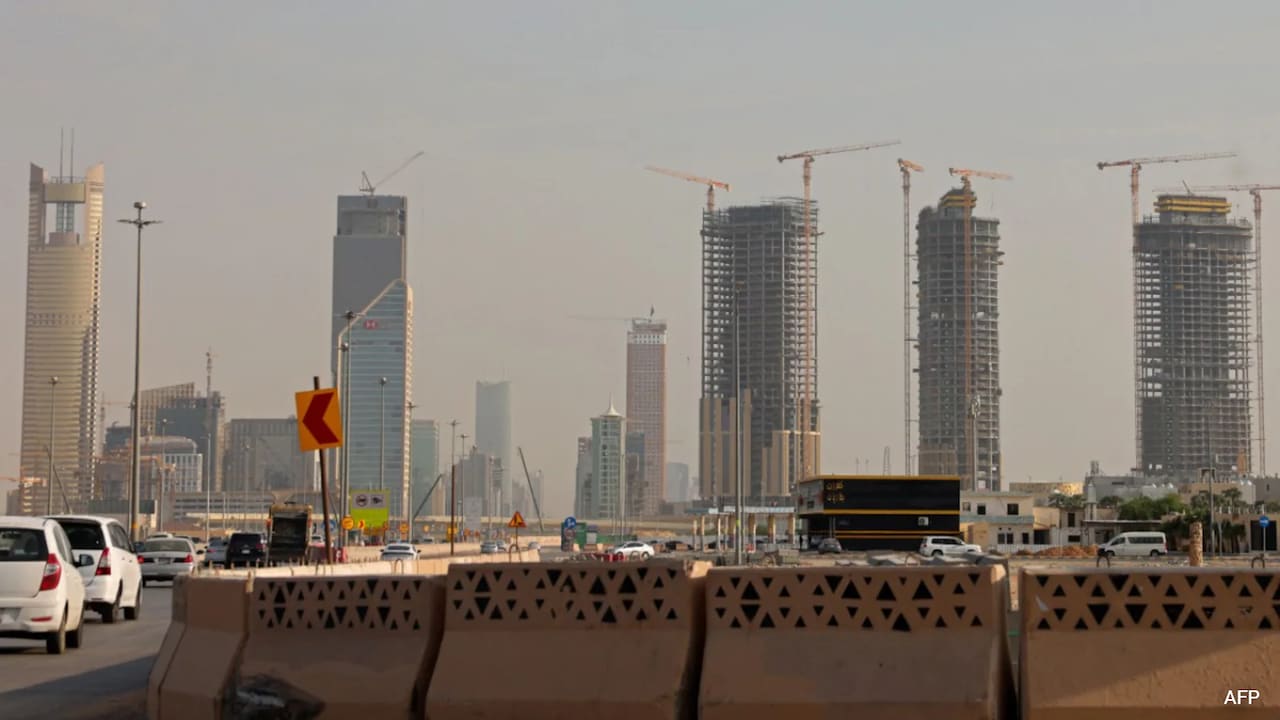
An attempted aerial attack struck a commercial high-rise housing Saudi Aramco offices in central Riyadh, shattering facade glass, triggering emergency evacuations, and exposing a critical flaw in urban infrastructure defense. While state communications downplayed the incident as a thwarted interception with minor debris damage, the structural impact on a corporate tower miles from traditional oilfields signals a deliberate shift in asymmetric warfare. Adversaries are no longer targeting remote processing plants in the Eastern Province; they are aiming directly at the financial and administrative nerve centers of the Saudi capital.
The dust settles differently on steel and glass than it does on desert sand. For decades, the security doctrine protecting the world’s largest oil exporter relied on a simple geographic assumption. The energy assets were in the east, heavily fortified behind concentric rings of surface-to-air batteries, radar arrays, and desert buffers. Riyadh, sitting hundreds of miles inland on the Najd plateau, functioned as the insulated boardroom. That insulation just cracked.
When air defense interceptors engage low-flying, radar-evading munitions over a densely populated metropolis, the physics of interception create a secondary crisis. Even a successful kinetic hit at low altitude scatters high-velocity shrapnel and unspent fuel directly onto commercial districts. In this instance, the physical scarring on the Aramco-leased skyscraper proves that the margin for error in urban air defense has shrunk to zero.
The Anatomy of an Urban Interception
Modern air defense systems were engineered for open skies, not concrete canyons. Battery commanders operating Patriot or THAAD installations around Riyadh face a brutal mathematical equation when tracking incoming one-way attack drones or low-trajectory ballistic threats.
To protect the city center, interceptors must engage targets before they breach the inner perimeter. If the engagement happens too late, the collision occurs directly above commercial real estate. A typical interceptor missile travels at Mach 3 or higher, carrying a fragmentation warhead designed to shred an incoming target into harmless pieces. Over an empty desert, those pieces fall without consequence. Over a downtown financial corridor, every piece of titanium casing and composite airframe becomes a kinetic projectile.
Urban skyscrapers act as massive vertical sails. Their glass curtain walls, engineered to withstand wind shear and thermal expansion, fail catastrophically when subjected to localized pressure waves or high-speed metal fragments. The damage observed on the Riyadh tower—shattered glazing across multiple upper floors and scorched aluminum cladding—bears the unmistakable signature of a terminal-phase blast or heavy falling debris from a near-miss interception.
Why Riyadh and Why Now
Targeting a corporate office building rather than a refinery seems counterproductive on paper. A damaged skyscraper does not halt crude exports or take millions of barrels per day offline the way the 2019 Abqaiq-Khurais strikes did. Yet, looking strictly at barrel counts misses the strategic objective entirely.
Riyadh is currently the centerpiece of an aggressive economic transformation aimed at convincing global capital, multinational banks, and tech giants to relocate their regional headquarters to the Kingdom. Under the Regional Headquarters Program, foreign firms face intense pressure to establish permanent executive bases in the capital to secure lucrative state contracts.
By striking a high-profile tower associated with Saudi Aramco in the heart of Riyadh, the attackers aimed at psychological leverage over physical destruction.
- Expatriate Confidence: Foreign executives and engineering talent view Riyadh as a secure, sanitized environment compared to other regional hotspots. Visible damage to a premier office tower forces corporate risk officers to recalculate hardship pay, evacuation protocols, and insurance premiums.
- Capital Flight Risk: Sovereign wealth initiatives rely on uninterrupted foreign direct investment. Kinetic incidents in commercial zones introduce geopolitical risk premiums that financial markets immediately price into debt and equity offerings.
- Resource Dilution: Forcing the Royal Saudi Air Defense Forces to deploy their most advanced interceptors to guard office towers stretches battery coverage thin, potentially leaving peripheral industrial sites more exposed.
The Limitations of Hardened Concrete and Glass
Commercial architecture in the Gulf has evolved rapidly, prioritizing aesthetic ambition and energy efficiency over blast mitigation. High-rise towers in Riyadh's King Abdullah Financial District and along the King Fahd Road corridor rely heavily on double-glazed, low-emissivity glass units designed to reflect solar heat.
They are not bunkers. Unlike diplomatic compounds or military command centers, commercial skyscrapers lack standoff perimeters, blast-resistant laminated glazing, and reinforced structural cores capable of absorbing external concussions. Retrofitting an existing forty-story glass tower to withstand nearby aerial detonations is functionally impossible without stripping the building down to its structural steel frame.
Facility managers in Riyadh are now confronting a reality that security consultants have warned about for years. When corporate offices share airspace with high-value state targets, commercial real estate becomes collateral infrastructure. Standard corporate emergency plans—designed for fires, medical emergencies, or localized civil unrest—fall entirely short when threats arrive from above at hundreds of miles per hour with less than three minutes of radar warning.
The Cost Asymmetry Problem
The economics of these engagements heavily favor the aggressor. A long-range, GPS-guided loitering munition built from commercial off-the-shelf components costs roughly $20,000 to $50,000 to assemble. A single PAC-3 MSE interceptor fired to destroy that threat costs upwards of $4 million.
This hundred-to-one cost imbalance creates an unsustainable attrition dynamic. Even when air defenses achieve a 95 percent interception rate, the defender bleeds capital while the attacker achieves strategic disruption with the remaining 5 percent that leaks through—or simply through the falling debris of the 95 percent that were successfully hit.
Furthermore, radar cross-sections of modern composite drones mimic those of large birds, forcing air defense operators to lower their automated engagement thresholds. Lowering those thresholds increases the risk of false positives and accidental engagements in congested civilian airspace, where commercial airliners approach King Khalid International Airport just miles away.
Market Reaction and the Illusion of Stability
Following the strike, official statements emphasized continuity. Crude benchmarks barely flinched, largely because physical loading terminals at Ras Tanura remained untouched and global oil markets have grown desensitized to localized Middle Eastern flare-ups unless actual supply pipelines are severed.
That market complacency masks a deeper operational vulnerability. Saudi Aramco is not merely an upstream oil producer; it is a sprawling corporate enterprise whose daily logistics, trading desks, procurement contracts, and digital infrastructure are managed out of urban hubs in Dhahran and Riyadh. Disrupting the administrative brain of the company causes friction across global supply chains that takes weeks to untangle, even if not a single pumpjack stops moving.
Insurance underwriters in London and Zurich pay far closer attention to structural damage reports than equity traders do. War-risk insurance rates for commercial properties and aviation corridors in the region respond immediately to verified kinetic impacts in capital cities. Every shattered window in Riyadh translates directly into higher operational overhead for every multinational corporation operating within the Kingdom.
The New Reality of Corporate Risk
Security briefings across Riyadh’s business districts are already shifting from routine compliance exercises to urgent tactical reviews. Corporations can no longer outsource their physical security entirely to state air defense networks.
If an executive team sits on the thirty-fifth floor of a glass tower in a contested region, physical security requires layered internal protocols. That means establishing hardened interior safe zones away from exterior curtain walls, installing blast-mitigation window films that prevent glass from turning into lethal shards upon impact, and deploying independent acoustic and optical early-warning sensors that bypass slow public alert channels.
The strike on the Riyadh tower stripped away the comfortable fiction that corporate boardrooms sit safely behind the front lines. In modern asymmetric conflict, the glass facade of a financial district is the front line.