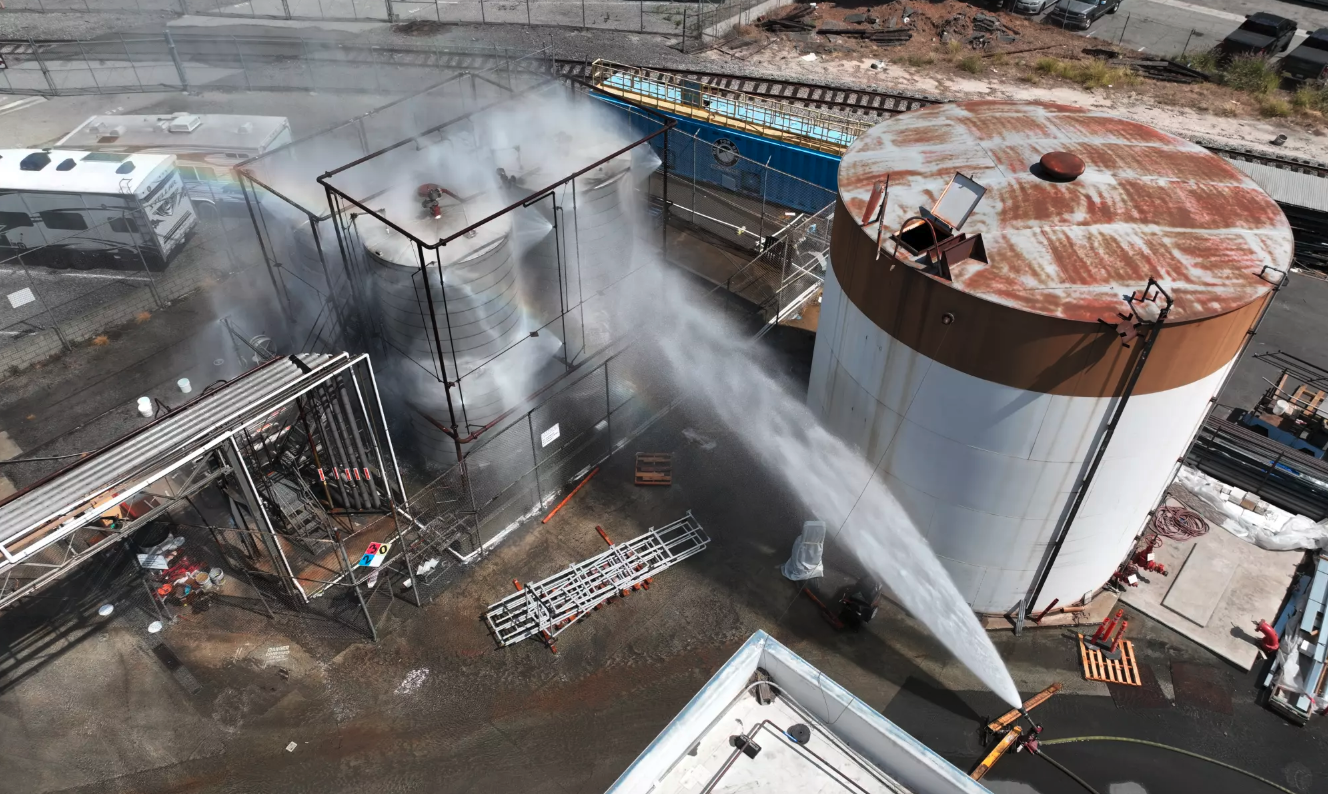
A faulty cooling system valve on a industrial tank at the GKN Aerospace facility in Garden Grove sparked a massive hazardous materials emergency, forcing the evacuation of 50,000 Southern California residents. The crisis began on May 21, 2026, when a 34,000-gallon storage tank containing roughly 7,000 gallons of highly volatile methyl methacrylate began to rapidly overheat. Investigators later discovered that a failed cooling system valve prevented emergency crews from introducing chemical stabilizers or draining the tank. This mechanical failure triggered a high-stakes standoff as the chemical converted to gas, pushing internal temperatures past 100 degrees Fahrenheit and raising the immediate threat of a Boiling Liquid Expanding Vapor Explosion.
The immediate explosion threat subsided only after a chance structural crack formed in the tank over the Memorial Day weekend, venting the built-up internal pressure. While regional fire officials reduced the evacuation perimeter by 65 percent, approximately 16,000 residents remain displaced as hazardous materials teams monitor lingering risks of localized fires, smaller ruptures, and toxic runoff.
The Chemistry of a Near Catastrophe
Methyl methacrylate is a highly flammable, volatile liquid chemical used extensively in the production of acrylic plastics, resins, and aerospace components. It has a critical vulnerability. The chemical possesses self-heating properties and a flashpoint of just 50 degrees Fahrenheit. Under standard operating procedures, industrial storage facilities must maintain the liquid at a constant 50 degrees Fahrenheit to prevent polymerization, a chemical reaction that generates its own thermal energy.
When the cooling valve failed at the Garden Grove plant, the liquid quickly surpassed its safe thermal threshold. This initiated a runaway effect. As the internal temperature climbed toward the 100-degree limit of the tank's monitoring equipment, the liquid began converting into a heavy, toxic vapor.
Emergency responders faced a dual dilemma. They could not drain the liquid due to the broken, gummed-up valve assembly, and they could not inject a neutralizing agent to halt the chemical reaction. The structural integrity of the entire tank hung in the balance. Had a full thermal explosion occurred, the blast would have ruptured two adjacent storage tanks, releasing a dense, toxic chemical plume across a densely populated section of central Orange County.
Emergency Response and the Tactical Pivot
First responders with the Orange County Fire Authority initially deployed automated deluge sprinkler systems to douse the exterior shell of the tank. Unmanned water hoses pumped roughly 1,250 gallons of water per minute over a grueling five-day stretch. This massive effort consumed more than 9 million gallons of municipal water.
The cooling operation ran into an early tactical snag. Drone thermal imaging initially suggested the tank was cooling down, but command staff later realized the aerial sensors were only reading the temperature of the water-cooled exterior metal plating, while the internal core of the chemical mass continued to heat up by roughly one degree Fahrenheit per hour.
Tank Capacity: 34,000 Gallons
Current Contents: ~7,000 Gallons of Methyl Methacrylate
Water Used for Cooling: ~9 Million Gallons
Target Safe Temperature: 50°F to 70°F
The breakthrough arrived via an unexpected material failure. Over the weekend, the intense internal pressure forced a microscopic crack to form in the tank wall. This structural defect acted as a makeshift relief mechanism, safely venting the gas buildup without triggering a violent detonation.
By Monday, emergency crews stripped away the external weather insulation from the tank body, allowing the direct application of water to drop internal temperatures down to 92 degrees Fahrenheit. While this intervention officially removed the threat of a massive regional blast, the incident commander warned that the remaining liquid could still rupture the compromised hull, causing a major ground-level hazardous spill or a localized flash fire.
Regulatory History and Regional Fallout
The Garden Grove crisis has brought renewed scrutiny to the intersection of industrial manufacturing and dense residential zoning. The GKN Aerospace facility sits in a busy commercial corridor bordering neighborhood tracts across Garden Grove, Anaheim, Westminster, Stanton, Buena Park, and Cypress. Local school districts were forced to close multiple campuses just days before the end of the academic year, while municipal shelters reached near-maximum capacity.
Regulatory records reveal this was not an isolated compliance issue for the site.
The company paid approximately $910,000 in regulatory fines to local air quality management authorities during the previous year for illegal emissions involving volatile organic compounds. This history of environmental violations has prompted the Orange County District Attorney to launch a formal investigation into the facility's maintenance logs and operational safety protocols. Whistleblowers have been publicly urged to step forward with information regarding the facility's mechanical upkeep and corporate oversight.
The federal footprint has expanded alongside the local judicial probe. Following a state of emergency declaration by California Governor Gavin Newsom, the federal government approved an emergency declaration, deploying personnel from the Federal Emergency Management Agency alongside environmental specialists.
The U.S. Environmental Protection Agency and the South Coast Air Quality Management District have established long-term monitoring networks around the facility. Their primary task involves scanning local sewer systems, storm drains, and neighborhood flight paths for chemical runoff or delayed vapor plumes.
The long-term recovery process hinges entirely on the stabilization of the remaining chemical volume. Experts from Purdue University's environmental engineering department note that a portion of the 7,000 gallons of methyl methacrylate may have already polymerized into a hardened, stable acrylic plastic, resembling plexiglass. This natural solidification could permanently neutralize the remaining hazard. However, until specialized hazardous materials teams can verify the ratio of liquid to solid inside the tank, the surrounding neighborhoods cannot fully reopen.
The tactical objective remains to drive the internal core temperature down into a stable zone between 60 and 70 degrees Fahrenheit before engineers attempt to cut into the hull or clear the blocked valve network.