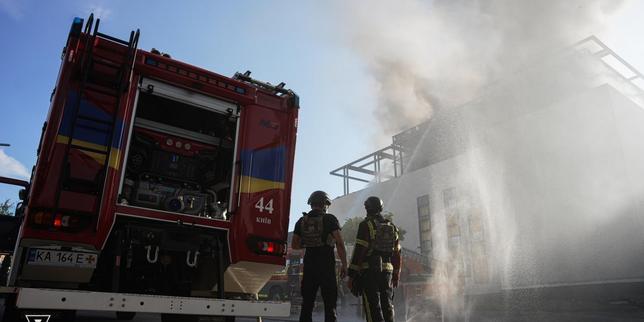
The sirens start long before the explosions shake the concrete foundations. When the latest coordinated barrage of Russian ballistic missiles and loitering munitions tore through Kyiv and surrounding districts, leaving at least 15 dead and dozens injured, the most devastating revelation was not the target list. It was the empty sky.
For years, the arithmetic of air defense in urban centers like Kyiv relied on a fragile equation of sophisticated Western interceptors meeting incoming supersonic threats. Today, that equation is breaking down. Chronic shortages of Patriot interceptor missiles have left the capital dangerously exposed, transforming what used to be a heavily shielded metropolitan airspace into a high-stakes lottery for survival.
Understanding why these nocturnal raids continue to exact such a high civilian toll requires looking past the immediate shock of burning residential blocks and damaged children's hospitals. The crisis is rooted in global production bottlenecks, shifting international military aid priorities, and an evolving Russian tactical playbook designed to exhaust remaining anti-air stocks.
The Anatomy of an Overloaded Grid
Air defense is a numbers game dictated by velocity and volume. When Moscow unleashes a mixed package consisting of decoys, cruise missiles, and high-speed ballistic projectiles, defending systems must make split-second calculations about prioritization. Every incoming threat consumes scarce resources.
When interceptor stockpiles run low, prioritization shifts from comprehensive protection to targeted asset preservation. Critical infrastructure takes precedence over residential neighborhoods. Civilian sectors that once enjoyed multiple layers of missile defense now find themselves relying on mobile anti-drone groups equipped with heavy machine guns or electronic jamming equipment—tactics that remain completely ineffective against ballistic missiles hurtling downward at Mach speeds.
The structural vulnerability has widened because production lines in Western manufacturing hubs cannot match the consumption rate of a protracted war of attrition. While factories work to scale output, the pipeline remains constrained by specialized supply chains and long lead times for sensitive guidance components.
The Ballistic Threat Multiplier
The strategic shift toward ballistic missiles represents a deliberate calculation by Russian military planners. Unlike subsonic cruise missiles or propeller-driven attack drones, ballistic trajectories offer minimal warning time and require specialized, high-tier intercept systems such as the Patriot or SAMP/T batteries to intercept reliably.
Global inventories of these specialized interceptors are finite. Competing geopolitical crises in the Middle East and elsewhere have continuously strained the same manufacturing and stockpiling pools that supply Kyiv. When global supplies tighten, delivery schedules slip, and front-line operators face difficult choices over which batteries to keep active and which to ration.
This dynamic creates a dangerous operational window. Every missed interception allows high-explosive payloads to penetrate deep into urban areas, targeting logistical hubs, food storage warehouses, and transportation arteries. The objective extends beyond physical destruction. It aims to erode psychological endurance by demonstrating that no district inside the capital remains truly safe.
The Cost Borne by First Responders
The humanitarian impact of chronic interceptor shortages reverberates far beyond the initial blast radius. Emergency services operate under exponential risk when secondary strikes target locations where rescue operations are already underway.
Medical personnel and state rescue workers responding to early-morning blasts frequently find themselves endangered by subsequent waves of incoming fire. Operating in an environment where air defense cannot guarantee a sealed sky means that treating the wounded and pulling survivors from collapsed masonry is an act of calculated hazard.
International humanitarian organizations operating within the capital have had to recalibrate their safety protocols, moving staff into hardened shelters as shockwaves register miles away from the impact points. The danger is no longer isolated to the immediate front lines in the east and south; it permeates every urban center within reach of long-range strike assets.
Rethinking Modern Air Defense Realities
The situation highlights a glaring vulnerability in modern military doctrine. Western defense strategies for decades prioritized expeditionary warfare against asymmetric opponents lacking advanced long-range precision strike capabilities. Fighting a near-peer adversary with deep stockpiles of ballistic and cruise missiles requires a defensive industrial base operating on a wartime footing that few nations have successfully mobilized.
Bridging the capability gap requires more than emergency financial aid packages. It demands immediate transfers of interceptor reserves, accelerated joint production initiatives, and decentralized electronic warfare deployments capable of degrading guidance systems before they reach populated zones. Until those manufacturing bottlenecks clear and inventory levels stabilize, the skies over Kyiv will remain a contested, perilous space where the margin between survival and tragedy is measured in missile availability.
The sirens will sound again. The vital question remains whether the hardware required to silence them will arrive before the next inventory threshold is crossed.