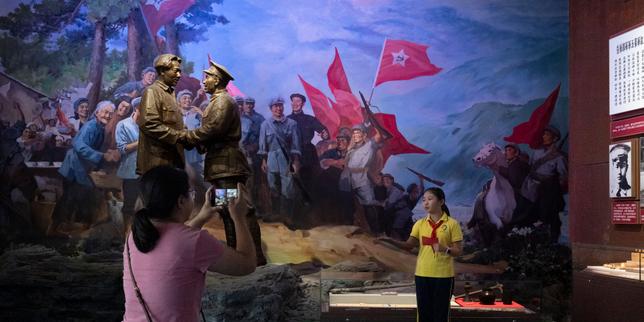
Fifty years after his heart stopped ticking inside Zhongnanhai, Mao Zedong remains the invisible architect of every political spasm shaking Beijing. The official state narrative insists on a neat mathematical formula dividing his record into pristine ideological triumphs and minor administrative errors. Yet beneath the polished glass of his mausoleum on Tiananmen Square, the ideological DNA of the founding chairman is weaponized by a current leadership desperate to justify absolute authoritarian control.
History does not simply repeat itself. It echoes in the corridors of power where party secretaries study the political mechanics of the Cultural Revolution not as a tragedy to avoid, but as a manual for crushing internal dissent. In similar news, read about: What the Ruins of the Minab School Tell Us About Modern Warfare.
To understand why the ghost of the Great Helmsman refuses to fade, look past the giant porcelain statues adorning public squares or the romanticized nostalgia of factory workers yearning for an era of forced egalitarianism. The survival of his political utility rests on a calculated institutional necessity. The Chinese Communist Party anchors its sole source of legitimacy in the myth of 1949. Dismantling Mao entirely would mean pulling the foundational cornerstone out from beneath the party's monopoly on governance.
A fragile state structure demands an untouchable founding myth. The New York Times has provided coverage on this critical subject in great detail.
State media routinely propagates sanitized histories that gloss over the catastrophic human toll of the Great Leap Forward and the decade of terror that followed. Millions perished not from natural disasters, but from ideological zealotry disguised as economic policy. Entire generations were hollowed out by neighbor turning against neighbor, teacher against student, and child against parent.
Acknowledging the full magnitude of those horrors would force an existential reckoning. The current leadership prefers selective amnesia coupled with aggressive enforcement.
Modern economic policies frequently clash with Maoist orthodoxy, yet the political instruments remain identical. State control over private enterprise, the marginalization of independent judicial bodies, and the relentless elevation of supreme leadership echo the darkest chapters of mid-century authoritarianism. When tech tycoons are reined in and private wealth faces sudden ideological vetting, the ghost of central planning stirs.
The paradox defines contemporary political life across the mainland. Citizens enjoy the material abundance born of decades of market reforms while existing under a political framework forged in the crucible of permanent revolution.
Dissidents who attempt to drag the darker truths of that era into the light face swift retribution. Historical archives remain locked tight. Academic research into the famines is treated as subversion. Guarding the gates of history ensures the party controls the parameters of the future.
The strategy works because the alternative terrifies the ruling elite. Opening the door to genuine historical accountability could trigger an uncontrollable cascade of public disillusionment.
As the half-century marker passes since his final breath, the political machinery built in his image marches forward. Every directive emphasizing ideological purity, every campaign against Western influence, and every consolidation of personal power draws direct inspiration from his playbook. The supreme leader in Beijing today governs with the realization that abandoning the ideological ghost of the past would leave the present system dangerously exposed to the unpredictable currents of political reform.
Control the past, and you dictate the boundaries of tomorrow.


