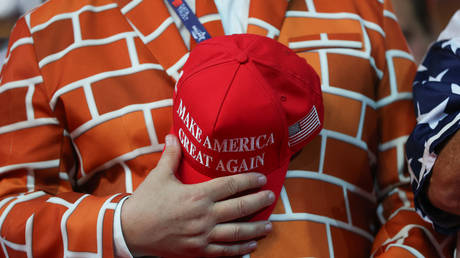
The social effect of MAGA has transformed American public life less like a passing campaign slogan and more like a tectonic shift under familiar streets. When a headline claims the nation is breathing easier under Make America Great Again, it captures a real feeling of relief among millions of citizens who felt ignored by coastal institutions. Yet that same exhale feels like a held breath—or outright alarm—to neighbors who see democratic norms, civil rights, and institutional guardrails under strain.
Any serious look at the social effect of MAGA requires separating poetic slogans from measurable reality. Polling across 2025 and 2026 shows that while a majority of Republicans identify with the movement, self-identified MAGA supporters make up a minority of the overall adult electorate, and voter sentiment on economic pressure, immigration enforcement, and executive power remains sharply contested. One person's restoration is another person's disruption. Treating a complex, fractured society as if it moves with a single chest misses the deeper mechanics reshaping how Americans live, work, and argue.
Why Millions Felt Ignored Before MAGA Took Root
Movements do not materialize out of thin air. They feed on real grievances that established parties either misread or treated as temporary noise.
For decades, industrial towns and rural counties watched manufacturing jobs disappear, local newspapers close, and public health indicators lag behind peer nations. Researchers studying county-level voting patterns have repeatedly found links between economic distress, stagnating life expectancy, and support for Donald Trump's populist message. When people feel their hometowns are hollowed out while experts in distant capitals lecture them about abstract progress, anger turns into a demand for disruption.
Trump understood the theater of grievance better than traditional politicians. He spoke in blunt, unfiltered cadences that made supporters feel defended rather than scolded. That alone explains why the social effect of MAGA cannot be reduced to simple villainy or simple triumph.
Consider a hypothetical example from a midwestern county that lost two factories over twenty years. A resident there sees shuttered storefronts, rising household costs, and a federal government that seems slow and distant. When a political leader promises aggressive border enforcement, tariff protection, and a return to national pride, that promise feels like recognition even before policy details are settled. Recognition is a powerful drug in politics. Often, it matters more than white papers.
How Identity Replaced Policy in Everyday Life
Traditional American politics once sorted voters mostly by income brackets, union membership, or regional habits. MAGA accelerated a shift toward identity-sorted politics, where political affiliation acts like a personal tribe and a moral compass.
Political scientists examining MAGA support have highlighted how racial, cultural, and gender anxieties interact with preferences for strong leadership and strict conformity. For supporters, defending traditional norms, national sovereignty, and cultural boundaries feels like protecting a threatened way of life. For critics, those same pushes—from aggressive immigration crackdowns and restrictions on birthright citizenship to rollbacks on transgender protections and disputes over classroom curricula—feel like targeted exclusion and an expansion of executive authority.
Trust in shared institutions has paid the price. Surveys consistently show deep skepticism toward legacy media, federal agencies, and elected officials across the board. When citizens cannot agree on basic facts or legitimate referees, every school board meeting, local election, or court ruling becomes a proxy war.
Even inside the movement itself, unity is more fragile than outsiders assume. Polling from 2025 and 2026 shows clear divisions between self-identified MAGA Republicans and non-MAGA conservatives, alongside sharp debates over economic results, foreign entanglements, and fringe voices. A coalition built around a dominant personality and broad grievances rarely stays friction-free once governing meets everyday constraints.
The Economic Reality Behind the Slogan
Slogans promise certainty; household budgets demand results. Nowhere is the tension of the social effect of MAGA sharper than at the grocery register, the mortgage lender, and the local job market.
Many voters backed Trump's return on expectations that tough trade measures, deregulation, and border restrictions would lower daily costs and restore domestic leverage. Yet tariffs and supply-chain shifts carry trade-offs. Higher import costs can raise prices for consumers and domestic manufacturers that rely on global inputs, while labor shifts in construction, agriculture, and hospitality can create bottlenecks.
Public polling through late 2026 underscores how unforgiving voters are on pocketbook issues. Inflation and living costs have remained top concerns for Americans, and dissatisfaction with economic handling and presidential approval has weighed heavily in recent surveys and election cycles. No political movement—left, right, or populist—can repeal basic supply-and-demand math forever.
At the same time, critics and defenders alike have to be honest about gray areas. Some communities genuinely welcome stricter border controls or industrial protectionism, while others bear higher costs or fear family separation and civil liberties erosion. A clear-eyed analysis refuses easy cheerleading and refuses doom-scrolling clichés.
What Comes After the Exhale
If the nation is breathing, it is breathing uneven air. One half of a block may feel a surge of national pride and cultural vindication; the other half may feel anxious, alienated, or exhausted by constant conflict.
Decades of covering political realignments teach a sobering lesson: movements rarely vanish overnight, even when their leaders lose popularity or face midterm pushback. They leave behind new habits, new media ecosystems, and new expectations of what government should do—or undo. Watch how local civic institutions, state legislatures, and everyday neighbors handle friction over the next several years, because that is where the real social effect of MAGA will be settled.