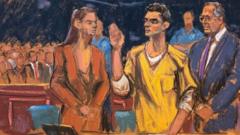
Luigi Mangione pleaded guilty in a Manhattan federal courtroom to charges stemming from the 2024 killing of UnitedHealthcare CEO Brian Thompson, dismantling months of legal positioning and immediately triggering a high-stakes constitutional battle over double jeopardy. Standing before U.S. District Judge Margaret Garnett, the 28-year-old defendant admitted under oath that he tracked Thompson to a Midtown hotel and shot him outside an investor conference. The open plea, entered without a negotiated agreement with prosecutors, carries a maximum sentence of life in prison. Yet the true shockwave of the hearing extended far beyond the federal admission, instantly throwing New York State's separate upcoming murder prosecution into systemic chaos.
The confession was delivered with chilling clarity. Speaking quickly enough that the presiding judge asked him to moderate his pace, Mangione detailed how he posed as an investor via email to extract schedule details for the corporate gathering. He utilized a 3D-printed firearm equipped with a silencer. He acknowledged that his actions were illegal and designed to inflict fear of death or serious injury.
“I shot Mr. Thompson, and he died,” Mangione told the court.
For the legal observers who packed the room, the confession marked a sudden pivot. For months, defense attorneys had signaled intent to fight the charges, pointing to complex psychiatric dimensions and challenging the foundational evidence recovered from a backpack in Central Park. The erosion of those defenses, accelerated by judicial rulings that allowed the ballistic and notebook evidence while stripping away the federal death penalty option, narrowed the strategic horizon for the defense team. By choosing an open plea, Mangione bypassed a lengthy federal trial while retaining a specific legal card to play against the state of New York.
The Double Jeopardy Gambit
Minutes after the federal proceeding concluded, defense counsel Karen Friedman Agnifilo dropped a procedural bombshell. The team filed an immediate motion in New York state court demanding the outright dismissal of the pending state murder case. The core argument rests on aggressive application of double jeopardy protections, asserting that the federal stalking charges and the state murder counts derive from the identical underlying conduct.
State prosecutors now face an acute dilemma. Earlier court filings from the Manhattan District Attorney's office explicitly acknowledged that a federal guilty plea could jeopardize a separate state prosecution. While New York law permits dual sovereignty prosecutions under specific statutory frameworks, the local protections can operate more broadly than federal minimums. Legal scholars note that trying Mangione in state court for the murder after he has already been convicted federally for the lethal outcome of the stalking operation invites a severe appellate gauntlet.
The Manhattan District Attorney's office responded to the defense motion by stating they are fully prepared to litigate. They remain anchored to the objective of securing a state-level conviction, regardless of the federal entanglement. However, the calculus inside the prosecutor's office has shifted. A trial that was projected to mesmerize the public next month now sits on shaky legal ground, hostage to complex motions regarding the constitutional limits of punishing a defendant twice for the same bullets fired on a Manhattan sidewalk.
The Anatomy of a Public Divide
Outside the courthouse, the atmospheric tension reflected a broader cultural fracture. The case has spent over a year acting as a lightning rod for deep-seated public fury directed at the American health insurance apparatus. Chants and demonstrations outside previous hearings featured protesters adopting elements of pop culture iconography to voice systemic grievances.
Defense statements touched directly on these grievances, noting that Mangione endured years of severe physical pain following a back injury and perceived the corporate medical bureaucracy as an insurmountable barrier. The legal team framed his descent as a reaction to systemic institutional failure.
Conversely, representatives and family members of the victim presented a starkly contrasting reality to the court. Representatives for Brian Thompson emphasized that no personal grievance justifies cold-blooded violence. In statements delivered following the hearing, the family expressed gratitude that the federal machinery held an accountable party responsible, urging the judiciary to apply a penalty that mirrors the irrevocable nature of the crime.
Judge Garnett scheduled the federal sentencing hearing for December 18. The federal system requires inmates to serve a minimum of 85 percent of their sentence without the possibility of traditional parole, meaning Mangione faces decades behind bars even if state charges are ultimately dismissed or barred by procedural hurdles.
The confession closes the investigative chapter on how the midtown shooting was executed, yet it leaves the structural integrity of New York's criminal docket hanging in the balance. The state courts must now decide whether the federal guilty plea acts as an impenetrable shield against further prosecution.