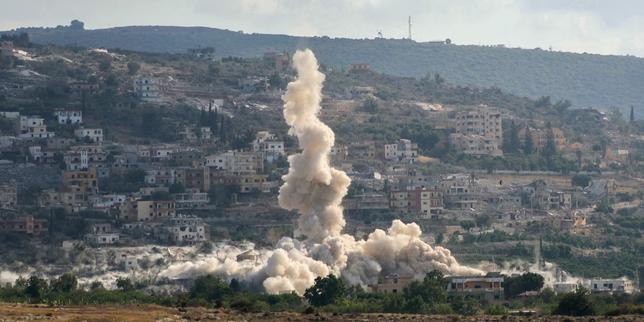
Fresh Israeli strikes across southern Lebanon have left at least four dead and dozens wounded, piercing what remained of a fragile regional ceasefire and signaling a dangerous escalation in a long-standing border conflict. These latest bombardments, triggered according to military statements by prior drone incursions, demonstrate how quickly a localized flare-up can destabilize an entire front. The human toll continues to mount in rural towns and border communities, where families find themselves trapped in the crossfire of high-tech aerial warfare and asymmetric retaliation. Understanding why these flashpoints persist requires looking past daily casualty reports and examining the structural mechanics driving the violence.
The Mechanics of Escalation
Modern military engagements along the Blue Line rarely begin in a vacuum. A single drone launch or cross-border rocket volley functions as the spark, but the dry tinder has been accumulating for years. Intelligence briefings point to a tit-for-tat tactical doctrine where deterrence relies entirely on disproportionate response. When the Israel Defense Forces initiate airstrikes following localized provocations, the strategic objective extends beyond immediate force protection. Command structures seek to degrade command nodes, push adversary units away from sovereign borders, and re-establish a psychological deterrent.
Yet, this logic contains a profound structural flaw. Every civilian casualty, every flattened apartment block in southern Lebanon, hardens local sentiment and refills the recruitment pools for militant organizations like Hezbollah. The kinetic efficiency of a precision airstrike does not translate into political stability. Instead, it deepens an ongoing cycle of mutual exhaustion where neither side can achieve decisive victory, yet both retain the capacity to inflict catastrophic regional damage.
The Regional Shockwaves
Beyond the immediate theater of operations, these strikes send tremors through financial markets, diplomatic channels, and neighboring states already teetering on the edge of collapse. Lebanon remains a state caught in institutional paralysis, grappling with economic insolvency, a hollowed-out currency, and a government incapable of enforcing a monopoly on the use of force. When the south burns, the economic fallout swallows what little commerce remains in Beirut and the Bekaa Valley.
International mediators find themselves running in place. Diplomatic channels churn out endless communiques urging restraint, but these appeals ring hollow against the backdrop of active radar locks and inbound munitions. Foreign ministries issue repetitive warnings to their citizens to evacuate while windows of commercial transit remain open, acknowledging privately that de-escalation mechanisms have broken down entirely.
Life Under the Flight Path
On the ground, the reality is measured in dust, sirens, and the terrifying hum of unmanned aerial vehicles overhead. Villages that once thrived on seasonal agriculture and remittances from expatriate workers now look like ghost towns. Those who remain are predominantly the elderly or the impoverished, individuals lacking the financial means to relocate north toward the capital or further up the coast.
Consider a hypothetical town located five kilometers from the northern Israeli border. In peacetime, olive harvesting defined the rhythm of autumn. Today, farmers calculate the risk of stepping into an orchard against the certainty of financial ruin if they abandon their crop. Artillery shells and air-dropped ordnance do not discriminate between combatant infrastructure and civilian livelihoods. Every crater dug into a village square represents another severed tie to the land, ensuring that even if a lasting diplomatic settlement were somehow brokered tomorrow, the social fabric of the borderlands would take generations to repair.
The Strategic Dead End
Military analysts looking at the current disposition of forces see an intractable strategic deadlock. The southern border of Lebanon has transformed into a testing ground for next-generation electronic warfare, loitering munitions, and underground tunnel networks. Neither side possesses the political mandate or the appetite for a full-scale ground invasion of the magnitude seen in past decades, yet both are trapped in a doctrine of perpetual readiness.
Deterrence has failed as a concept because the thresholds for acceptable pain have shifted upward on both sides. What was once considered an intolerable escalation is now absorbed as routine operational noise. Until political actors find a mechanism to address the root grievances governing sovereignty, security guarantees, and territorial integrity, these sporadic bursts of lethal violence will remain the defining characteristic of the frontier. The smoke rising over southern Lebanon is not an aberration; it is the permanent status quo