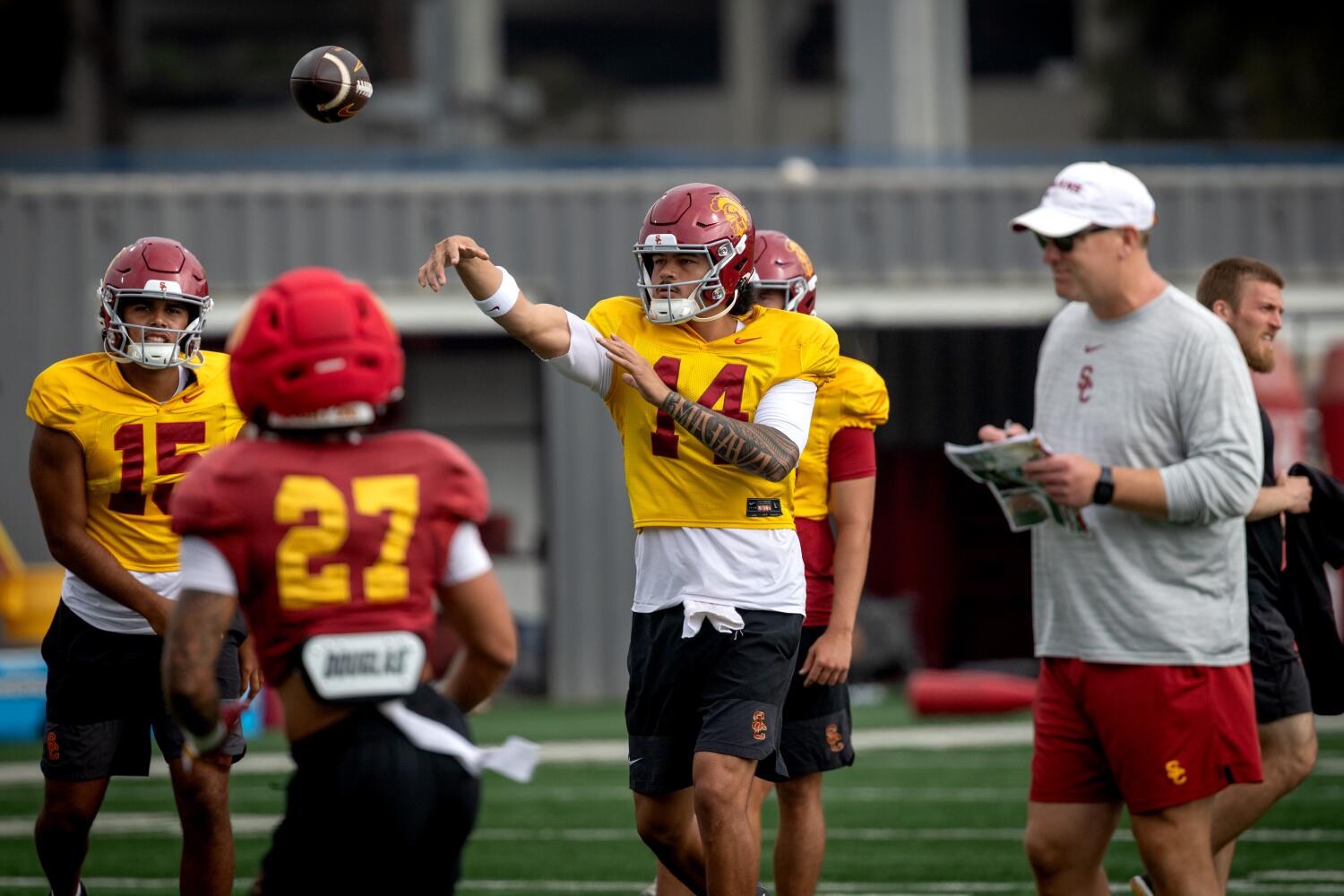
Quarterback Jayden Maiava enters his third season at USC facing a pressure cooker entirely of his own construction. When a signal-caller throws for 3,711 yards and 24 touchdowns while absorbing the physical toll of 54 rushing attempts, the national media stops treating him as a promising transfer project. They start treating him like a referendum on a program's ceiling.
Yet the most compelling evolution surrounding Maiava heading into the 2026 college football season is not his arm angle, his footwork, or his placement on preseason watch lists. It is his vocal presence. For a player who once operated primarily within the quiet intensity of Lincoln Riley’s complex offensive schemes, finding a commanding auditory footprint has become the single most vital variable for the Trojans' pursuit of the College Football Playoff.
To understand why this shift matters, you have to look past the box scores from last fall.
The Anatomy of Quiet Leadership
College football quarterbacks are conditioned to be seen and not heard until they earn the right to command the room. Maiava arrived in Los Angeles via UNLV with immense physical traits, standing 6-foot-4 and packing 225 pounds of dense frame, but he initially deferred to veterans and quiet execution.
That approach worked during flashes of brilliance, but it also contributed to operational friction during high-stakes road environments and tight losses. When things break down in the trenches—such as when a projected starter goes down with injury during fall camp—an offense cannot rely purely on chalkboard execution. It needs a field general who dictates terms.
- Vocal authority sets the emotional temperature of an entire roster during chaotic fourth quarters.
- Pre-snap communication minimizes destructive penalties that stall drives against elite defensive fronts.
- Accountability in the huddle transforms a collection of talented athletes into a cohesive unit.
Maiava spent the offseason recognizing this exact deficiency. He is no longer waiting for permission to direct traffic. By stepping up at Big Ten Media Days and speaking with unvarnished candor about the program's trajectory, he signaled a psychological shift. He is matching his physical output with vocal dominance.
Decoding the Riley System Dynamics
Lincoln Riley demands absolute precision from his quarterbacks. The offense relies heavily on rhythmic timing, anticipatory throws, and rapid post-snap diagnostics. Maiava proved he could handle the mechanical requirements last year, finishing among the nation's elite in passing yardage.
However, raw production masks situational breakdowns. Turnovers in critical windows cost USC crucial games against conference opponents last season, keeping them just outside the elite tier. These errors typically stem from a fractional miscommunication between the passer and a shifting supporting cast of pass-catchers.
When a quarterback actively uses his voice to organize protections, clarify hot routes, and challenge teammates during practice, those margins for error shrink. Maiava’s willingness to hold himself and his peers to a higher standard represents the maturation required to elevate an explosive offense into a championship machine.
The Burden of Expectation
Comparisons to former USC greats are an unavoidable tax for any quarterback who steps onto Howard Jones Field. Analysts and opposing coaches routinely drop names like Caleb Williams when evaluating Maiava’s dual-threat capacity and resilience under a heavy pass rush.
Those comparisons are both unfair and analytically lazy. Maiava operates with a different physical temperament and a different supporting infrastructure, particularly with defensive coordinator Gary Patterson shoring up the other side of the ball.
The real burden is not living up to a ghost from a previous roster. The burden is converting immense statistical output into definitive victories against heavyweight competition when the lights burn brightest.
If Maiava’s voice carries the same weight in crunch-time huddles as his arm does on deep vertical routes, the Trojans will finally bridge the gap between preseason hype and postseason hardware. The silence is officially over.