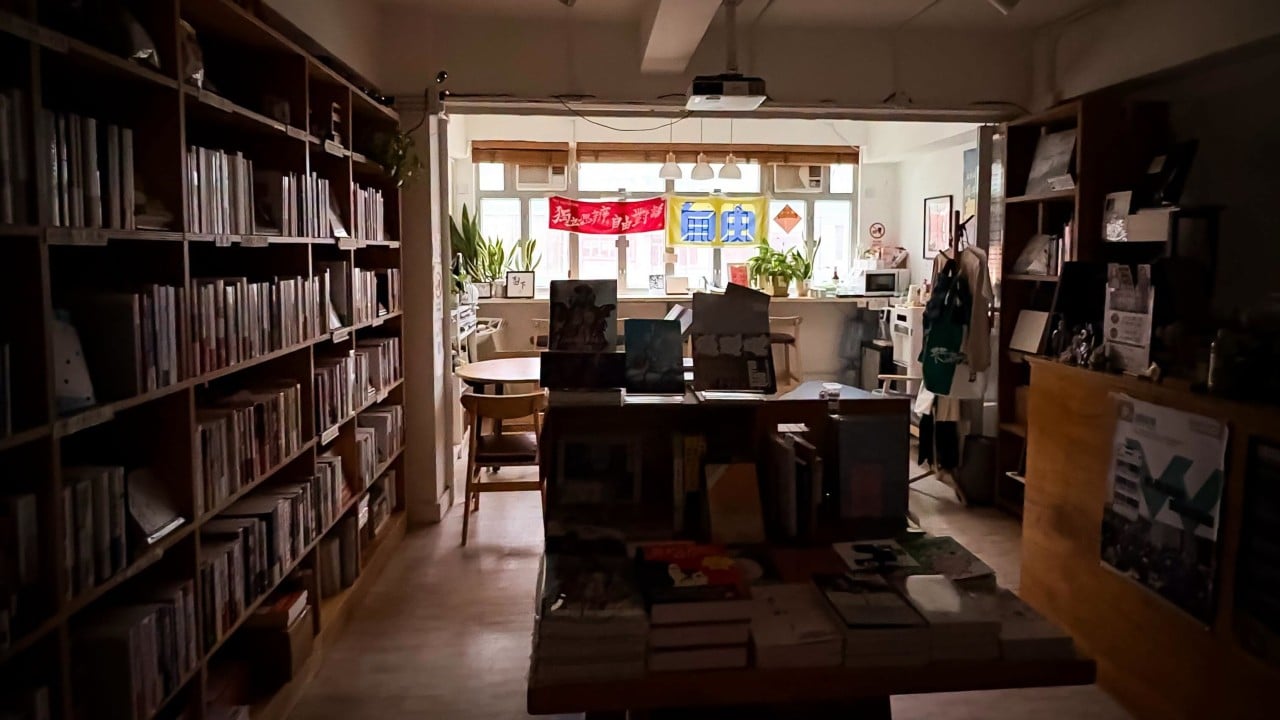
The recent national security raids on Hong Kong independent bookstores—resulting in multiple arrests of shop owners and staff—are not merely a localized crackdown on dissent. They represent the final phase of a highly organized, bureaucratic restructuring of the city's literary infrastructure. By targeting the last remaining spaces for independent thought under the city’s domestic national security legislation, known as Article 23, authorities have shifted from high-profile political arrests to a grinding war of attrition against small business logistics.
This is no longer just about public protest. It is about control over the physical supply chain of written words. The targeting of spaces like Hunter Bookstore, Book Punch, Have A Nice Stay, and Greenfield Bookstore exposes a systematic effort to eliminate "soft resistance" by making the day-to-day operation of a non-sanctioned bookstore financially, legally, and logistically impossible.
The Logistical Squeeze Replacing the Visible Crackdown
The public sees the dramatic afternoon raids. Masked officers carrying blue plastic crates out of commercial buildings in Mong Kok and Sham Shui Po dominate the headlines. What remains invisible is the long-term administrative pressure that precedes these spectacles.
Before national security police arrested Leticia Wong of Hunter Bookstore or Pong Yat-ming of Book Punch, their establishments were subjected to an unceasing barrage of bureaucratic inspections. Wong noted that authorities conducted regulatory actions involving her shop nearly a hundred times over a three-year period. These were not high-level national security interrogations. They were routine tax audits, building safety checks, fire code inspections, and labor department visits.
This tactic serves a dual purpose. It drains the limited financial reserves of independent shop owners through administrative fines, and it creates a permanent state of psychological weariness. When courts fined Book Punch for minor permit violations regarding community Spanish classes and comedy shows, the message was clear. The state does not need to prove a grand treasonous conspiracy to shut a bookstore down; it can simply make the business model unviable through municipal code enforcement.
The Weaponization of the Customs Border
The legal mechanism driving the latest wave of bookstore arrests relies heavily on an expanded definition of "seditious publications" under the Safeguarding National Security Ordinance. The operational reality of this law relies on a tightening loop between the Customs and Excise Department and the National Security Department.
Recent enforcement actions reveal that the process often begins far from the retail counter. Customs officials intercept incoming cargo shipments from overseas—specifically tracking books published in Taiwan or Western nations. Once a text like Mark Clifford's The Troublemaker, a biography of jailed media tycoon Jimmy Lai, or critical sociological texts regarding mainland governance are identified in a commercial shipment, the trap is set.
[Overseas Publisher] ➔ [Customs Interception/Flagging] ➔ [Controlled Delivery/Observation] ➔ [National Security Raid]
Under current amendments, customs officers possess summary powers to seize items deemed to possess seditious intent without needing an immediate arrest warrant. The subsequent police raids on retail shops are the culmination of a controlled delivery process, where the mere act of receiving and displaying the imported publication constitutes an offense. This shifts the burden of legal compliance entirely onto the retailer. A bookseller must guess whether an imported title will cross the invisible, constantly shifting red line of state tolerance.
Market Consolidation and the De Facto Ban List
While international observers focus on the concept of banned books, the Hong Kong government has repeatedly stated that freedom of speech is legally protected. In practice, the administration achieves its goals through market exclusion rather than explicit, published blocklists.
The annual Hong Kong Book Fair, organized by the Trade Development Council, was historically the primary revenue driver for independent publishers and booksellers. In recent cycles, long-standing independent operators like Elmbook and Luckwin Bookstore were abruptly disqualified from participating without formal explanation. Denied access to the city’s largest literary market, these businesses face severe structural deficits. Elmbook subsequently announced its planned closure, illustrating how exclusion accomplishes what a formal ban would make too controversial.
Concurrently, state-backed entities maintain a dominant position over the city's retail landscape. Through shell companies and direct ownership, mainland-controlled conglomerates command over 80 percent of Hong Kong's commercial publishing and distribution market. Independent bookstores are not just fighting political pressure; they are competing against a state-subsidized near-monopoly that controls the logistics hubs, the prime real estate, and the distribution networks.
The Illusion of Financial Sovereignty
A critical and under-reported aspect of the mid-2026 arrests is the introduction of money laundering charges against booksellers alongside traditional national security counts. When police arrested the operators of Hunter Bookstore, they formally accused them of violating the Organized and Serious Crimes Ordinance by receiving remittances from foreign organizations.
By framing book sales, cultural talks, or international crowd-funding as illicit financial transactions, the state effectively cuts off these shops from global support networks. It transforms a debate over freedom of expression into a criminal asset investigation. For an independent business, a money laundering investigation means frozen bank accounts, seized point-of-sale systems, and the immediate termination of merchant services. Even if an owner is later released on bail, their business is functionally strangled because they can no longer process digital payments or pay suppliers.
The Strategic Shift to the Micro Scale
The suppression of independent bookstores marks the end of Hong Kong's era of open cultural autonomy. When public squares, newspapers, and legislative chambers are cleared of opposition, the micro-spaces of the city become the final battlegrounds.
A bookshop occupying a tiny second-floor walk-up in Mong Kok is no threat to state security in a military sense. It is, however, an uncontrolled node where citizens can gather, exchange alternative histories, and maintain a shared cultural identity outside of state sanction. The relentless enforcement of Article 23 against these small retail businesses proves that the modern state views the distribution of an unapproved biography or a collection of political cartoons with the exact same severity as an armed insurrection. The objective is absolute uniformity, achieved one bookshelf at a time.
:max_bytes(150000):strip_icc():focal(749x0:751x2)/auschwitz-2-691cb034ee9e43cfa45a0969012c6337.jpg)