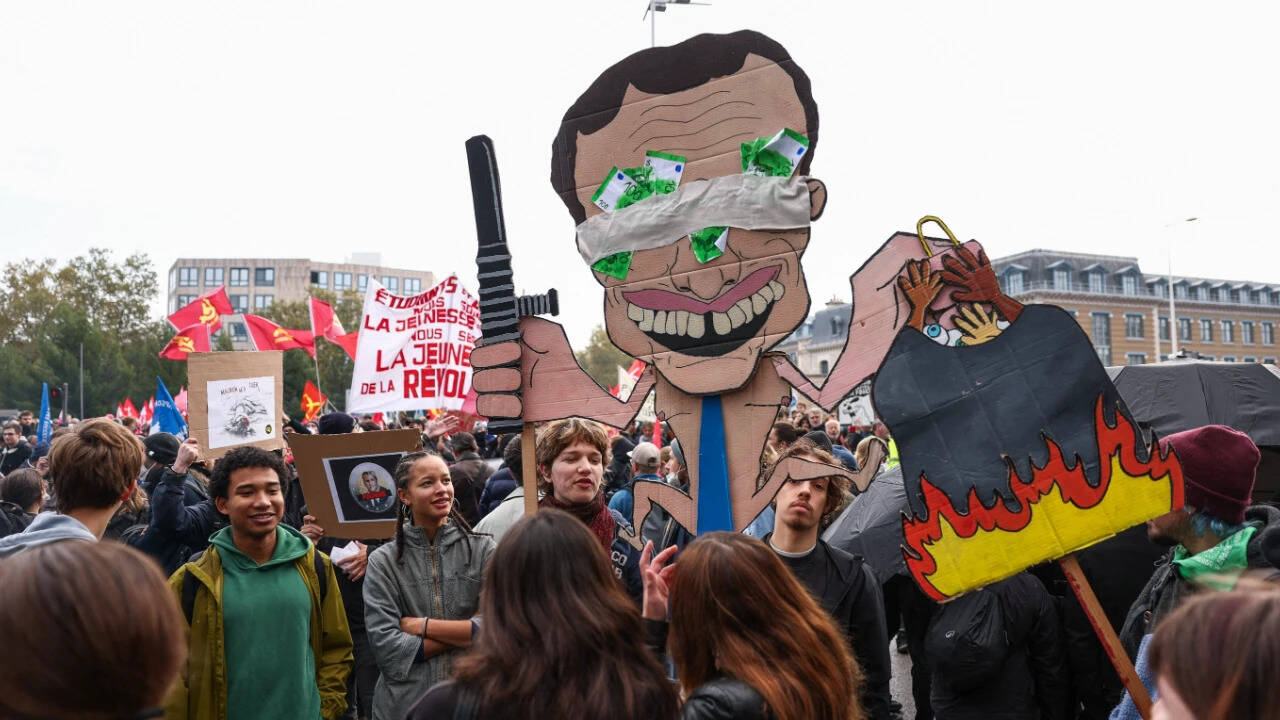
France has mobilized 70,000 police officers and gendarmes across the country ahead of fresh nationwide protests, a massive security deployment designed to contain demonstrations before they can paralyze urban centers or fracture into property destruction. When the French Interior Ministry puts seventy thousand uniformed personnel on the streets, it is doing far more than managing crowd flow. It is executing a calculated doctrine of preemptive saturation that reveals deep anxiety inside the state apparatus about the volatility of modern French street politics and the fragile legitimacy of its crowd-control apparatus.
Numbers tell the story first. Seventy thousand officers represents a staggering logistical commitment for a peacetime European democracy, pulling personnel from regional precincts, motorway patrols, and administrative posts to reinforce specialized riot units in Paris, Lyon, Marseille, Nantes, and Rennes. This level of mobilization has become a recurring reflex in France whenever labor unions, grassroots collectives, or political movements call for national days of action.
Yet the sheer scale of the deployment masks a critical operational reality. Having tens of thousands of bodies in riot gear does not automatically translate into effective public order. In fact, veteran commanders and civil liberties observers alike point out that massive, static deployments often expose the very weaknesses they are meant to hide.
The Anatomy of a Mass Mobilization
To understand what a 70,000-strong security footprint actually looks like on the ground, you have to strip away the headline figure and examine the chain of command. France operates a dual policing system that splits territorial responsibility between the Police Nationale, which oversees major cities and urban areas, and the Gendarmerie Nationale, a military force responsible for rural zones, smaller towns, and critical infrastructure. During major national protests, the Interior Ministry fuses these two distinct bureaucracies into a single operational grid.
At the tip of the spear sit the specialized mobile units. These are the Compagnies Républicaines de Sécurité (CRS) on the police side and the Escadrons de Gendarmerie Mobile (EGM) on the military side. Unlike regular beat cops, these units live and train together in barracks, rotating across the country on multi-week deployments. They carry the heavy protective gear, the tear gas launchers, and the institutional memory of decades of French street confrontations.
Behind them, however, lies a much thinner bench. When the government announces a deployment of 70,000 personnel, the bulk of that number consists of regular departmental police officers, traffic units, and plainclothes intelligence spotters pulled off their daily routines.
This creates an immediate operational strain. Pulling thousands of local officers into protest duty leaves suburban precincts understaffed and delays routine criminal investigations. More importantly, regular officers lack the collective unit cohesion and specialized de-escalation training of the CRS or Mobile Gendarmes. When tensions spike on a boulevard in Bordeaux or a square in Paris, putting under-trained personnel on a static police line increases the risk of panic, miscommunication, and disproportionate force.
The Intelligence Pre-Emption Game
Long before the first banner is unfurled at Place de la République or the Vieux-Port, the real battle takes place in the intelligence rooms of the Service Central du Renseignement Territorial (SCRT) and the Paris Police Prefecture. Modern French protest policing relies heavily on predictive mapping. Analysts track encrypted messaging channels, monitor union bus bookings from provincial towns, and cross-reference known activist networks to estimate turnout down to the neighborhood level.
Based on these assessments, prefects issue sweeping administrative decrees in the twenty-four hours preceding a demonstration. These decrees typically establish protection perimeters around government buildings, luxury retail corridors, and transit hubs. Within these zones, officers gain expanded powers to conduct bag searches, verify identities, and confiscate anything that could remotely serve as a projectile or protective mask.
Prefects also routinely ban protests outright in sensitive districts, forcing organizers onto predetermined, easily kettled boulevards. The goal is simple. By controlling the geography of dissent before a single protester leaves home, the state aims to box in volatile elements and prevent the kind of fast-moving, decentralized marches that overwhelmed Paris during the height of the Yellow Vest movement.
Why France Keeps Reaching for the Riot Shield
If you zoom out from the tactical maps, a broader structural question emerges. Why does France, more than almost any other Western European nation, repeatedly find itself deploying army-sized security forces to manage domestic political expression?
The answer lies in a collision between a hyper-centralized executive branch and a deeply ingrained culture of street politics. In countries like Germany or the Netherlands, labor disputes and policy battles are routinely absorbed through protracted institutional negotiations, coalition compromises, and decentralized regional governance. France works differently. The Fifth Republic concentrates immense power in the presidency, often allowing the government to push through sweeping economic or social reforms with minimal parliamentary friction.
When institutional channels feel sealed off, the street becomes the primary arena of political negotiation. For French unions and grassroots movements, a massive street turnout is not merely a symbolic gesture. It is a direct test of strength intended to force the government into retreat.
Successive French administrations have responded to this dynamic by treating large-scale protests less as a democratic safety valve and more as an existential threat to state authority. Every broken bank window or burning barricade is broadcast globally in high definition, creating intense political pressure on the Interior Minister to project absolute control. The result is an arms race of escalation. Organizers push for maximum disruption to prove their relevance, while the state responds with overwhelming numerical force to prove its resolve.
The Fatigue Factor Inside the Ranks
Behind the stoic lines of riot shields and helmets, France's security forces are dealing with severe institutional exhaustion. A 70,000-officer mobilization does not happen in a vacuum. It lands on top of an already punishing operational calendar that includes permanent counter-terrorism patrols under Operation Sentinelle, border enforcement duties, and major international security commitments.
Union representatives within the police ranks have repeatedly warned that mobile units are spending upwards of two hundred days a year away from their home barracks. When CRS squadrons are constantly bounced from one national emergency to the next, training cycles collapse. Officers do not get adequate rest, equipment maintenance falls behind, and morale erodes.
Fatigue is a silent catalyst for street violence. An exhausted officer standing in heavy Kevlar for twelve hours in cold rain or stifling heat has a significantly lower threshold for stress. Decision-making narrows. Verbal de-escalation gives way to rigid compliance demands. When a small group of black-clad agitators begins hurling paving stones or fireworks at an exhausted police line, the likelihood of an uncoordinated baton charge or indiscriminate tear gas deployment rises sharply.
The Evolution of French Crowd Control Tactics
To understand why French protests frequently look like low-intensity urban warfare compared to demonstrations in London or Berlin, you have to look at the doctrine governing how police engage crowds. For decades, French policing relied on a strategy of maintien de l'ordre (maintenance of public order) built around strict physical separation. Mobile units held wide, disciplined lines, absorbing projectiles behind heavy shields while keeping a safe distance from demonstrators.
That doctrine fractured over the past decade. Confronted with agile, loosely organized groups of militant protesters—often referred to as black blocs—who embed themselves inside peaceful union marches to smash corporate storefronts and attack police lines, the Interior Ministry shifted toward a much more aggressive posture.
The Rise of Mobile Intervention Units
The centerpiece of this shift was the creation and expansion of motorized, fast-strike squads such as the Brigades de Répression de l'Action Violente Motorisées (BRAV-M) in Paris. Operating in pairs on motorcycles, these units are designed to dart rapidly through crowds, disperse violent clusters, and make immediate arrests before agitators can melt back into the main march.
Proponents inside the police hierarchy argue that traditional, slow-moving CRS formations are ill-equipped to catch modern street militants who use encrypted apps to coordinate hit-and-run vandalism. From a purely tactical standpoint, mobile squads deny agitators the time and space needed to build barricades or loot storefronts.
Critics, including human rights monitors from the Council of Europe and France's own independent rights defender, argue that this shift has blurred the line between riot control and aggressive anti-crime policing. When units trained for rapid, high-adrenaline arrests in housing projects are dropped into the middle of a political demonstration, the results can be chaotic. Peaceful marchers, journalists, and legal observers frequently get caught in sudden sweeps, fueling public anger and feeding the very cycle of resentment that draws more people into the streets.
Controversial Less-Lethal Weaponry
France's tactical posture is also defined by its reliance on specialized weaponry that many neighboring European police forces refuse to deploy in crowd settings. Chief among these is the Lanceur de Balles de Défense (LBD), a shoulder-fired launcher that shoots 40mm hard rubber projectiles, alongside explosive sting-ball grenades used to disperse dense crowds.
Police commanders defend these tools as essential intermediate measures that allow officers to repel violent attackers without resorting to lethal firearms or dangerous hand-to-hand melee combat. Yet medical researchers and judicial inquiries have documented severe injuries—including permanent eye damage and cranial trauma—resulting from LBD impacts during chaotic street clashes.
Every time a major mobilization of 70,000 officers is announced, debates over these weapons immediately resurface. For many citizens, the sight of heavily armored squads wielding launchers reinforces the perception that the state views its own electorate as an adversary to be subdued rather than a public to be protected.
What the Headlines Miss About Protest Economics and Logistics
Media coverage of massive French protest deployments naturally gravitates toward dramatic visuals of smoke-filled boulevards and lines of armored vans. What rarely makes the evening broadcast is the quiet, enormous economic and logistical machinery grinding away behind the scenes.
Deploying 70,000 personnel requires requisitioning thousands of hotel rooms across regional hubs, arranging mobile catering operations capable of feeding tens of thousands of officers on shift, and burning through massive reserves of fuel and overtime budgets. A single weekend of nationwide maximum mobilization costs the French treasury millions of euros in direct operational expenses alone.
At the same time, the preventative lockdowns enforced by these deployments inflict a heavy indirect toll on urban economies. When prefects order the closure of major metro stations, shut down bus routes, and advise retail stores along historic boulevards to board up their windows with plywood, commercial activity grinds to a halt. Restaurant bookings evaporate. Tourists cancel museum visits. Small business owners absorb thousands of euros in lost revenue even in cities where not a single window is broken.
The Asymmetric Cost of Disruption
This dynamic hands protest organizers a powerful strategic advantage. Simply by issuing a credible call for a nationwide day of action, unions and activist networks force the state into an expensive, high-visibility defensive crouch. Even if turnout falls short of expectations, the sight of 70,000 officers locking down city centers validates the organizers' narrative that the government is isolated and fearful of popular anger.
Conversely, if the state scales back its deployment to save money and avoid looking heavy-handed, and a small radical faction manages to torch a historic building or ransack a luxury shopping district, the political fallout for the government is immediate and devastating. Caught between these two traps, French officials almost always choose maximum force.
The Thin Line Between Order and Escalation
Managing a massive street protest in a democracy requires an extraordinarily delicate balance. Police commanders must protect the constitutional right to peaceful assembly while simultaneously fulfilling their duty to prevent arson, looting, and physical assaults on emergency workers.
When 70,000 officers take their positions across France, the outcome of the day rarely hinges on the grand strategic pronouncements coming out of Paris. It depends on micro-decisions made at chaotic intersections by mid-level commanders on the ground.
A single prefect choosing to open an exit corridor rather than trapping a restless crowd in a tight kettle can defuse hours of tension in minutes. A squadron leader holding fire when a few bottles fly from the back of a crowd can prevent a peaceful union march from turning into a pitched battle. On the other hand, a misjudged tear gas volley fired into a dense, slow-moving crowd of families and retirees can instantly radicalize hundreds of bystanders.
France's reliance on massive security deployments reveals a nation locked in a stubborn political stalemate. Seventy thousand officers can secure government ministries, clear barricades from major intersections, and keep the arteries of the republic open for another twenty-four hours, yet no amount of riot gear can resolve the underlying social and political fractures driving people into the streets in the first place.


