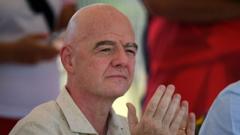
Premier League chief executive Richard Masters has publicly accused FIFA president Gianni Infantino of pressing the self-destruct button over a failed scheme to sell minority stakes in tournament assets to private equity investors. The explosive confrontation, delivered via a series of sharp statements to public broadcasters, exposes a deeper governance fracture within world football. FIFA finds itself isolated as European powerhouses, led by UEFA and England's Football Association, push back against what they categorize as a profound breach of trust over the administration of the World Cup.
The friction centers on a foundational ideological battleground. For decades, international sports governing bodies operated under a non-profit paradigm where mega-events like the World Cup were held in trust for the global development of the game. Infantino's financial maneuverings sought to monetize these crown jewels by introducing private capital into tournament structures.
Masters made no attempt to soften his assessment. He characterized the failed equity play as a entirely self-inflicted wound.
The Anatomy of a Governance Breakdown
To understand how global football reached this precipice, one must examine the mechanics of modern sports administration. FIFA operates as an association registered under Swiss law, ostensibly bound to reinvest revenues back into member associations. Yet, under successive leadership paradigms, the organization has aggressively expanded commercial operations, culminating in the bloated, 48-team men's tournament model.
Expanding tournaments requires massive capital injection. Infrastructure demands, security costs, and administrative bloat strain even FIFA's vast balance sheet. Private investment firms spotted an opening. They offered liquidity in exchange for equity yields tied directly to tournament revenues.
When details leaked regarding the proposed sell-off of tournament stakes to private financiers, internal resistance flared. Kevin Lamour, serving as FIFA chief operating officer, broke ranks and released a scathing statement claiming the administration had been misled about the true scope of the financial proposals. Lamour's subsequent departure from the organization triggered immediate condemnation across European football corridors.
UEFA executives seized on the administrative chaos. Member associations that previously tolerated Infantino's centralized style suddenly found common cause. The English Football Association formally withdrew its backing, signaling a major shift in diplomatic alignment. Israel and other European constituents swiftly followed suit, isolating the presidency in Zurich.
Financial Realities and Private Equity Ambitions
Private equity in sports is not inherently nefarious. Formula One, various European domestic leagues, and franchise systems across North America routinely utilize external capital to accelerate growth, upgrade broadcast technology, and expand global footprints.
Football operates under a different social contract. National associations view the World Cup as public property belonging to the global sporting public rather than a corporate asset class. Selling a slice of the tournament equity creates structural conflicts of interest. Private investors demand predictable, maximized returns. That pressure inevitably influences scheduling, tournament frequency, and host nation requirements, subordinating sporting merit to shareholder dividends.
Masters emphasized this exact distinction during his remarks. A governing body acting as a custodian cannot monetize its primary trust without fundamentally altering its moral authority.
[Traditional Model] ---> Non-Profit Custodianship ---> Reinvestment in Grassroots
[Proposed Model]    ---> Private Equity Stake   ---> Shareholder Yield Demands
The stark contrast between these operating models defines the current civil war. FIFA's leadership miscalculated the appetite of domestic leagues and continental federations to swallow corporate restructuring disguised as modernization.
The Succession Battle Ahead
With Infantino fighting to secure his political survival ahead of upcoming re-election cycles, the opposition is organizing. European stakeholders are actively grooming alternative leadership candidates.
Any viable challenger must center their platform on sweeping governance reform. The concentration of executive power within the presidency has left the organization vulnerable to unilateral decision-making. Observers within European sporting circles argue that decentralizing authority and restoring transparent oversight are prerequisites for restoring institutional credibility.
The fallout from the aborted equity plan reaches far beyond boardroom squabbles. It exposes the fragility of international sports administration when commercial ambition outpaces democratic accountability. Domestic leagues supply the talent, the rhythm of the global calendar, and the financial oxygen that sustains the sport's ecosystem. Alienating those leagues creates an unsustainable operational climate.
The countdown toward the next electoral cycle has begun, and the institutional damage inflicted over the tournament equity fiasco will dictate the terms of engagement for years to come. FIFA stands at a crossroads, forced to decide whether it serves as a guardian of global sport or an aggressive corporate holding company.