Federal immigration authorities are no longer just policing international borders and managing deportations. They have turned their multi-million dollar surveillance apparatus toward American citizens who openly oppose their actions. Under the banner of protecting officer safety and rooting out domestic extremism, U.S. Immigration and Customs Enforcement (ICE) has begun executing a coordinated campaign to track down, warn, and prosecute its domestic critics. This aggressive shift converts immigration enforcement into a tool for political policing, creating a severe chilling effect on constitutionally protected speech across the United States.
The operational reality of this strategy unfolded directly on the ground in New York.
David Streever, a resident of Rochester, sent an angry email to the acting director of ICE, Todd Lyons, following the fatal shooting of a protester named Renee Good by an immigration officer during a demonstration in Minnesota. Streever called Lyons a monstrous human being and predicted his political downfall. The email contained no threats of physical violence, no plans for an attack, and no unlawful directives.
Federal agents responded anyway.
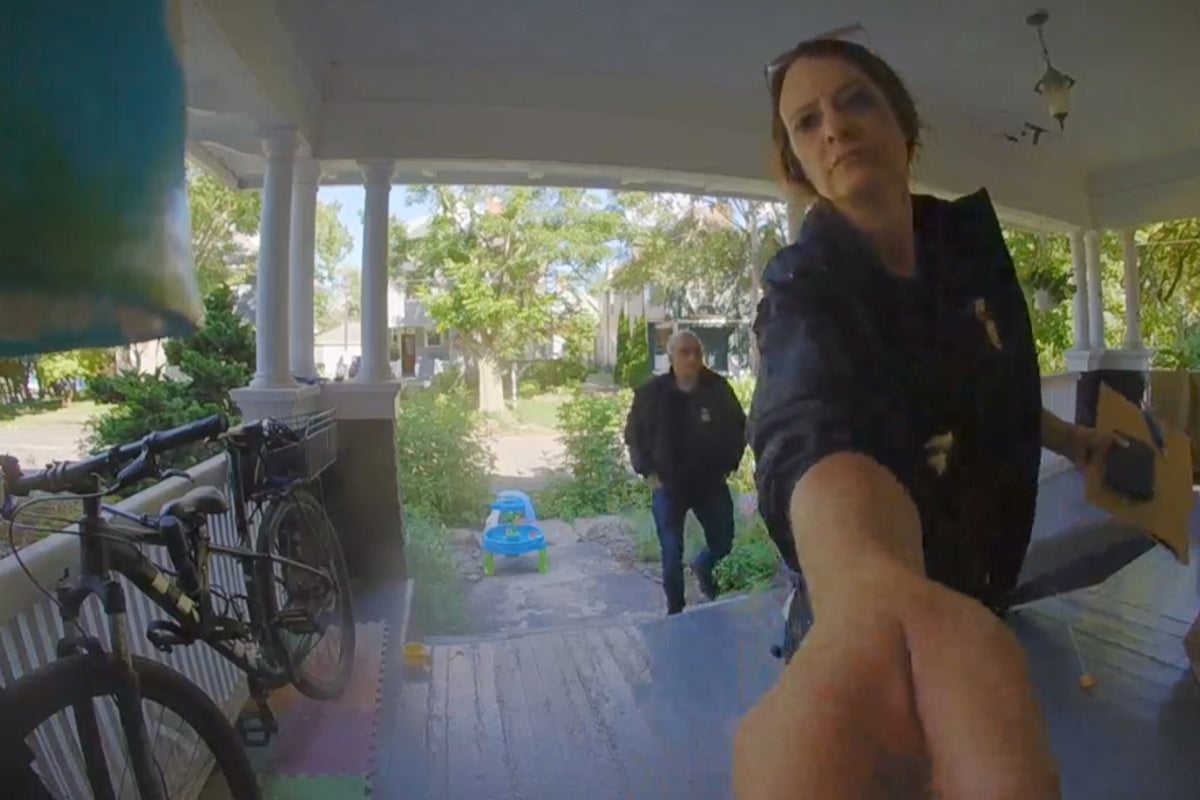
While Streever was traveling internationally, two federal officers arrived at his upstate New York home to serve his wife with an official warning notice regarding his online activity. When Streever returned to the country, federal agents tracked his movements to a hotel in New York City, attempting to confront him in person before being turned away by hotel security.
The Intimidation Tactics at the Ballot Box
The pressure campaign extends beyond private residences and hotel rooms into the core spaces of American civic life. The same week agents targeted Streever, two federal officers entered a voting location during the New York primary elections in Syracuse. Their target was Paigelynne Gonyea, a local poll worker who had published a social media post featuring a photograph of the ICE officer involved in the Minnesota shooting.
The officers confronted Gonyea directly at her workspace. They wore long coats that obscured whether they were carrying weapons, a direct confrontation that alarmed election officials given that federal law strictly prohibits the deployment of armed agents to active polling sites. Department of Homeland Security officials later defended the action, claiming Gonyea had engaged in doxxing by making the officer's information accessible online.
Civil liberties advocates view these incidents as a deliberate abuse of federal authority designed to frighten the public into silence. The First Amendment protects harsh, inflammatory, and offensive criticism of public officials. It does not protect true threats, which the Supreme Court defines as a serious expression of an intent to commit unlawful violence. By treating angry political emails and social media commentary as security threats worthy of physical deployment, the agency is redefining lawful dissent as a criminal matter.
The Millions Spent on Spy Infrastructure
This campaign does not rely on casual internet searches. It is powered by a massive procurement of advanced surveillance technology designed to map out the networks of political activists.
ICE has secured contracts worth up to $25 million for specialized spy software. These tools include social media monitoring systems, cell phone location tracking infrastructure, and remote hacking utilities. Specifically, the agency utilizes software from Penlink to monitor which mobile devices appear at protest locations, allowing analysts to build detailed profiles of targets based on their daily movements, online associations, and digital histories.
Surveillance Asset Procurement
--------------------------------------------------
Contract Value: Up to $25 million
Primary Tools: Social media scrapers, location trackers
Key Vendor Software: Penlink profiling systems
Target Profiles: Anti-ICE protesters, organizers, donors
An internal privacy impact assessment published by the agency indicated these analytics systems would track threats to the organization. However, recent enforcement actions demonstrate that the infrastructure is actively searching for political opposition rather than specific indicators of violence. The technological net captures not just the individual organizer, but the family members, friends, and digital followers linked to them.
The Minnesota Judicial Offensive
The most severe escalation is occurring within the federal court system. In Minnesota, federal prosecutors obtained a sweeping conspiracy indictment against 15 individuals who participated in demonstrations against immigration crackdowns in the Twin Cities metro region.
The government's legal strategy bypasses traditional protest charges like trespassing or failure to disperse. Instead, prosecutors are using expansive federal conspiracy statutes that require proving only an intent to impede federal agents through intimidation or non-violent blockades. The evidence underpinning these high-stakes charges consists primarily of encrypted Signal chat logs where activists discussed logistics, along with public activities that traditionally enjoy full constitutional protection.
In the indictments, prosecutors cited a defendant's choice to write an article for an anarchist blog and participation in a speaking tour as overt acts in furtherance of a criminal conspiracy. While a judge eventually dismissed charges against six individuals due to prosecutorial misconduct, other cases have proceeded to trial with devastating results. A federal judge appointed during the previous administration handed down sentences ranging from 30 to 100 years for individuals connected to the unrest.
Redefining the Nature of Domestic Terrorism
This systemic crackdown stems directly from an executive shift in how federal law enforcement defines security threats. A directive issued to federal law enforcement ordered agencies to focus investigative resources on specific ideologies deemed hostile to the state. The document explicitly listed anti-Americanism, anti-capitalism, and extremism on migration as motivational factors for domestic terrorism.
By elevating opposition to immigration policy to the level of ideological terrorism, the administration provides a bureaucratic justification for ICE to deploy its counter-terrorism apparatus against American citizens. The line separating criminal behavior from political dissent has been systematically erased.
When a citizen recognizes that an email to a public official results in federal agents arriving at their home, or that a social media post brings uninvited officers to their workplace, the calculus of public participation changes. Activists delete accounts. Organizers cancel public meetings. Neighbors choose not to record encounters between immigration enforcement and community members.
The administration has made it clear that the vast powers built to monitor international networks are now fully calibrated to police domestic speech, leaving citizens to weigh the cost of their constitutional rights against the reality of federal retaliation.