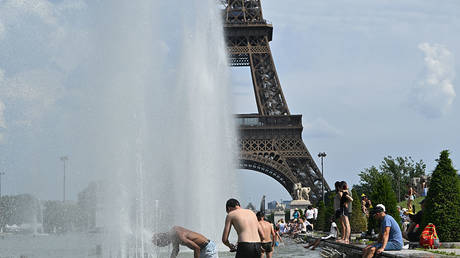
The record-shattering heatwave currently baking Western Europe, leaving hundreds dead and pushing temperatures past 111°F in places like Pissos, France, is fundamentally an infrastructure failure masquerading as a weather event. While public health officials rightly focus on vulnerable populations and rising casualty counts, the underlying emergency is structural. Europe is attempting to run a twenty-first-century digital economy on a mid-twentieth-century physical foundation that cannot handle ambient thermal stress.
The immediate toll of this June 2026 "Omega" heat dome is undeniable. Spain's MoMo monitoring system has linked over 200 deaths to the spike in temperatures. In France, dozens have drowned in desperate attempts to find cool water. Yet behind these human tragedies lies a cascading operational collapse.
When ambient temperatures surge, the entire framework of modern life begins to warp, shatter, and fail in ways that standard municipal planning completely fails to anticipate.
The Grid Fallacy
The most critical point of vulnerability is the electrical grid. The general public assumes that power outages during heatwaves are caused simply by too many people turning on air conditioners at the same time. While the surge in cooling demand is a major factor, the more dangerous reality is a steep decline in physical supply caused by the heat itself.
Power generation and transmission suffer from severe physical degradation as temperatures climb. Consider how the primary pillars of the European energy mix actually behave under thermal stress.
- Nuclear Power: Reactors do not fail from a lack of fuel; they fail from a lack of cold water. In southwestern France, EDF was forced to shut down a reactor at the Golfech nuclear power plant because the Garonne River neared its legal environmental limit of 28°C. Using water warmer than this threshold risks killing local river ecosystems. When rivers get too hot, nuclear output drops.
- Solar Photovoltaics: Solar panels require sunlight, not heat. The physical efficiency of solar cells drops dramatically once surface temperatures exceed 25°C (77°F). During a severe heatwave, a solar farm can see its power output degrade by 10% to 25% precisely when demand hits its peak.
- Underground Distribution: French energy distributor Enedis reported that underground temperatures can reach a staggering 80°C (176°F) due to a combination of baked earth and heavily loaded cables. This intense thermal environment weakens insulation, triggers transformer failures, and causes localized blackouts, such as the transformer failure that cut power to tens of thousands of homes in northwestern France.
When these factors combine with low wind speeds across the North Sea, the system operator faces a mathematically impossible equation.
Digital Vulnerability
The modern push toward full digitization has inadvertently created a massive surface area for climate risk. We have built an economy where financial transactions, supply chains, and medical records rely entirely on data centers that require an immense, unyielding supply of electricity and cooling to survive.
A striking example occurred in Ghent, Belgium, where a hospital was forced to cancel scheduled surgeries and reroute emergency patients. The reason had nothing to do with medical staff or local equipment. The facility's electronic patient record system was knocked completely offline because a central server facility in Paris overheated and failed.
When a server crashes due to a thermal spike, it is not just a temporary technical glitch. It represents a hard economic cost. Inventory systems freeze. E-commerce platforms drop orders. Digital accounting records can become corrupted. The fastest, most sophisticated microchips in the world are utterly useless if the wall outlet goes dead or the cooling unit fails.
The Air Conditioning Divide
The human toll is also dictated by architecture and economics. Western Europe is a region where widespread residential air conditioning has historically been a luxury rather than a standard utility.
Buildings across London, Paris, and Frankfurt were specifically engineered to trap heat, featuring thick insulation and large windows designed to keep residents warm during long, damp winters. When a prolonged heat dome traps stagnant, hot air over these cities, these structures effectively turn into brick ovens.
The resulting strain on emergency services is unprecedented. The London Ambulance Service recorded its highest number of life-threatening emergencies in a single day, responding to hundreds of category-one calls for cardiac arrests and severe respiratory distress.
We are witnessing a structural mismatch. The climate has shifted permanently, but the built environment of Europe remains stubbornly fixed in the past.
The Policy Deadlock
The response from political leadership reveals a profound misunderstanding of the crisis. Governments frequently announce emergency mobilizations for healthcare systems or debate individual school closures, yet they consistently ignore the long-term capital investments required to harden physical infrastructure.
Industrial policy focuses heavily on subsidizing advanced semiconductor manufacturing and software development. But there is minimal political will focused on rebuilding smart grids, investing in distributed industrial battery storage, or upgrading cooling systems for public utilities.
A nation cannot transition to a green or digital future if its physical foundation melts under a summer sky.
The current crisis will eventually subside as the jet stream shifts and temperatures drop. But the underlying lesson remains unlearned. Until infrastructure resilience is treated with the same urgency as carbon targets or digital innovation, every passing summer will bring the same predictable, preventable collapse.