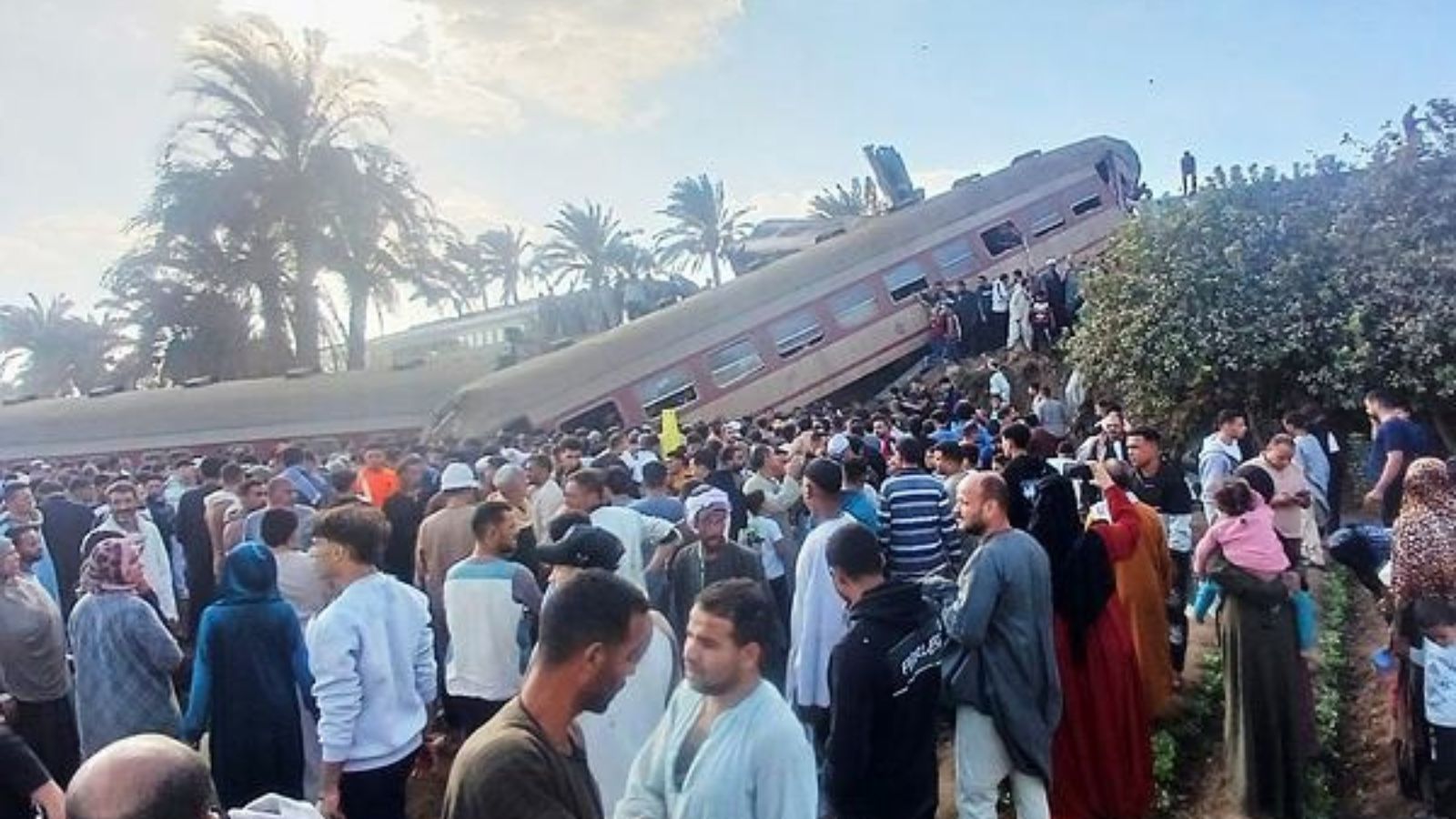
An Egypt train collision that leaves four people dead and eighty-eight injured triggers a familiar ritual in Cairo. Presidential directives fly across state wires, investigations are ordered with swift public fanfare, and ministries promise accountability before the wreckage is even cleared. Yet anyone who has covered rail transport in the Nile Delta knows that ordering a probe is rarely the same thing as fixing the tracks, the signals, or the human habits operating under relentless strain. When an Egypt train collision happens, the immediate casualties dominate the headlines, while the deeper mechanical and institutional friction behind the crash often slips out of view.
To understand why these disasters keep recurring, we have to look past the press releases and examine how an aging, high-volume network actually runs day to day. Egypt moves millions of passengers every single day across corridors that connect dense agricultural provinces, industrial hubs, and sprawling urban centers. Trains run crowded, schedules are tight, and modernization projects unfold alongside legacy infrastructure that was never designed for modern traffic density.
Why Probes Rarely Touch the Root Causes
Investigations are fast. Structural reform is slow.
When a serious rail accident occurs, officials immediately point toward technical committees, prosecutorial inquiries, or disciplinary reviews. On paper, those steps look decisive. In practice, early probes tend to focus on what can be pinned down quickly—a signal state, a driver's action, a piece of equipment—rather than the layered system pressures that set up the failure in the first place.
A crash on a busy corridor almost never comes from a single isolated mistake. It usually emerges where multiple weak points align at the exact wrong moment. A delayed maintenance window meets an overworked crew. A partially upgraded signaling stretch borders an older manual section. A passenger train shares tracks with freight or older rolling stock running on tight headways.
When an investigation stops at individual blame or immediate hardware checks, it leaves the wider operating environment untouched. Drivers and dispatchers work inside strict timelines and high-stress conditions where shortcuts sometimes become informal workarounds just to keep trains moving. Blaming a single link in that chain makes for a neat official narrative, yet it does little to make the next shift safer.
There is also a persistent gap between announcing a probe and publishing transparent, actionable findings that reach the public and the workforce. Without clear follow-through on lessons learned, the same vulnerabilities sit quietly in plain sight until another collision forces the issue back into the spotlight.
The Hidden Friction of Multi-Year Rail Modernization
Upgrades do not erase risk overnight. They often create new seams.
Over the past decade, Egypt has poured massive capital and political attention into overhauling its railway network. New locomotives, refurbished carriages, digital signaling contracts, and station renovations have reshaped parts of the system. From a distance, heavy investment looks like a straightforward cure for years of underfunding.
On the ground, large-scale modernization on a live network is a high-wire act. You cannot simply shut down an entire national artery for years while contractors rip out old relays, lay new cable, and test modern control systems. Work happens around active traffic, often in phases that leave neighboring segments operating on different technical standards.
Legacy Lines Meets New Hardware
Mixing old and new creates awkward handoffs. A train equipped with modern features or running on a newly laid stretch of track still has to interact with older stations, crossings, and communication protocols. Where one system ends and another begins, coordination depends heavily on procedure, discipline, and clear lines of authority.
Consider a hypothetical example along a busy provincial line. Suppose a stretch of track has received fresh ballast and updated signaling hardware, while an adjacent junction still relies on older control gear and manual checks during night shifts. If a schedule slips and two trains converge near that transition point under low visibility, small miscommunications can cascade fast. Even when individual workers try to follow the book, conflicting cues or legacy habits can turn a minor delay into a severe hazard.
Hardware alone cannot solve operational complexity. A brand-new signal or locomotive is only as safe as the maintenance schedule keeping it calibrated, the spare-parts supply keeping it running, and the training keeping crews sharp when routine procedures break down.
Cost and Speed Pressures on Public Transit
Affordable fares are a social lifeline. They also squeeze margins.
Rail travel in Egypt is deeply tied to everyday affordability for working families, students, and commuters who depend on low-cost transport to reach jobs and markets. Keeping fares low is a major social priority, yet it limits how much revenue the network generates directly from tickets.
When farebox revenue stays tight, capital budgets and state subsidies carry a heavier load. Every delayed shipment of parts, every deferred track renewal, and every stretch of overdue inspection carries a real cost in wear and tear. Steel rails, sleepers, brakes, and switches endure punishing loads year-round, especially on routes packed with commuters.
Human Factors on Overstretched Corridors
Machines fail. People improvise.
Spend enough time around rail operations and you start noticing how much safety rests on human judgment under pressure. Train drivers, signal operators, station masters, and maintenance technicians make hundreds of routine decisions every day. Most of the time, those decisions keep the timetable alive.
When shifts run long, equipment behaves unpredictably, or communication channels get noisy, human stamina gets tested. Fatigue narrows attention. Familiarity breeds assumptions about what the line ahead looks like. A rule written in a manual can feel disconnected from the immediate pressure to clear a platform or recover lost time.
Unofficial Crossings and Everyday Hazards
The danger is not confined to railway employees. Along many corridors, tracks cut straight through towns, farmland, and densely built neighborhoods. Where formal level crossings are spaced far apart or gates fail to deter pedestrians and drivers, informal paths appear.
Vehicles try to beat oncoming trains. Pedestrians cross while looking at phones or carrying heavy loads. Every near-miss adds psychological strain to crews who already carry heavy responsibility, and every strike disrupts schedules and endangers passengers aboard the train itself.
Why Quick Fixes Fall Short After a Crash
After a tragedy, the temptation is to reach for dramatic gestures. Officials may order sweeping inspections, suspend staff, or announce fresh targets for safety audits.
Sweeping inspections often produce long lists of defects that everyone in the system already knew existed. The harder test comes three months or six months later, when the cameras move on and routine pressures return. Safety improves steadily only when daily habits change—when maintenance crews get protected time, when dispatchers have reliable tools, and when reporting near-misses leads to system fixes rather than reflexive punishment.
Counter-Arguments and Overlooked Realities
Critics sometimes argue that recurring accidents prove modernization efforts are failing or misdirected. That view misses half the picture. Without large-scale infrastructure investment, a network carrying millions of riders on aging assets faces even steeper structural decay over time.
At the same time, defenders of big capital projects sometimes treat spending totals as proof of safety. Billions spent on new rolling stock and signaling contracts do not automatically translate into error-free operations if maintenance workflows, crew training, and track discipline lag behind.
Another overlooked factor is data transparency. When accident investigations stay opaque or technical findings are slow to circulate across the wider workforce, engineers and operators lose valuable chances to learn from close calls and system flaws. Open technical review—paired with clear accountability for management decisions, not just frontline errors—remains one of the toughest cultural shifts in any large state-backed transport system.
What Separates Real Reform from Another Probe
A probe is a starting line, not a finish line. Real safety shows up in boring, unglamorous details: consistent track geometry, reliable braking systems, clear signaling transitions, realistic crew schedules, and maintenance teams that have the tools and time to finish jobs properly before a train rolls out.
When another Egypt train collision shocks the country, the real measure of leadership is not how fast an investigation is ordered on day one. It is whether the rules, budgets, and daily practices on the tracks actually change by day one hundred.


