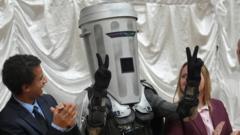
When a politician triggers an unnecessary electoral contest to prove a point, the general expectation is total vindication. Nigel Farage secured his return to Parliament for the Clacton constituency with 22,239 votes, accounting for 63.3 per cent of the ballots cast. Yet the true headline from the August 2026 contest is not the victory of the Reform UK leader. It is the startling 9,455 votes secured by a satirical candidate wearing a silver bucket on his head.
This was no ordinary parliamentary showdown. Labour, the Conservatives, the Liberal Democrats, and the Greens opted for a complete boycott, leaving the field open to an unprecedented thirty-four candidates. Among them stood Count Binface, the intergalactic alter-ego of comedian Jon Harvey. By capturing nearly twenty-seven per cent of the total vote share, the parody contender transformed a calculated political stunt into an extraordinary referendum on voter exhaustion. If you liked this piece, you should check out: this related article.
Anatomy of a Manufactured Crisis
To understand how a satirical space warrior became the official runner-up in a British parliamentary race, one must look at why the ballot took place at all. Farage resigned his seat weeks prior amid intense scrutiny surrounding an unreported financial gift. Rather than facing the parliamentary inquiry head-on without interruption, the populist leader chose to throw himself back onto the mercy of the electorate, framing the move as a direct test of popular mandate.
It was a gamble designed to project unshakeable strength. Instead, it exposed a deep fracture in local engagement. Major opposition parties recognized the exercise for what it was and refused to lend it legitimacy. By stepping away, they left a vacuum. Vacuum cleaners, trash cans, and kitchen utensils have a funny habit of filling empty spaces. For another angle on this development, check out the latest update from NPR.
Turnout plummeted to just over forty-four per cent. Thousands of constituents who had previously participated chose to stay home, sweating through the hottest day of the year while local polling stations gathered dust. Those who did show up did not merely cast protest votes; they weaponized humor.
The Mechanics of Protest Voting
Protest voting in British politics is a long-standing tradition, often embodied by the Monster Raving Loony Party. Eccentric manifestos promising the abolition of things people dislike have entertained Westminster for decades. Yet Binface represents a distinct evolution in this phenomenon. This was not just a vote against a specific party; it was an organized expression of total disillusionment with the theater of modern politics.
Campaigning under a platform featuring policies such as making the price of a crumbly croissant legally capped and ensuring Tony Pulis manages the England football team, the campaign struck a nerve. It provided a socially acceptable vehicle for serious discontent. When voters feel alienated by mainstream options and insulted by tactical resignations, a fictional alien from the Sigma 9 system starts looking like a viable conduit for frustration.
Consider the mathematics of the result. In a standard multi-party race, split opposition allows a plurality winner to coast through safely. In Clacton, the absence of the traditional center-left and center-right meant that anyone seeking an alternative to Reform UK had to choose between dozens of fringe independents or the most high-profile novelty act in the country. The consolidation behind the bin-helmeted figure was swift and merciless.
The Absence at the Count
The atmosphere at the verification center underscored the bizarre nature of the event. While the votes were being tallied, Farage declared victory from afar, ultimately choosing not to attend the physical declaration. Official explanations cited security concerns and police warnings regarding a potential disruption. Local law enforcement subsequently disputed the scale of any credible threat, leaving many to wonder if avoiding the inevitable podium photo-op alongside a man dressed as a space warlord was the true motivation.
Standing shoulder-to-shoulder with thirty-three other candidates—including representatives advocating for universal divinity and various satirical platforms—would have forced the Reform leader into a surreal tableau. Democracy often demands that victors stand side-by-side with their critics and jesters alike. Ducking that ritual diminishes the gravity of a parliamentary return.
The numbers tell a story of a diminished mandate despite the high percentage share. Comparing this contest to historical precedent highlights the difference. When high-profile politicians have triggered previous resignations over matters of principle, they typically commanded overwhelming local consensus. Securing twenty-two thousand votes in a depleted electorate where nearly ten thousand people actively backed a comedian reveals a constituency sharply divided between fervent loyalty and exasperated mockery.
Beyond the Joke
It is easy to dismiss the entire episode as a piece of silly season political theater. Newspapers love a quirky photo opportunity, and social media thrives on viral concession speeches delivered with mock-stateliness. Yet writing this off as mere entertainment misses the warning sign flashing for the political establishment.
When nearly a quarter of an electorate turns to a satirical candidate because the structural alternatives have either boycotted the process or failed to inspire, the social contract is straining at the seams. Voters are telling Westminster that they view the system as a performance. If politics is treated as a game by its practitioners, the public reserves the right to play along on their own terms.
The dust has settled on the Essex coast, and the incumbent is back in his Westminster office. But the ghost of the cosmic runner-up lingers over the benches. Every time a politician attempts to weaponize an unnecessary ballot for personal political theater, they risk reminding the public just how entertaining it can be to point out that the emperor has no clothes—or that the alien has a better manifesto.
This short video captures the official declaration and humorous highlights of the Clacton by-election results featuring Count Binface.
http://googleusercontent.com/youtube_content/1