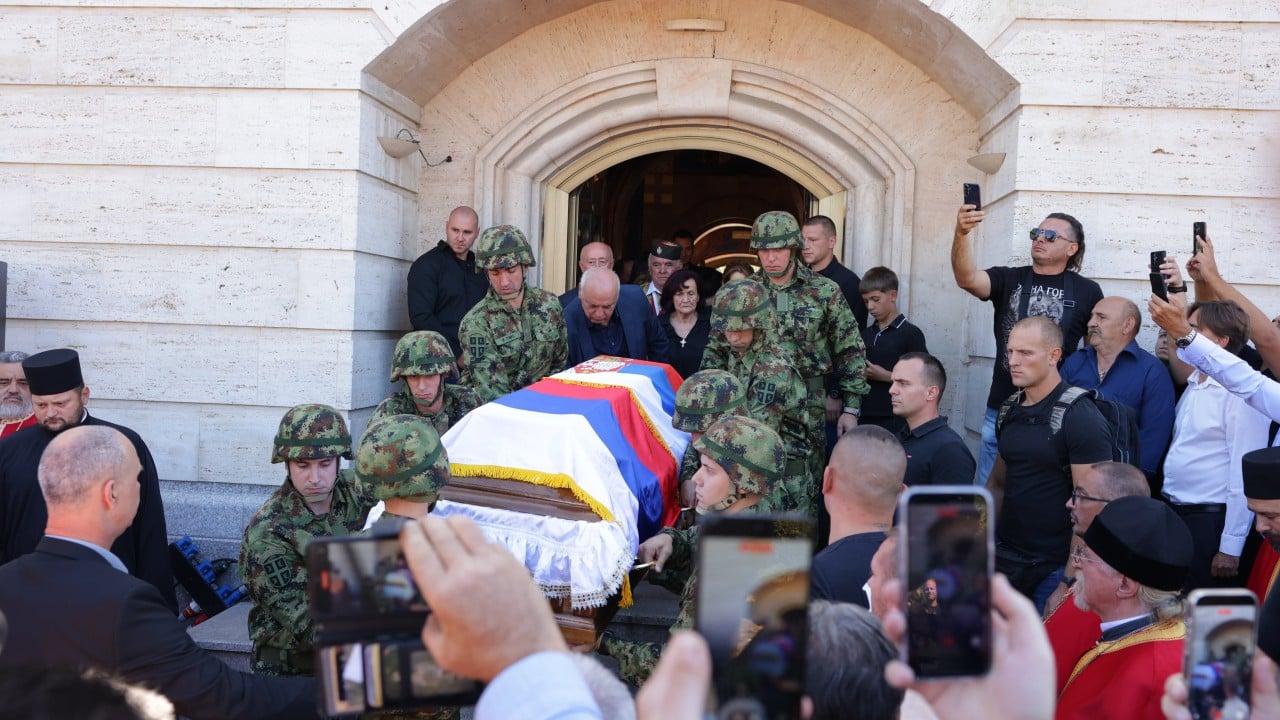
The coffin of Ratko Mladić did not merely carry the remains of a convicted war criminal; it carried a calculated political instrument. When the former Bosnian Serb commander—sentenced to life imprisonment for genocide, crimes against humanity, and the slaughter of more than 8,000 Bosniak men and boys at Srebrenica—was laid to rest at Belgrade's Topčider cemetery with military honours, the event exposed the deep fracture lines of the Western Balkans. European Union capitals fumed, diplomatic visits were cancelled in protest, and human rights commissioners issued sharp rebukes. Yet back in Belgrade, the state apparatus operated with a chillingly pragmatic choreography. This was never just about honoring a dead general. It was a high-stakes stress test of domestic loyalty engineered to shore up a weakening political regime on the eve of snap elections.
To understand why a state formally pursuing European Union membership would openly court international condemnation by facilitating a hero's farewell, one must look past the immediate outrage and examine the domestic arithmetic of President Aleksandar Vučić’s government. Don't forget to check out our previous coverage on this related article.
The Anatomy of Political Survival
External observers often misread modern Serbian politics through the lens of European integration. Brussels views compliance with international tribunals and the rejection of wartime atrocities as non-negotiable prerequisites for entry into the bloc. But Belgrade operates under a different set of electoral imperatives.
The nationalist core that still reveres Mladić as a defender of the Serb nation represents a critical voting bloc. Vučić, a former extreme nationalist turned populist technocrat, has spent over a decade balancing an impossible tightrope. He must keep EU financial lifelines and accession dialogue technically alive while ensuring his right-wing base does not defect to more radical challengers. To read more about the history of this, NBC News provides an in-depth summary.
Allowing the machinery of the state—including government transport of the remains and the prominent attendance of senior cabinet ministers—to facilitate the funeral was a carefully calibrated maneuver. Vučić himself kept a diplomatic arm's length, avoiding direct personal participation while his administration ensured the logistics ran smoothly. Hours after the soil settled over Topčider cemetery, the Serbian government requested the dissolution of parliament to trigger snap elections. The timing was not a coincidence. It was a signal that the regime would feed nationalist sentiment to secure its domestic flanks, regardless of the cost in Brussels.
The Sanitization of Atrocity
The normalization of wartime violence in public discourse does not happen overnight. It requires a systematic erosion of historical accountability. Over the past decade, murals glorifying Mladić have proliferated across Belgrade walls, initially met with half-hearted civic removals before settling into a state of tolerated permanence. Football fan clubs, traditionally barometers of raw street-level nationalism, coordinated synchronized tributes that treated a convicted architect of genocide as a martyr.
When state officials and the head of the Serbian Orthodox Church, Patriarch Porfirije, step forward to lead such memorials, they cross a dangerous threshold. They institutionalize revisionism. The strategy relies on semantic displacement. Official state rhetoric frequently avoids acknowledging the Srebrenica genocide directly, instead labeling it a "horrific crime" while systematically attacking international courts as structurally biased against Serbs.
This narrative creates a perpetual grievance loop. By framing every international indictment of wartime leaders as an attack on the entire nation, the political elite successfully conflates the defense of indicted war criminals with the defense of the Serb people themselves. Consequently, criticism from Brussels is easily spun by pro-government media as external hostility, turning diplomatic isolation into a perverse electoral asset.
The Cost of Strategic Ambiguity
The European Union’s response to these developments has exposed the structural limitations of conditionality-based diplomacy. Enlargement Commissioner Marta Kos swiftly cancelled a planned visit to Belgrade, and foreign ministries across Western Europe issued stern condemnations. Yet these reactions follow a familiar, toothless cycle.
Brussels demands adherence to European values, Belgrade offers rhetorical compliance accompanied by domestic defiance, and the accession process remains suspended in perpetual limbo. Meanwhile, alternative geopolitical players watch closely. Russia's ambassador stood visibly among the mourners in Belgrade, a reminder that Serbia maintains strategic hedges against the West. When the European People’s Party faces internal pressure to cut ties with Vučić’s ruling party, the hesitation of mainstream European leadership demonstrates a fear of pushing Serbia entirely out of the Western orbit.
This hesitation creates a moral hazard. Impunity becomes institutionalized when regional leaders realize that geopolitical pragmatism in Brussels will ultimately override enforcement of historical accountability. The state funeral for Ratko Mladić demonstrated that thirty years after the guns fell silent in Bosnia, the ghosts of the 1990s remain useful tools for politicians willing to mortgage the future for a momentary surge at the ballot box.