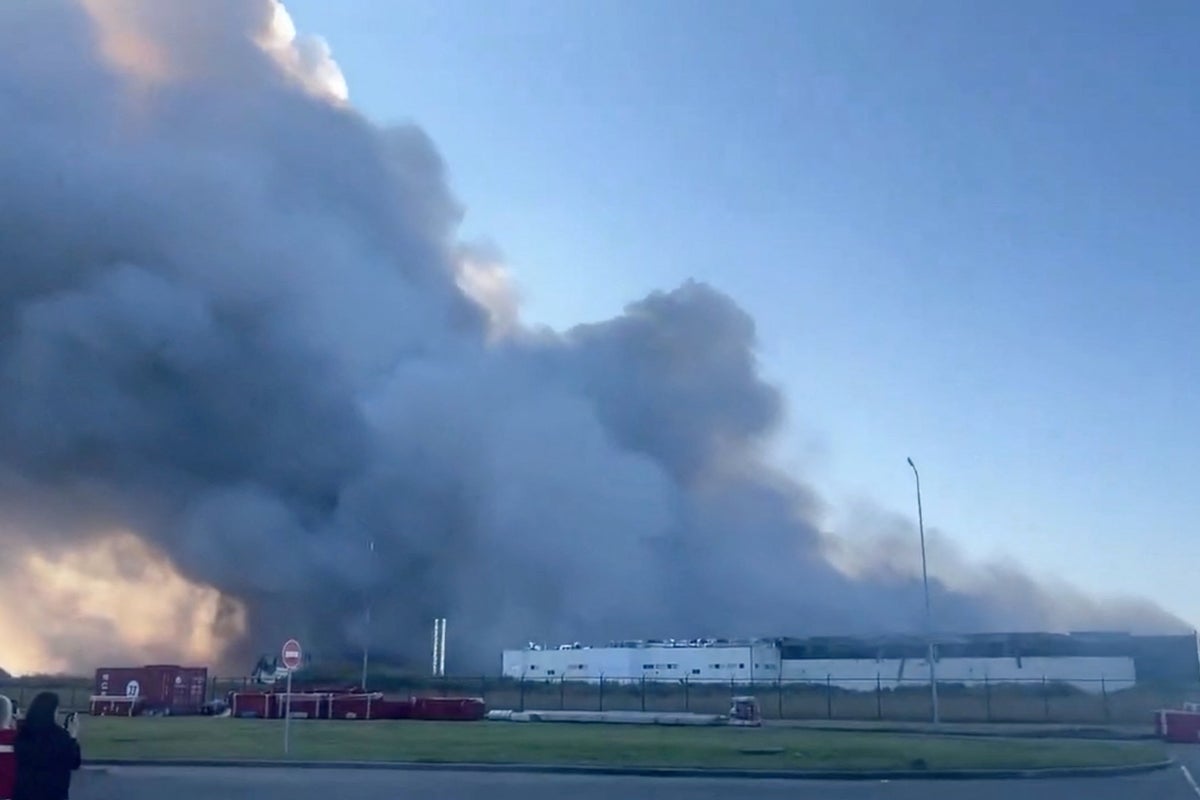
The tactical map along the border of the Russian Federation shifted decisively when a coordinated wave of Ukrainian strikes hit major commercial logistics nodes inside Belgorod, including sorting hubs belonging to major domestic online retailers. Two civilians died, sixteen others sustained injuries, and a sprawling Ozon distribution facility went up in flames, forcing the company to freeze regional deliveries. Moscow responded with immediate vows of retaliatory, massive strikes targeting Ukraine’s power grid. This exchange marks a brutal evolution in the war. The conflict is no longer confined to military trenches or frontline artillery duels. It has expanded into a direct war of economic attrition fought across supply chains, distribution centers, and civilian infrastructure.
Most mainstream reporting frames these cross-border exchanges as isolated retaliatory cycles or tragic anomalies of an ongoing war. That interpretation misses the underlying structural transformation. Ukraine has systematically altered its targeting calculus. Kyiv is no longer just striking military garrisons or ammunition dumps. It is intentionally targeting the logistical nervous system of the Russian domestic economy. Retail hubs like Ozon and Wildberries function as dual-use economic engines. They sustain consumer normalization inside Russia while absorbing industrial capacity. When a sorting hub burns, the shockwaves travel directly up the supply chain. This disrupts everything from regional commerce to the distribution of industrial parts used in military supply lines.
The Evolution of Asymmetric Economic Warfare
For years, military analysts assumed that asymmetric warfare would be defined purely by drone swarms targeting armored columns. Instead, the current phase relies on long-range attritional strikes against economic nodes that maintain domestic stability for the Kremlin. Russia built its war economy on a precarious balance. It tried to insulate its major urban centers from the daily horrors experienced in the Donbas or Kharkiv. By hitting logistics hubs in Belgorod, Ukrainian strategists are deliberately puncturing that illusion of normalcy.
The mechanics of these strikes reveal a high degree of calibration. Commercial logistics facilities possess massive footprints, high concentrations of automated sorting machinery, and extensive fuel-dependent transport fleets. A successful strike creates compounding failures.
- Sorting operations halt immediately, creating a localized gridlock that paralyzes regional commerce.
- Surrounding municipal power grids often sustain collateral damage from intercepted projectiles or secondary detonations.
- Public anxiety spikes as civilian populations realize that retail centers and distribution hubs sit squarely inside the crosshairs.
Moscow understands the psychological and economic danger of this pivot. Kremlin spokesman Dmitry Peskov labeled the strategy a dangerous escalation, pointing out that targeting the civilian retail economy crosses lines previously treated as unwritten red lines. Yet, the Russian Ministry of Defense's threat of renewed massive strikes against Ukrainian energy infrastructure is less a novel tactical innovation than a recycling of an old playbook. Moscow spent previous winters systematically attempting to freeze the Ukrainian population into submission. Threatening the power grid once more is a predictable reflex. It is a symmetrical weapon wielded against an adversary that has already decentralized its energy grid and adapted to persistent blackouts.
The Logistics Crisis Behind the Front Lines
The tactical reality on the ground is grim. Belgorod operates as the primary staging and logistical throat for southern Russian military operations. Convoys, supply trucks, and reinforcement units transit through or adjacent to the city's commercial infrastructure. By blurring the lines between military staging grounds and commercial distribution centers, the theater of war has swallowed civilian supply chains whole.
Retail giants caught in this crossfire face an impossible dilemma. Ozon and similar platforms cannot easily relocate massive fulfillment centers out of range without inducing systemic commercial failure across western Russia. If they stay, they risk catastrophic structural loss and workforce depletion. If they pull back, supply lines stretch to breaking points. This introduces severe friction into the Russian domestic market. This friction is precisely what Kyiv intends to exploit. Every ruble spent repairing a civilian sorting facility or reorganizing freight routes is a ruble diverted from the frontline military budget.
The strategic gamble taken by the Ukrainian command carries severe risks. Intensified attacks on Russian territory invariably provide the Kremlin with internal propaganda narratives necessary to justify further mobilization and brutal retaliatory campaigns against Ukrainian generation plants. When apartment blocks or municipal power stations in Kyiv, Kharkiv, or Odesa absorb the blow of Moscow's promised massive strikes, the civilian toll mounts exponentially. The conflict has settled into a grinding contest of societal endurance. Both sides are betting that the other's economic and psychological breaking point will arrive first.
As winter approaches, the vulnerability of both Ukrainian power plants and Russian supply logistics dictates the rhythm of the entire campaign. There is no diplomatic off-ramp visible on the horizon. The burning warehouses of Belgorod and the darkened grid coordinates across Ukraine point toward a protracted winter of mutual economic strangulation.