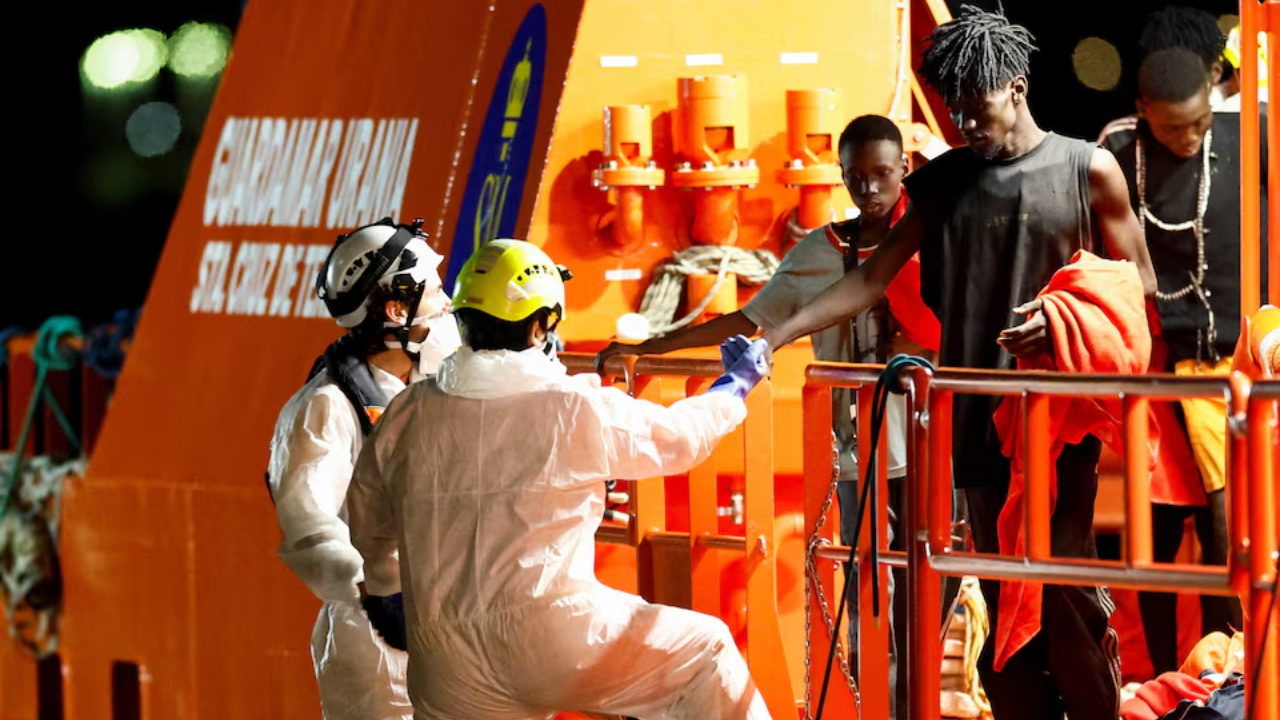
Forty-four survivors staggered ashore in the port of Arguineguín on the island of Gran Canaria, bearing the physical devastation of a month spent drifting on the open ocean. Their vessel, an overloaded wooden craft carrying West African migrants, had departed Gambia nearly four weeks prior. By the time a search plane spotted the craft bobbing one hundred and twenty kilometers south of the Spanish archipelago, only forty-four men remained upright or conscious. Five bodies lay decomposing inside the hull, while rights organizations fear that up to eighty-three passengers perished over the course of the harrowing voyage.
This tragedy highlights the grim realities of the Atlantic migration corridor, widely recognized as one of the most perilous maritime routes on Earth. While headline figures emphasize a statistical drop in total arrivals to the Spanish islands over recent months, aggregate statistics obscure the catastrophic cost borne by those who still attempt the crossing. When vessels vanish into the vast expanse of the open ocean, they often slip entirely past the radar of international rescue agencies until it is far too late.
The Anatomy of a Ghost Voyage
The survivors who made landfall reported a descent into absolute desperation. Originally carrying upward of one hundred people—including women and an infant—the boat exhausted its meager food and water reserves weeks before rescue. Driven by extreme thirst, passengers resorted to drinking raw seawater, accelerating organ failure and inducing acute delirium.
As individuals succumbed to dehydration and illness, their companions faced an agonizing logistical and psychological nightmare. Survivors told Red Cross workers that they initially attempted to bury or release the dead into the sea. Eventually, the remaining passengers grew too weak to lift the bodies of their peers, leaving the deceased inside the cramped hull alongside the living for days on end.
Rough seas compounded the horror. Spain's Maritime Rescue Service confirmed that choppy waters featuring waves measuring two and a half meters high made it impossible to immediately retrieve the five corpses left inside the drifting boat. Helicopters had to airlift three critical patients directly to local hospitals while forty-one others were towed to safety, arriving in a state of profound physical collapse.
Discrepancies in the Death Toll
Official tallies rarely capture the true scale of maritime loss. State authorities count only the bodies physically recovered from the water or vessels. Independent human rights monitors paint a drastically darker picture.
Helena Maleno, founder of the migration advocacy group Walking Borders, estimated that eighty-three people lost their lives during this single journey. This figure accounts for those who slipped overboard, succumbed to illness early in the trip, or vanished before international authorities registered the distress call. Families back in West Africa are left in prolonged uncertainty, relying on fragmented phone calls and grassroots tracking networks to learn the fate of their relatives.
The Atlantic route defies easy rescue operations. Unlike the narrower Mediterranean crossings where proximity to various coastlines allows for rapid intervention, the West African route spans hundreds of miles of open ocean. Strong trade winds and powerful oceanic currents systematically push drifting, disabled vessels away from shipping lanes and further out toward the open sea, occasionally carrying empty or occupied boats all the way to the Caribbean.
The Economic Engine of Desperation
Behind every overloaded wooden boat lies a complex web of structural collapse. Gambia and neighboring nations continue to grapple with severe youth unemployment, limited educational infrastructure, and bleak domestic economic prospects.
Local experts note that traditional industries have collapsed under the weight of regional inflation and environmental pressures. For thousands of young men, the choice to board an unseaworthy vessel is framed not as a reckless gamble, but as a rational response to an absolute lack of local opportunity. Trafficking networks exploit this vacuum, charging steep fees for seats on precarious boats while offering zero safety guarantees.
Governments in the region face immense pressure to address these root causes, yet tangible economic reform remains elusive. Official responses from West African capitals frequently lean toward silence or deflection, leaving civil society organizations to shoulder the burden of tracking the missing and supporting traumatized survivors.
As long as the structural push factors remain unaddressed, vessels will continue to launch from secluded beaches under the cover of night. The survivors of this latest drift will recover in European hospitals, but thousands more remain exposed to an unforgiving ocean that leaves very few witnesses behind.