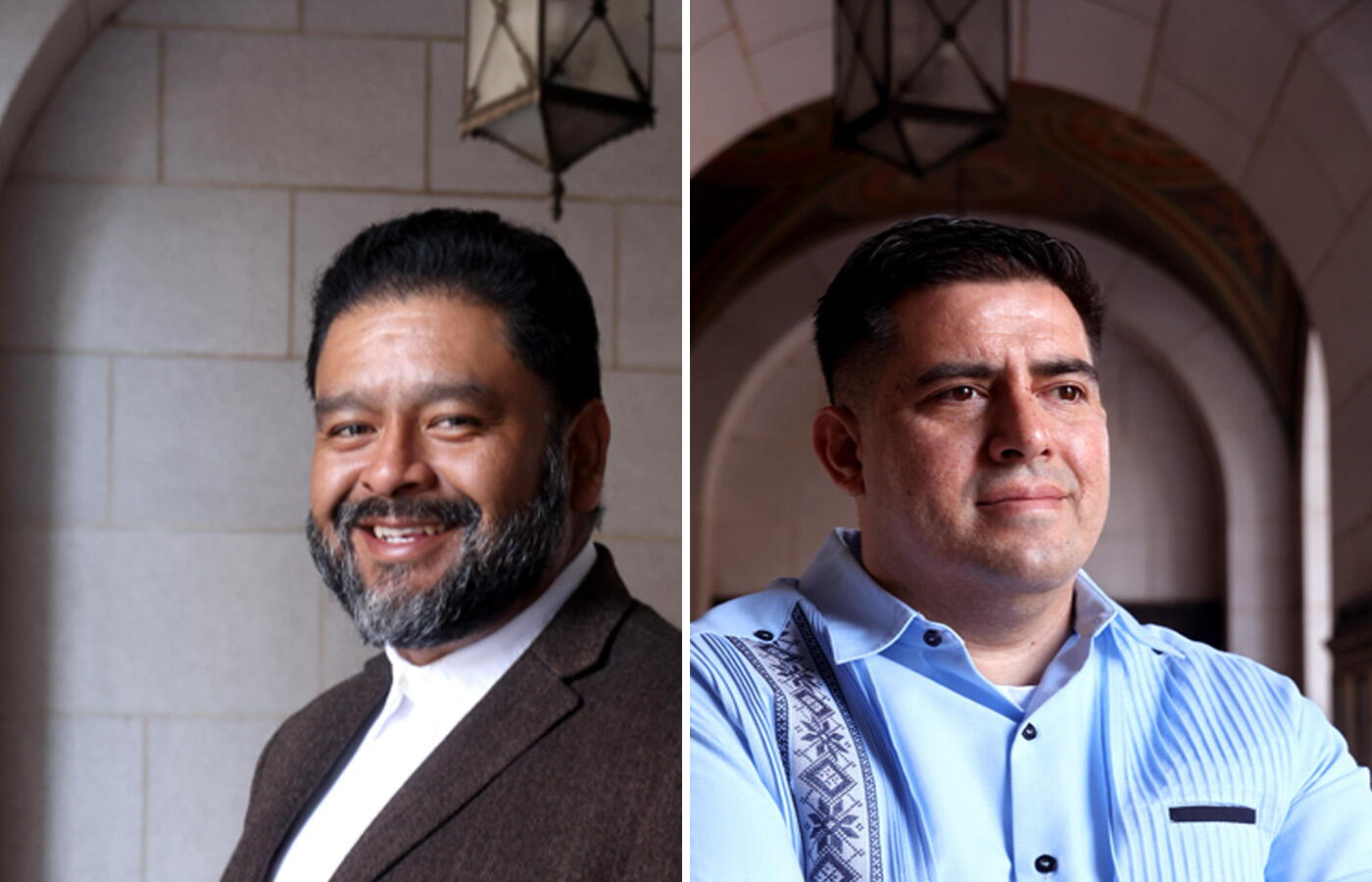
In Los Angeles City Council District 9, a razor-thin margin of 156 votes separates two candidates locked in a bitter struggle for power. That tiny gap—smaller than the attendance at a neighborhood PTA meeting—exposes a glaring reality about modern urban politics. When billion-dollar municipal budgets, sweeping zoning laws, and basic street-level services hang on a fraction of a percent of the electorate, the traditional playbook for municipal governance breaks down completely.
I have covered municipal politics long enough to know that a margin this tight is never just a statistical fluke. It is a symptom of deep structural friction. Most observers look at a 156-vote spread and see a thrilling horse race or a nail-biting drama for local political junkies. They miss the larger truth. A razor-thin margin in one of the most consequential districts in the second-largest city in America reveals a crisis of voter disengagement, a fractured political coalition, and a municipal machinery struggling to count ballots at the speed of modern public trust.
The Anatomy of a 156-Vote Margin
To understand why 156 votes matter so much in District 9, you have to look at what the seat actually controls. Stretching from the gleaming towers of Downtown Los Angeles down through the historic corridors of South Central, District 9 sits at the epicenter of the city’s most urgent battles over gentrification, homelessness, and economic development. Whoever holds this seat wields immense discretionary power over land use, affordable housing funds, and local policing strategies.
Yet, when the dust settled on the initial tallies, the entire future of this vital corridor rested on a few dozen households.
Why does a district with hundreds of thousands of residents come down to a statistical tie? The answer lies in the mechanics of local turnout. Municipal elections in Los Angeles have historically suffered from dismal participation rates, even after the city moved its election calendar to align with state and federal races to boost numbers. In low-turnout environments, the electorate shrinks to a hyper-engaged sliver of the population. Every single door knock, every targeted mailer, and every union phone bank carries exponentially more weight.
When turnout drops, the margin for error vanishes. A single rainy afternoon, a localized mail delay, or a poorly worded ballot measure on the same page can swing an entire council seat. In a race decided by 156 votes, the outcome is rarely a sweeping mandate for a candidate’s platform. Instead, it is a reflection of which campaign had the superior ground game in the final 48 hours before the polls closed.
Why Los Angeles Takes Weeks to Count Ballots
The agonizingly slow drip of election results in Los Angeles County has become a familiar ritual, yet it continues to fuel public skepticism. While other major jurisdictions report near-final numbers on election night, L.A. voters routinely wait weeks to learn who won a close race.
This delay is not a sign of incompetence or malfeasance. It is the direct consequence of California’s expansive ballot-access laws colliding with the sheer scale of the nation’s largest county.
Under state law, any mail-in ballot postmarked on or before Election Day must be counted if it arrives within seven days. Add to that the millions of conditional voter registration ballots—commonly known as same-day registration—and provisional ballots cast by voters whose eligibility must be verified manually by election workers.
Each of those late-arriving or conditional ballots requires a rigorous, multi-step verification process:
- Signature verification: Election workers must compare the signature on the ballot envelope against the voter's registration file on record. If a signature does not match, the county must notify the voter and give them time to "cure" the ballot by submitting a verification form.
- Duplication and adjudication: Damaged ballots, coffee-stained sheets, or ballots marked with the wrong type of pen cannot be fed directly into high-speed optical scanners. Bipartisan teams of election workers must manually duplicate the voter's choices onto a clean ballot under strict observation.
- Provisional cross-checking: For voters who cast conditional ballots on Election Day, staff must verify against statewide databases that the person did not already vote in another precinct or county.
When a candidate leads by 15,000 votes, these late batches of ballots are mere footnotes. When the spread is 156 votes, every single batch released by the Registrar-Recorder/County Clerk at 4:00 p.m. becomes a seismic event. A batch of 2,000 cured mail-in ballots from a single neighborhood can erase a lead overnight and flip the race entirely.
The Myth of the Monolithic Voting Bloc
For decades, political consultants in Los Angeles relied on broad demographic assumptions to map out their paths to victory in districts like the 9th. They treated entire neighborhoods as predictable voting blocs that would reliably fall in line behind traditional endorsements from established political machines, labor unions, or community clergy.
The 156-vote split shatters that outdated model.
District 9 is undergoing rapid demographic and economic transformation. Longtime working-class families who have lived in South Los Angeles for generations now share streets with younger, transit-oriented renters moving into newly constructed apartments near the USC corridor and Downtown. Their priorities do not always align.
A homeowner worried about property values, street maintenance, and visible encampments views city hall through a very different lens than a service-industry renter facing a 10 percent rent hike and demanding aggressive tenant protections. When two candidates split these competing interests down the middle, traditional institutional endorsements lose their decisive punch.
In a hypothetical example of how this plays out on the ground, consider two neighboring blocks in the same precinct. On the first block, long-term residents vote heavily for the candidate promising stricter enforcement of public space laws and faster police response times. Two hundred feet away, in a newly built multi-family complex, younger voters cast ballots for the challenger advocating for housing-first initiatives and alternative crisis response teams. The net result at the precinct level is a dead heat. Multiply that dynamic across dozens of precincts, and you get a 156-vote margin.
The High Cost of a Razor-Thin Mandate
Winning an election by 156 votes gives a candidate the exact same legal authority as winning by 15,000 votes. Once sworn in, the councilmember gets the same staff budget, the same committee assignments, and the same single vote on the 15-member council.
Politically, however, a micro-margin is a heavy anchor.
A councilmember who squeaks into office by less than two hundred votes enters City Hall with virtually no political capital. Every controversial decision—whether approving a dense housing development, reallocating funds from the police department, or clearing an encampment—will be met with immediate, organized resistance from the nearly half of the electorate that voted against them.
Furthermore, a razor-thin victory guarantees that the campaign never truly ends. Opponents immediately begin laying the groundwork for a recall effort or grooming a challenger for the next election cycle four years away. Instead of taking bold, long-term action to fix systemic problems in the district, the officeholder is forced into a defensive posture, constantly calculating how every constituent email and zoning variance will play in the next razor-thin election.
What Happens When Recounts Enter the Picture
In California, unlike some other states, there is no automatic taxpayer-funded recount for local races, no matter how close the margin. Even if the final certified tally shows a difference of a single vote, the county will not recount the ballots unless someone steps up to pay for it.
Under the California Elections Code, any registered voter can request a recount within five days of the official certification of the election results. However, the person requesting the recount must deposit funds with the county each day to cover the actual cost of the operation. In a jurisdiction as massive and complex as Los Angeles County, a full manual recount of a council district can easily cost tens of thousands of dollars per day.
If the recount succeeds in reversing the outcome of the election, the county refunds the money to the requester. If the outcome stands, the requester forfeits every dime.
This financial barrier turns the post-election phase into a high-stakes poker game. Campaigns are already drained of cash after months of paying for mailers, digital ads, and field organizers. Raising another $50,000 or $100,000 in a matter of days for a recount requires deep-pocketed institutional allies—typically major labor unions, real estate developers, or political action committees—willing to gamble on the mathematical probability of finding enough uncounted or misread ballots to overcome the deficit.
Historically, recounts in California rarely overturn margins larger than a few dozen votes. Optical scan machines are remarkably accurate, and human error during manual counts tends to cut both ways, canceling out isolated discrepancies. Yet, when the gap is 156 votes, the temptation to roll the dice becomes almost irresistible for major political stakeholders whose legislative agendas hang in the balance.
The Real Lesson for Urban Democracy
The spectacle of two candidates separated by 156 votes in Los Angeles's 9th District serves as a stark warning about the fragility of local representation. We spend endless hours obsessing over national presidential races where individual votes are filtered through the Electoral College and drowned out by millions of others. Meanwhile, at the municipal level—where decisions directly dictate the safety of your walk to the bus stop, the cost of your rent, and the cleanliness of your neighborhood park—elections are routinely decided by a handful of people.
When 156 votes determine the fate of an entire council district, the loudest takeaway has nothing to do with the personalities of the two candidates on the ballot. It is an indictment of civic apathy. Tens of thousands of eligible voters in District 9 stayed home, left their mail-in ballots sitting on the kitchen counter, or skipped the down-ballot local races altogether. By choosing not to participate, they handed absolute control of their neighborhoods to a tiny fraction of their neighbors.