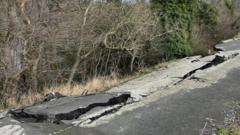
The collapse of a primary arterial road in a rural geography is rarely a singular engineering failure; it is a manifestation of a systemic imbalance between localized infrastructure maintenance costs and the diminishing marginal utility perceived by central fiscal authorities. When a road fails and remains closed, the resulting "infrastructure gap" creates a feedback loop of economic contraction, where the cost of repair begins to exceed the immediate taxable output of the isolated region. This analysis deconstructs the mechanisms of road failure, the structural barriers to restoration, and the socio-economic friction caused by permanent transit disruption.
The Anatomy of Civil Engineering Failure
Road collapses in rural corridors typically follow a predictable degradation sequence. While public sentiment often blames "neglect," the technical reality usually involves a breach in the Hydrological Integrity Chain.
- Subgrade Saturation: If drainage systems (culverts and ditches) are not cleared of organic debris, water permeates the road’s sub-base. This reduces the soil's shear strength.
- Structural Instability: Once the sub-base is compromised, the asphalt or concrete surface loses its load-bearing support. Heavy vehicle transit then creates micro-fractures, accelerating water ingress.
- Mass Wasting Events: In hilly or mountainous terrain, this leads to a "slip"—a gravitational failure where the entire road bench detaches from the hillside.
Repairing a slip is not a matter of "filling a hole." It requires geotechnical stabilization, often involving the installation of bored piles or retaining walls anchored into the bedrock. The engineering complexity scales exponentially with the slope's gradient, often pushing repair costs into the millions for a segment of road that may only serve a few hundred residents.
The Fiscal Gatekeeping Mechanism
The primary reason road closures persist indefinitely is the Benefit-Cost Analysis (BCA) framework used by municipal and national transport agencies. These agencies operate under a "Triage Logic," where limited capital is allocated based on specific metrics that naturally disadvantage rural populations.
The Connectivity Valuation Formula
To justify a repair, the projected economic benefits must outweigh the capital expenditure. These benefits are calculated through:
- Average Annual Daily Traffic (AADT): Rural roads often fall below the minimum threshold for "critical infrastructure" status.
- Time Savings Valuation: Planners calculate the monetary value of time lost by commuters. In a low-density area, the aggregate hours lost by 50 villagers do not compete with 10 minutes of delay for 10,000 urban commuters.
- Vehicle Operating Costs (VOC): The increased wear and tear on vehicles forced to take long detours.
When a road collapses, the "detour reality" sets in. If a 5-minute trip becomes a 40-minute circumnavigation, the local economy experiences an immediate Logistics Tax. This tax hits small businesses, emergency services, and agricultural supply chains hardest, yet it is often categorized as a "localized externality" rather than a systemic failure requiring urgent intervention.
The Socio-Economic Friction of Permanent Detours
The closure of a road acts as a physical barrier that reshapes the social and economic geography of a village. This shift occurs in three distinct phases of institutional withdrawal.
Phase 1: Service Erosion
The first casualty is the efficiency of public services. Emergency Response Times (ERT) increase as ambulances and fire engines are forced onto secondary, often inferior, routes. This introduces a measurable risk to life and property. Similarly, school bus routes are elongated, increasing the operational cost for the school district and reducing the "active time" of students.
Phase 2: Commercial Displacement
Small-scale commerce in rural areas often relies on "pass-through" traffic. When a road closes, the customer base shrinks to the immediate residents. Without the inflow of outside capital, local shops face a liquidity crisis. Suppliers may also refuse to deliver to isolated areas due to the increased fuel and time costs of the detour, leading to "Delivery Deserts."
Phase 3: Property Devaluation and Capital Flight
Infrastructure is a primary driver of real estate value. A house on a "dead-end" road—that used to be a through-road—suffers a liquidity discount. Potential buyers are deterred by the uncertainty of the road's future, and current residents with the means to leave often do so, resulting in a "brain drain" and a shrinking local tax base. This further reduces the village's political leverage to demand repairs.
Technical Barriers to Restoration
The assumption that "government can just fix it" ignores the bureaucratic and environmental hurdles that define modern civil engineering.
- Environmental Permitting: If a road collapse affects a waterway or a protected habitat, the environmental impact study can take years. Agencies must prove that the repair will not cause downstream siltation or disrupt local fauna.
- Utility Realignment: Roads are often conduits for fiber-optic cables, water mains, and power lines. A collapse involves multiple stakeholders, each with their own budget cycles and priorities.
- The "Build Back Better" Paradox: Modern safety standards often prohibit a simple "like-for-like" repair. If a road was built 50 years ago, a new repair must meet current seismic, drainage, and width standards. This "Upgrading Requirement" can triple the cost of what residents perceive as a simple patch job.
The Political Economy of Rural Neglect
The dynamic between villagers and the state is characterized by Information Asymmetry. The state knows the cost of the repair and the low ROI; the villagers know the visceral impact of the loss. This leads to a cycle of "Protest and Platitude," where officials offer vague timelines to quell public anger without committing specific budget lines.
In the absence of a clear "Economic Trigger"—such as a major industry requiring the road—the path to reopening relies on political volatility. Infrastructure becomes a "squeaky wheel" problem. Only when the political cost of inaction (measured in lost votes or media scrutiny) exceeds the financial cost of the repair does the project move toward the tender phase.
Strategic Realignment for Isolated Communities
For residents and local councils facing a permanent closure, the strategy must shift from emotive appeals to data-driven advocacy.
- Quantifying the Logistics Tax: Communities should document the cumulative increase in fuel costs, vehicle maintenance, and lost wages. Presenting a consolidated "Economic Loss Report" forces the government to include these figures in their BCA.
- Risk Profile Documentation: Mapping the increase in emergency response times provides a legal and ethical lever. If the state’s inaction results in a "Service Level Breach," the liability profile shifts.
- Alternative Funding Structures: Exploring "Local Improvement Districts" or public-private partnerships where local businesses contribute to the repair in exchange for tax credits.
The reality of 21st-century infrastructure is that many rural assets are being "managed into decline." Without a fundamental shift in how we value rural connectivity beyond simple traffic counts, the road that "will never reopen" becomes a self-fulfilling prophecy of regional abandonment. The only way to break this cycle is to redefine the road not as a convenience, but as a critical lifeline whose value is intrinsic to the state's obligation to its citizens.