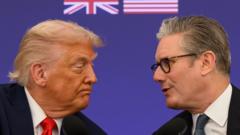
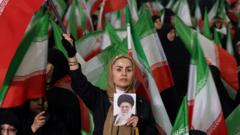
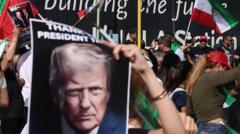
The intersection of high-stakes geopolitics and unchecked digital information flow has created a structural vulnerability in how the West interprets Iranian political stability. When a former U.S. President asserts the death of a foreign head of state—specifically Supreme Leader Ayatollah Ali Khamenei—without immediate state confirmation, it triggers a predictable sequence of market volatility, intelligence scrambling, and domestic Iranian counter-signaling. This event is not merely a rumor; it is a stress test of the global information ecosystem's ability to verify biological facts in an era of deep-seated opacity.
Understanding the validity of such claims requires moving beyond the surface-level rhetoric of political speeches. We must instead analyze the specific indicators of leadership transition within the Islamic Republic, the mechanics of Iranian state media response, and the strategic utility of "death rumors" as a tool of psychological operations.
The Triad of Succession Indicators
The biological status of the Supreme Leader is the single most critical variable in Middle Eastern stability. Because the office of the Vali-e Faqih (Guardian Jurist) holds ultimate authority over the military, the judiciary, and the clerical establishment, a vacuum at the top is a systemic risk. We analyze the validity of any "death claim" through three primary forensic lenses.
1. The Assembly of Experts Mobilization
The Assembly of Experts is the 88-member body of clerics constitutionally charged with electing the successor. Under Article 107 of the Iranian Constitution, this body must convene immediately upon the vacancy of the seat.
- The Baseline: Routine meetings occur twice a year.
- The Trigger: An emergency session outside the published schedule is the most reliable "hard" indicator of a leadership crisis.
- Observation: In the hours following recent claims of Khamenei’s demise, no movement was detected among the clerical elite in Qom or Tehran that suggested an emergency vote.
2. Operational Shifts in the IRGC
The Islamic Revolutionary Guard Corps (IRGC) is the institutional guarantor of the regime's survival. A transition period is the moment of highest internal and external vulnerability.
- The Baseline: Routine internal security and regional proxy management.
- The Trigger: A shift in posture—including the grounding of civil aviation, the sudden movement of elite divisions into the capital, or a complete telecommunications blackout—is the signature of a succession event.
- Observation: Throughout the recent period of speculation, Iranian military posture remained consistent with long-term regional objectives rather than domestic emergency protocols.
3. The State Media Counter-Signaling Loop
Iran utilizes its official news outlets, notably the Islamic Republic News Agency (IRNA) and the Islamic Republic of Iran Broadcasting (IRIB), as the primary instruments for biological verification.
- The Baseline: Routine coverage of state speeches and diplomatic meetings.
- The Trigger: The "Proof of Life" protocol. This usually involves high-definition footage of the Supreme Leader in a public setting or a televised address.
- The Constraint: In an era of advanced deepfakes and generative AI, the bar for visual proof has risen significantly. A mere photograph of the leader is no longer a definitive metric of survival.
The Cost Function of False Death Claims
The propagation of rumors concerning the death of a foreign leader is often analyzed as a "gaffe" or a "misstatement," but its implications are more structurally significant. In the context of the United States and Iran, a false claim of Khamenei's death functions as a disruptive mechanism in global intelligence and economic stability.
Intelligence Resource Reallocation
When a high-level figure makes such an assertion, the immediate response is a massive, cross-agency reallocation of signals intelligence (SIGINT) and human intelligence (HUMINT) resources. Analysts must pivot to verify or debunk the claim, pulling focus from existing threat vectors. This creates an intelligence blind spot, as resources are diverted to chase a ghost rather than monitor active kinetic movements.
Market Volatility and Risk Premiums
Global energy markets are hypersensitive to the stability of the Persian Gulf. A leadership vacuum in Iran would, in theory, introduce a risk premium on Brent Crude and other commodities. However, the market’s response to these claims has become increasingly cynical. When a death rumor is debunked, it leads to a "cry wolf" effect, where future, potentially true reports are discounted by traders, leading to delayed reactions in the event of an actual crisis.
Strategic Disinformation as a Tool of Regional Destabilization
The "death of Khamenei" rumor has become a recurring trope in the information war between the West and the Islamic Republic. This is not accidental. The strategic utility of these rumors is rooted in the "decapitation" psychology of modern conflict.
- Provoking a Response: By claiming a leader is dead, the adversary forces the regime to prove he is alive. This forces the leader into a public or semi-public appearance that might otherwise have been avoided for security or health reasons.
- Highlighting the Succession Crisis: The Islamic Republic has an existential fear of the transition period. Every rumor of the Leader’s death serves to remind the Iranian public and the international community of the fragility of the regime’s structure.
- Testing the Information Integrity of the Regime: The speed and coherence of the regime’s rebuttal provide Western intelligence with data on the regime’s internal communication speed and PR agility.
The Mechanism of Verification in the Age of Generative AI
The biggest challenge in assessing the validity of these claims in the 2020s is the emergence of high-fidelity synthetic media. We can no longer rely on a 30-second clip of a leader speaking to verify their biological status.
The Verification Hierarchy
To achieve a high-confidence assessment of a leader’s status, we must look for a convergence of indicators that are difficult to fake simultaneously.
- Physical Presence: Reports from third-party diplomatic sources who have physically met with the individual in a controlled environment.
- Synchronized Movements: Large-scale changes in the movements of top-tier officials and family members.
- Signals Analysis: A noticeable change in the encryption and volume of communication between the Office of the Supreme Leader and the heads of the armed forces.
The absence of these three indicators renders any claim of a foreign leader’s death as "low-confidence speculation."
Geopolitical Stability and the Succession Bottleneck
The structural vulnerability of Iran is centered on a single point of failure: the 86-year-old Supreme Leader. The rumors of his death are persistent because the biological reality of his age is undeniable. This creates a "succession bottleneck" where every minor health event or public absence is magnified into a potential collapse of the state.
The core problem for Western strategists is not whether Khamenei is currently alive, but how to prepare for the inevitable moment when he is not. The "death rumors" of today are a dress rehearsal for a reality that will fundamentally redraw the map of the Middle East.
The Successor Profile
The speculation often centers on two figures: Mojtaba Khamenei (the son) and the recently deceased Ebrahim Raisi (who was a primary contender until his helicopter crash). The elimination of Raisi from the succession equation has narrowed the field, making the biological status of the current Supreme Leader even more critical. If the leader were to die today, the transition would be more contested and less predictable than it would have been two years ago.
Strategic Play: Navigating the Information Void
The professional analyst must operate on a principle of "radical skepticism" toward any high-level political claim regarding the death of a foreign adversary. The strategic play is to ignore the headline and monitor the structural indicators. If the Assembly of Experts is not meeting, if the IRGC is not on high alert, and if the regional proxies are not adjusting their posture, then the leader is functionally alive—regardless of his actual biological state.
Verification in the modern era is a forensic process, not a linguistic one. The focus must remain on the machinery of the state rather than the mouthpieces of its detractors.
The most effective approach for intelligence communities and private sector risk analysts is to build a "Succession Matrix"—a set of quantifiable metrics that must be triggered before a death report is treated as actionable. This matrix includes:
- State Media Tone Shift: A transition from political rhetoric to religious or mournful programming.
- Diplomatic Recalls: The sudden return of high-ranking Iranian diplomats from key Western and regional posts.
- Financial Outflows: Large, unexplained movements of capital by regime-linked entities.
Without these indicators, the claim of a leader's death is simply noise in an increasingly crowded signal environment.