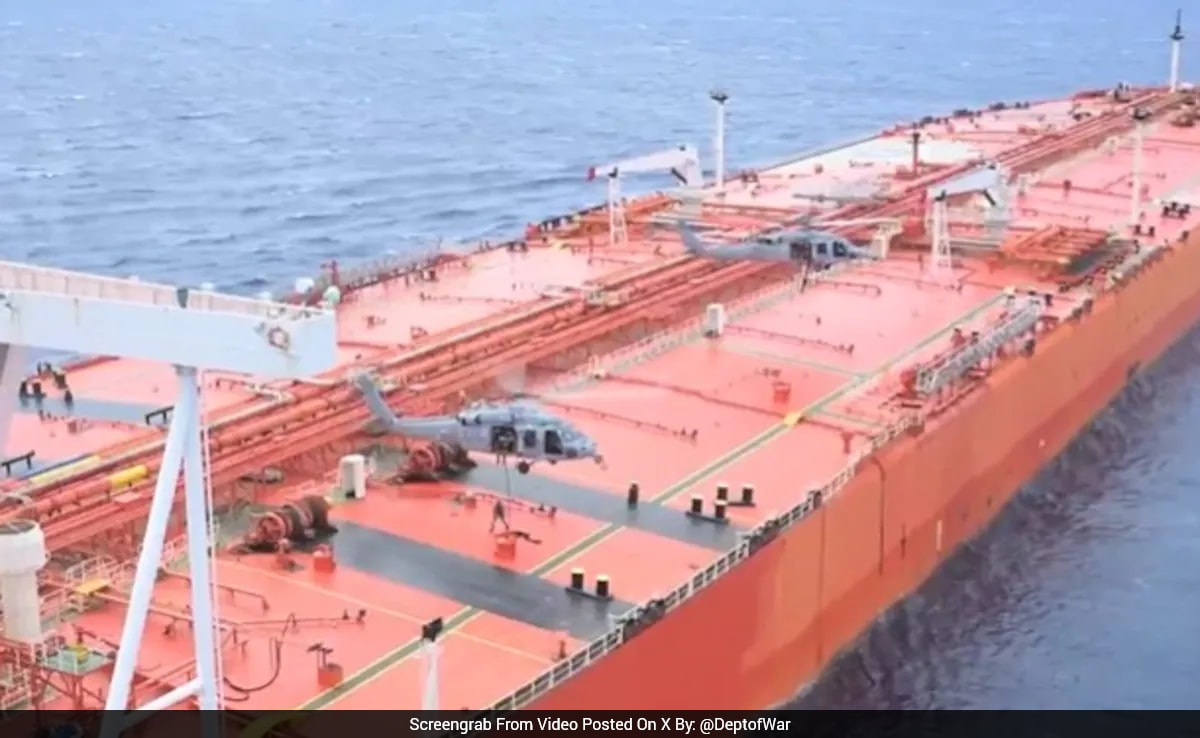
The concept of international waters as a lawless sanctuary just died in the Bay of Bengal. On April 21, 2026, U.S. Navy SEALs descended from helicopters onto the deck of the M/T Tifani, a bright orange tanker carrying two million barrels of Iranian crude. While the boarding was described as "incident-free," its implications are seismic. Washington is no longer content with paper sanctions or blockading the Strait of Hormuz; it is now actively hunting and seizing ships thousands of miles from the original conflict zone.
This shift signals the start of a global maritime dragnet that treats the high seas not as a neutral buffer, but as a primary theater of economic warfare. By intercepting a vessel halfway between Sri Lanka and the Strait of Malacca, the U.S. Indo-Pacific Command has effectively extended its "Operation Economic Fury" across the world's most vital shipping lanes. If you are moving sanctioned cargo, there is no longer a distance far enough to provide safety.
The Death of the Ghost Fleet
For years, the "dark fleet"—a loosely organized assembly of aging tankers with opaque ownership—operated with near-impunity. These vessels used a reliable playbook: spoofing AIS transponders to show false locations, conducting ship-to-ship (STS) transfers in the middle of the night, and flying "flags of convenience" from nations with little to no oversight.
The Tifani was a textbook example. It claimed to fly the flag of Botswana, a landlocked nation that quickly disavowed the ship, rendering it "stateless" under international law. In the past, being stateless was a legal gray area that frustrated Western navies. Today, it is an invitation for boarding. By stripping away the protection of a sovereign flag, the U.S. has found the legal leverage necessary to treat these tankers as "floating contraband" rather than sovereign property.
How the Tech Gap Collapsed
The reason these seizures are happening now, and not five years ago, isn't just political will—it is a massive leap in maritime surveillance.
- Synthetic Aperture Radar (SAR): Traditional satellite imagery is blocked by clouds and darkness. Modern SAR satellites can "see" through any weather, tracking the physical hulls of ships even when they turn off their transponders.
- RF Analytics: Companies now monitor the radio frequency signatures of ships. Every vessel has a unique "electronic fingerprint." Even if a ship changes its name and IMO number, its radar and radio emissions give it away.
- Predictive Behavioral Modeling: AI-driven platforms now flag "anomalous behavior," such as a tanker lingering in a known STS zone or a sudden, unexplained draft change that suggests a mid-ocean cargo offload.
When the Tifani loaded its cargo at Iran's Kharg Island on April 5, it was likely being tracked by at least three different layers of non-visual surveillance. The moment it cleared the Strait of Hormuz on April 9, its fate was sealed. The U.S. didn't find it by luck; they watched it the entire way.
The China Factor
While the immediate target is Iranian revenue, the real audience for these operations sits in Beijing. China is the primary destination for this "black" oil, often processed by small, independent refineries known as "teapots." By seizing these ships in the Indo-Pacific, the U.S. is directly interfering with China’s energy supply chain.
This creates a high-stakes game of maritime chicken. If U.S. forces continue to board vessels in the Indian Ocean or the South China Sea, they risk a direct confrontation with the People's Liberation Army Navy (PLAN), which has increasingly positioned itself as a guarantor of "freedom of navigation" for its own interests. The U.S. is betting that China will not risk a shooting war over a stateless tanker, but that bet gets riskier with every boarding.
The Legal Shell Game
The U.S. Department of Justice has refined its "civil forfeiture" strategy to a science. Instead of suing a country or a person, they file a complaint against the cargo itself.
In the case of the M/T Skipper, seized in December 2025, the DOJ successfully argued that the oil was "property affording a source of influence" over sanctioned groups like the IRGC. This legal maneuver allows the U.S. to take the oil, sell it, and put the proceeds into the U.S. Treasury or a fund for victims of state-sponsored terrorism. It is a self-funding enforcement mechanism. The more oil they seize, the more resources they have to fund more seizures.
The Problem of Aging Hulls
There is a massive environmental risk that the Pentagon is downplaying. Most dark fleet vessels are well past their retirement age. They are poorly maintained, often uninsured, and operated by skeleton crews.
Boarding a rust-bucket tanker carrying two million barrels of volatile crude in heavy seas is an ecological nightmare waiting to happen. A single tactical error or a mechanical failure during a forced boarding could result in an oil spill that would dwarf the Exxon Valdez. The U.S. claims to have environmental response teams on standby, but the reality of a mid-ocean cleanup is grim.
The New Maritime Reality
Shipping companies are now being forced to choose sides. The "middle ground" of operating in the shadows is evaporating. We are entering an era where the ownership and history of a vessel are as important as its cargo.
Industry analysts expect insurance premiums for any vessel that has even a tangential link to sanctioned ports to skyrocket. Even "clean" operators are being swept up in the friction, as increased naval patrols and mandatory "right of visit" boardings slow down global trade at a time when the world economy is already on edge.
The boarding of the Tifani was not a one-off event. It was a proof-of-concept for a new doctrine of aggressive, global maritime enforcement. Washington has decided that the only way to win an economic war is to physically control the commodities that fuel it. The high seas are no longer a neutral highway; they are a gated community, and the U.S. Navy is holding the keys.
If you are operating a vessel with a questionable pedigree or a history of "going dark," the message from the Bay of Bengal is clear: you are being watched, and you are no longer out of reach. The era of the "ghost fleet" is ending, not with a diplomatic agreement, but with the sound of combat boots hitting a steel deck in the middle of the night.