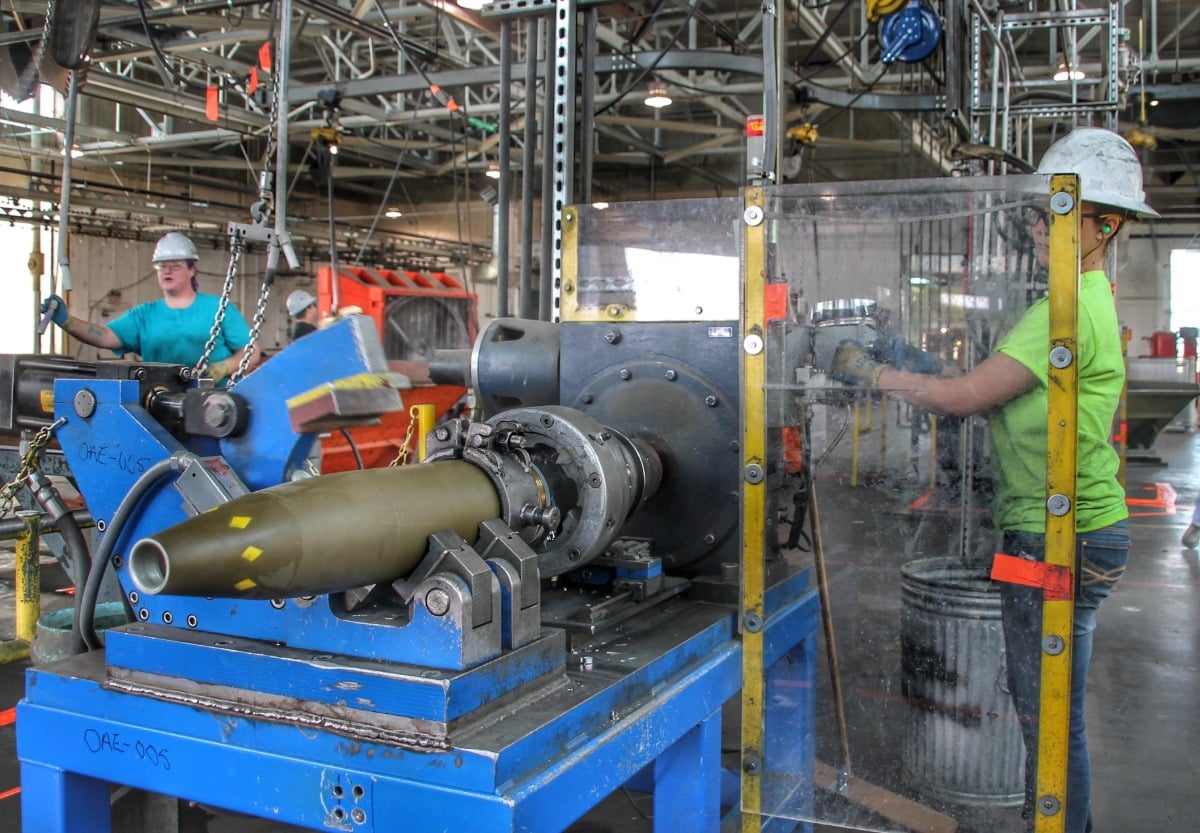
The defense procurement echo chamber is celebrating again. Industry analysts are nodding in unison because Norway’s Kongsberg Gruppen decided to buy a U.S. manufacturer specializing in mass-produced missiles. The narrative is predictably neat: Western stockpiles are depleted, near-peer conflicts demand unprecedented volume, and buying a turnkey factory on American soil is a masterstroke of scaling up.
It is a beautiful corporate deck. It is also entirely wrong.
The defense industrial complex remains obsessed with the ghost of World War II manufacturing. Executives look at the staggering expenditure of munitions in Ukraine and conclude that the winner of the next conflict will simply be whoever cranks out the most metal tubes from a conveyor belt. They are scaling up the past instead of building the architecture of the future.
Buying a factory that excels at stamping out cheap, fixed-trajectory, mass-produced ordnance is a twentieth-century solution to a twenty-first-century problem. If you look closely at the math, the economics of attrition, and the rapid evolution of electronic warfare, this acquisition looks less like a strategic triumph and more like an expensive hedge against a reality that no longer exists.
The Volume Trap and the Myth of Cheap Attrition
The lazy consensus dominating defense journalism goes like this: cheap mass production wins wars of attrition. Proponents argue that if an adversary can deploy thousands of low-cost drones or missiles, the only logical response is to build an equally massive, lower-cost counter-arsenal.
This logic collapses the moment it hits real-world physics and logistics.
True mass production works for consumer electronics because a silicon chip or a plastic casing does not need to bypass a billion-dollar integrated air defense system to do its job. A smartphone does not face active, militarized electronic jamming on its way to the retail store.
When you strip out the sophisticated guidance systems, the resilient anti-jamming GPS modules, and the multi-spectral seekers to make a missile cheap and easy to mass-produce, you are not building a weapon. You are building expensive target practice for the enemy.
During my years analyzing defense acquisitions, I have watched prime contractors pitch "low-cost, high-volume" solutions to the Pentagon, only for those programs to balloon in cost the moment operational reality sets in. The choice is never between cheap volume and expensive precision. The choice is between precision that works and volume that gets intercepted or misdirected before it even sees the target area.
The Sunk Cost of Hard Tooling
To understand why Kongsberg’s acquisition is fundamentally flawed, you have to look at the manufacturing floor. Traditional mass production relies on hard tooling—highly specialized, rigid factory setups designed to churn out a specific iteration of a weapon system at maximum speed.
Change a single component, swap a microchip due to supply chain shortages, or alter the aerodynamic profile to counter a new defensive radar, and your assembly line grinds to a halt. You face months of re-tooling and millions in capital expenditure.
In modern conflict, software-defined warfare changes week by week. If an adversary updates their electronic warfare coding on a Monday, a mass-produced missile variant without adaptable, modular architecture becomes obsolete by Tuesday. Yet, you still have ten thousand of them rolling off your newly acquired U.S. assembly line.
True manufacturing agility does not look like a massive, single-purpose plant. It looks like software-defined manufacturing:
- Flexible assembly cells that utilize advanced additive manufacturing.
- Open-architecture mission systems that allow software updates over the air right before deployment.
- Supply chains built around commercial, off-the-shelf components ruggedized for military use, rather than proprietary, single-source hardware.
By doubling down on traditional mass production facilities, defense primes are anchoring themselves to static designs. They are buying physical infrastructure at the exact moment they should be investing heavily in digital flexibility.
The Pentagon Supply Chain Illusion
There is an undeniable political calculation here. Kongsberg wants to deepen its footprint within the U.S. defense ecosystem. Buying an American manufacturer allows them to bypass certain Buy American Act restrictions and positions them closer to the Pentagon’s checkbook.
But let us dismantle the premise that building things inside the United States automatically solves the supply chain crisis.
The bottleneck in missile production is rarely the assembly of the hull or the integration of the rocket motor. The choke points exist deeper in the tiers of the supply chain: in specialized solid-rocket propellants, high-grade energetic materials, sensor components, and semiconductor foundries.
Marrying a Norwegian defense giant with a U.S. mass-production facility does not magically create more chemical engineers or open up new semiconductor fabs. It merely adds another hungry mouth to the front of the line for the same scarce raw materials. If the foundational inputs are bottlenecked, a larger factory just means your assembly line sits idle at a higher burn rate.
The Counter-Intuitive Reality of Precision
Let us run a thought experiment. Imagine a scenario where a military force needs to neutralize twenty high-value, hardened command nodes protected by sophisticated electronic warfare suites.
The mass-production advocates argue for firing eighty low-cost, less-sophisticated missiles, assuming that through sheer probability, twenty will get through the defensive umbrella.
Here is what that calculation ignores:
- The Logistics Footprint: Moving, storing, maintaining, and loading eighty weapons requires four times the transport infrastructure, four times the personnel, and significantly more time than handling twenty weapons.
- The Target Response Time: Firing eighty weapons creates a massive radar signature, giving the enemy ample time to locate your launch platforms and execute counter-battery strikes.
- The Actual Financial Cost: Eighty "cheap" missiles often end up costing more in total capital outlay than twenty highly advanced, survivable weapons that feature cognitive electronic warfare capabilities and autonomous target recognition.
The data from recent deployments consistently shows that high-end precision weapons, while staggeringly expensive per unit, offer a far higher return on investment when measuring the cost per target destroyed. Volume without survivability is a waste of treasury.
Where This Strategy Breaks Down
To be fair, there is one scenario where mass production makes sense: unguided or minimally guided artillery shells used for geographic suppression. But missiles are not artillery shells. They are complex, multi-stage systems meant to strike deep into contested territory.
When a company invests heavily in a mass-production facility for missiles, they are betting that the future of conflict will look exactly like the current war of attrition in Eastern Europe. They are ignoring the probability of a maritime or island-hopping campaign in the Indo-Pacific, where logistics lines stretch across thousands of miles of open ocean.
In a trans-oceanic conflict, you cannot easily move mass quantities of bulky, low-tier munitions. Air and sea lift capacities are severely constrained. Every cubic foot of cargo space on a transport aircraft or supply ship must be optimized. You cannot afford to ship weapons that have a fifty-percent failure or interception rate. You ship the absolute best, most lethal, most autonomous systems available, regardless of unit cost.
Kongsberg already possesses some of the finest precision engineering capabilities in the world with systems like the Naval Strike Missile. That weapon is successful precisely because it is sophisticated, low-observable, and highly intelligent. Deviating from that core DNA to chase the fool's gold of U.S. mass production is a fundamental misallocation of strategic focus.
Stop trying to solve a digital-age capacity problem with industrial-age factory footprints. The defense industry does not need bigger assembly lines; it needs smarter, more adaptable weapons that make every single shot count. Stop building targets for the enemy's electronic warfare units and start building systems that make those units irrelevant.