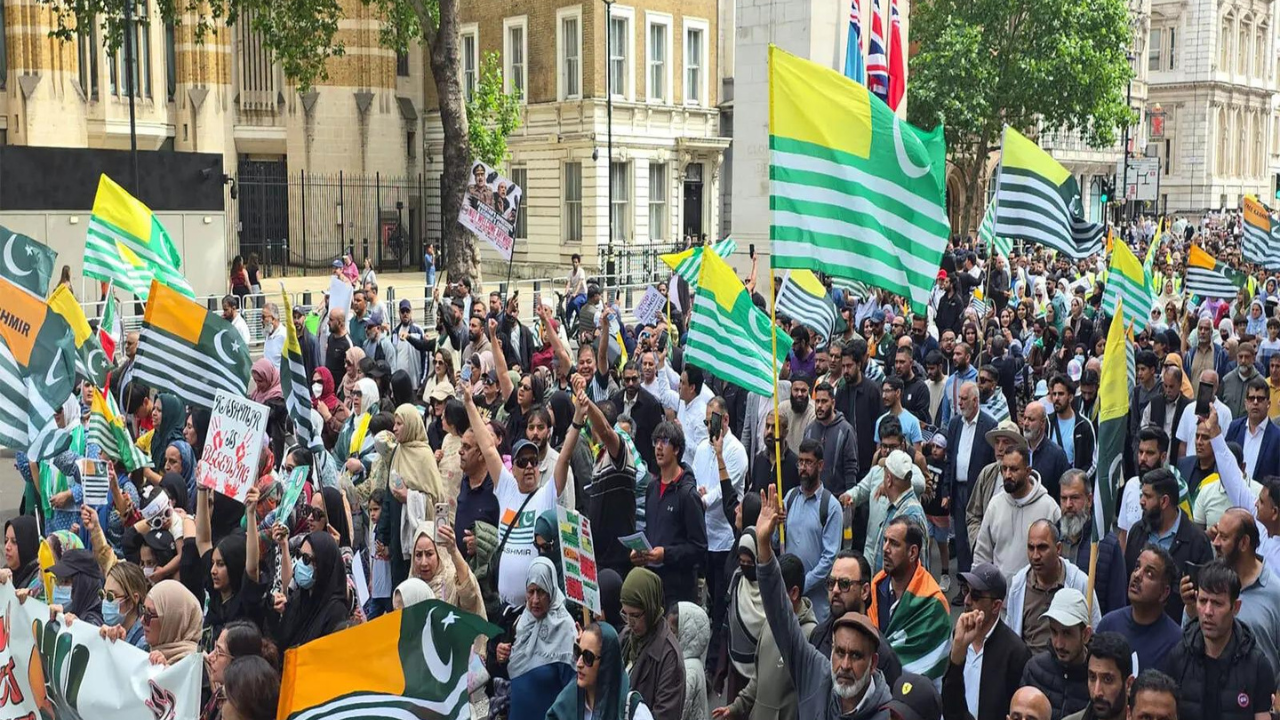
Thousands of British Kashmiris gathered outside the Palace of Westminster this week, bringing the Westminster traffic to a standstill to protest a violent military crackdown in Pakistan-administered Kashmir. The massive rally follows a lethal escalation in Rawalakot and Muzaffarabad, where Pakistani security forces opened fire on civilian demonstrators, leaving at least fifteen dead, dozens injured, and an entire region under a state-enforced communication blackout. While the immediate trigger for the protests is a contentious constitutional mechanism involving reserved legislative seats, the underlying crisis stems from decades of economic exploitation and systematic political disenfranchisement by Islamabad.
The unrest reveals a deeper truth that the Pakistani establishment has spent decades attempting to obscure. The region officially designated as "Azad" (Free) Jammu and Kashmir is experiencing a profound crisis of legitimacy, governed not by its people, but by a heavy-handed security apparatus that treats local dissent as acts of terror.
From Subsidies to Sovereignty
The current wave of demonstrations is organized by the Jammu Kashmir Joint Awami Action Committee, a grassroots coalition of traders, lawyers, students, and regular citizens. For over two years, this movement has paralyzed the region with wheel-jam strikes and public boycotts. The initial friction points were entirely economic. Residents revolted against skyrocketing electricity tariffs and the elimination of subsidies on wheat flour.
The irony of the electricity crisis is not lost on the local population. Pakistan-administered Kashmir is home to massive hydroelectric infrastructure, including the Mangla Dam, which generates thousands of megawatts of cheap electricity for Pakistan's national grid. Despite producing a vast share of the country's energy, local consumers are forced to pay inflated tariffs, effectively buying back their own natural resources at a premium.
What began as a kitchen-table struggle over utility bills has rapidly transformed into a structural challenge to Pakistani authority. The breaking point arrived when the Islamabad-backed administration officially banned the Action Committee under anti-terrorism laws, cutting off internet access and deploying paramilitary Rangers to seal the territory from outsiders.
The Twelve Seats Contrivance
To understand why thousands of diaspora Kashmiris are protesting in London, one must look at the mechanics of the regional legislative assembly. The flashpoint that broke ongoing negotiations between civil society and the state is the controversy surrounding twelve reserved seats in the fifty-three-member assembly.
These twelve seats are legally set aside for refugees who fled Indian-administered Kashmir after 1947 and settled across various provinces of Pakistan, such as Punjab and Sindh. In practice, these seats are weaponized by the dominant political parties in Islamabad to manufacture majorities in the regional parliament. Because the voting for these seats occurs outside the physical territory of Kashmir, the ruling party of Pakistan invariably sweeps them, planting loyalists who have no geographic, cultural, or economic ties to the region.
Local residents argue that this system dilutes their franchise. It ensures that regardless of how the population votes inside the territory, the ultimate political authority remains tethered to the desires of the federal government in Islamabad. By upholding this mechanism, the state has signaled that it values institutional control over democratic consensus.
The Diaspora as an Alternative Battleground
The British Kashmiri diaspora, numbering hundreds of thousands with deep family roots in districts like Mirpur, Kotli, and Rawalakot, acts as a crucial megaphone for a population currently silenced by digital blockouts. When Islamabad cuts the fiber-optic cables and suspends mobile networks in Muzaffarabad, the flow of information shifts to the streets of Bradford, Birmingham, and London.
More than thirty British Members of Parliament have signed a formal appeal urging the UK Foreign Office to intervene diplomatically. The involvement of British politicians highlights a distinct geopolitical shift. The diaspora is no longer just sending remittances home; it is actively lobbying Western governments to scrutinize Pakistan's internal governance and human rights record.
This internationalization is precisely what the Pakistani state sought to prevent by imposing travel bans on tourists and restricting journalists from entering the region. The heavy-handed response has backfired, transforming a localized labor and economic dispute into a highly visible human rights crisis on the steps of the UK Parliament.
A Failed Strategy of Coercion
The Pakistani state's reliance on emergency decrees, mass arrests, and anti-terrorism designations reflects a familiar, exhausted playbook. Every major protest cycle over the last three years has followed an identical trajectory: public anger peaks over economic negligence, the state deploys paramilitary forces, lives are lost, a temporary financial package is promised to pacify the crowds, and the underlying structural issues are left to rot.
This cycle is no longer sustainable. The labeling of a peaceful civic alliance as a terrorist organization has severed the last remaining avenues for genuine political dialogue. When a state uses anti-terror legislation to suppress demands for affordable bread and transparent legislative representation, it loses the moral authority required to govern effectively.
The thousands of protesters outside the Palace of Westminster are not merely demanding an end to the current military curfew. They are exposing the structural decay of an administrative system that uses the vocabulary of liberation while practicing the mechanics of occupation.