You smell it before you see it.
It is not the sharp, sterile scent of a newly minted art gallery with its fresh paint and polished concrete floors. Nor is it the heavy, suffocating funk of a forgotten attic where cardboard boxes go to rot. It smells of old paper, sun-warmed wax, ancient wood, and the faint, unmistakable ghost of a million human hands touching things that others threw away.
Push open the front door in South London, and the modern world evaporates.
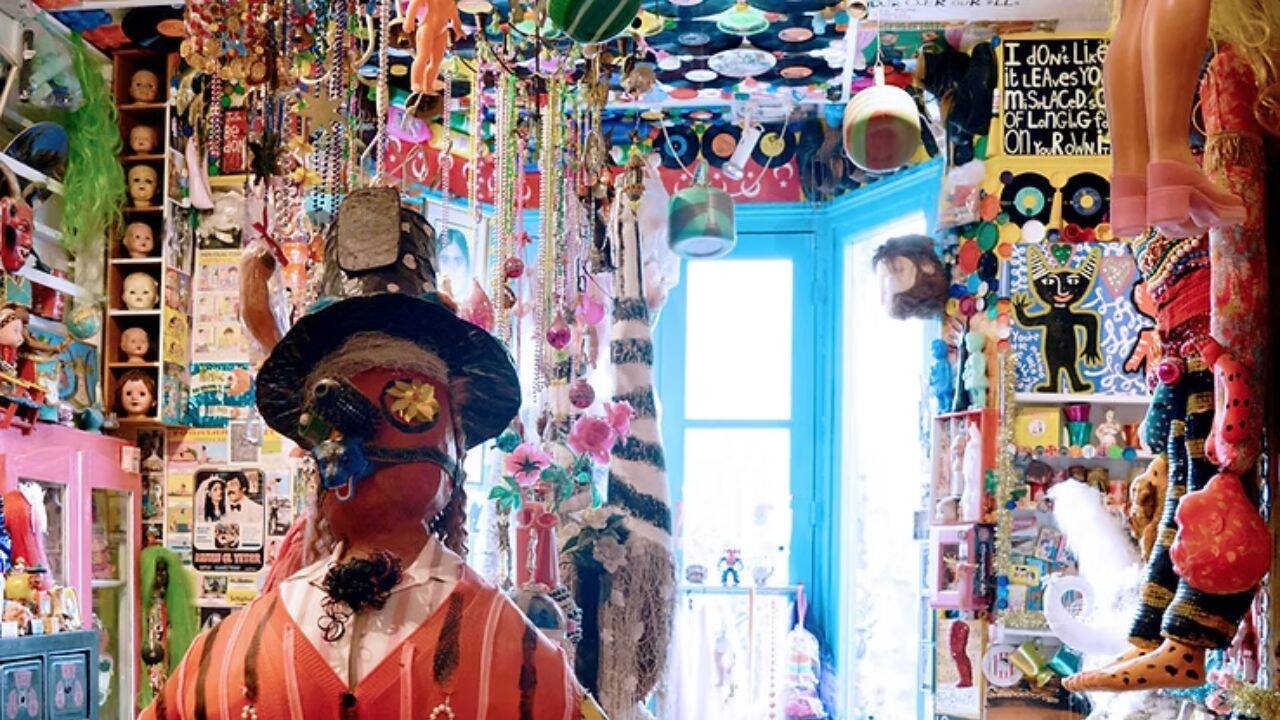
Outside, buses roar down asphalt arteries, commuters clutch glowing rectangular screens, and the relentless machinery of the twenty-first century marches forward without a backward glance. Inside, time has fractured, shattered, and reassembled itself into a chaotic, mesmerizing mosaic. Every square inch of wall space, every floorboard, every ceiling beam groans under the weight of porcelain faces, glass eyes, rusted clock gears, and forgotten relics.
This is the home of a woman who looked at the avalanche of urban discard and decided to build a fortress against oblivion.
The Weight of the Unwanted
Most people walk past the discarded. We see a broken china doll with a cracked cheek sitting on the pavement next to a skip, and our brains categorize it with ruthless efficiency: trash. Hazard. Clutter. We step around it, accelerating our pace, eager to reach the sanctuary of our minimalist living rooms where everything matches and nothing demands an emotional inventory.
Consider what happens when you refuse to look away.
Step inside this domestic labyrinth. Thousands of dolls stare back from shelves, windowsills, and suspended rafters. Some possess the delicate, hand-painted porcelain skin of the Victorian era; others are cheap, hollow-eyed plastic survivors of 1970s suburban childhoods. They are missing limbs, wearing moth-eaten velvet, or smiling with chipped lips. They do not look creepy until you stay long enough to realize they are witnesses.
They are the physical proxies of human memory. Every single one of them was once unwrapped on a birthday morning, clutched in a sweaty palm during a thunderstorm, or cried over when a childhood pet died. Then came the inevitable drift. The attic. The charity shop. The pavement.
The artist who lives here—surrounded by this staggering accumulation—does not see garbage. She sees an archive of feeling. When modern society decides that an object has exhausted its utility, it throws away the narrative attached to it. She rescues the narrative.
A Sanctuary Built of Bric-a-Brac
To understand the architecture of this space, you have to abandon conventional interior design. There are no Scandinavianneutrals here. There is no empty white space waiting to be optimized.
Instead, the rooms operate on a principle of radical accumulation. Tin toys march along the picture rails. Vintage postcards overlap like shingles on a roof. Enamelled advertising signs, rusty keys, copper kettles, and plastic dinosaurs form geological strata on the bookshelves.
It feels overwhelming at first. The human eye, trained by sleek interfaces and uncluttered digital spaces, panics slightly when confronted with infinite physical detail. You want to anchor your gaze on something simple, but there is nowhere to land. Every direction you look offers another story, another texture, another forgotten era breathing quietly in the gloom.
I remember standing in a room much like this years ago, holding a tarnished pocket watch that had stopped at 4:14. The glass was scratched, the mainspring broken. The person who owned it last was likely dead. Yet, holding it, I felt a sudden, sharp jolt of vertigo. We spend our lives frantically accumulating things, terrified of being buried by them, while simultaneously terrified of being forgotten. This house is the physical manifestation of that paradox. It is a monument to the fear of erasure.
The Currency of Salvage
Urban archaeology is a lonely pursuit. It requires a specific kind of patience—the willingness to dig through the refuse of a disposable culture while others mock your efforts as eccentricity or madness.
Critics look at spaces like this and diagnose a pathology. They whisper words like hoarding, obsession, inability to let go. They view the collection through the lens of economic utility: What is it worth? Where is the floor space? How do you clean the dust?
They are missing the point entirely.
The value here is not monetary. If you liquidated every doll, every rusty cog, every chipped tea saucer, you might buy a modest hatchback. The true currency is psychological resistance. In an age where everything is engineered for planned obsolescence—where our phones slow down after three years, our clothes fray after ten washes, and our digital memories live on fragile cloud servers controlled by faceless corporations—this house is permanent.
It is stubborn.
The dolls will outlast the smartphones. The rusted iron keys will outlive the algorithmic encryption keys we rely on today. By gathering the discarded remnants of daily life and giving them permanent shelter, the artist performs a quiet act of defiance against a culture that treats people and objects alike as disposable.
The Living Museum
Officially, spaces like this exist in a grey zone between private sanctuary and public archive. Visitors who manage to secure an invitation do not tour the house; they enter it. They walk slowly, breath bated, navigating narrow canyons of curiosities.
There is an intimacy to it that no traditional museum can ever replicate. In the British Museum or the Louvre, glass cases and security guards create a polite, sterile distance between you and the past. You look at a Roman coin or an Elizabethan ruff as something dead, categorized, and filed away by historians.
Here, the history is breathing on you.
A Victorian doll leans slightly forward from a high shelf, its glass eyes catching the slant of afternoon London sunlight, peering down at you as if it recognizes you. You brush against a stack of vintage luggage, and the smell of old leather and damp cellar air fills your lungs. You are not a spectator observing history from behind a velvet rope. You are a guest inside someone’s externalized mind.
And that is where the magic—and the slight discomfort—resides. Most of us keep our memories locked away in mental boxes or tucked safely into photo albums on our phones where we can swipe past the awkward years. We sanitize our personal histories. We present curated versions of ourselves to the world.
This house refuses curation. It lays everything bare—the beautiful, the broken, the cheap, the exquisite, the sentimental, and the bizarre—all jumbled together in a sprawling, unapologetic heap.
The Unfinished Story
As daylight fades through the soot-streaked windows of the South London terrace, the shadows lengthen across the sea of faces. The porcelain dolls seem to recede into the gathering dusk, their expressions shifting in the dim light from melancholy to watchful calm.
Outside, the city continues its frantic race toward tomorrow. Sirens wail in the distance. Neon signs flicker on. The world rushes to reinvent itself yet again, discarding last year's models, last year's aesthetics, last year's truths.
Inside, the past holds its ground.
The front door remains closed to the casual passerby, but the interior universe continues to expand, sustained by the belief that nothing truly precious ever has to be thrown away if someone is simply willing to love it after everyone else has walked away.