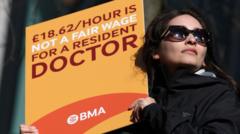
The standard media narrative regarding medical strikes is a predictable loop of hand-wringing. Pundits obsess over "patient safety" while unions chant about "fair pay." They both miss the point. Most articles on this topic suggest that strikes are a temporary glitch in a functioning system—a "necessary evil" that might, in some bizarre twist, improve efficiency through sheer desperation.
They are wrong.
Strikes aren't a glitch. They are a diagnostic test. And the results are in: the modern hospital is a bloated, bureaucratic zombie that functions better when the "essential" staff walks out. We need to stop asking if strikes are sustainable and start asking why the mortality rate often drops when doctors hit the picket line.
The Mortality Paradox No One Wants to Discuss
If you want to understand the rot in modern medicine, look at the data from the 1976 Los Angeles physician strike, or the 2000 walkout in Israel, or even the more recent industrial actions in the UK. A meta-analysis published in Social Science & Medicine looked at five major physician strikes between 1976 and 2003. The finding? Mortality stayed the same or actually decreased.
Let that sink in. The people we pay six-figure salaries to "save lives" stop working, and fewer people die.
This isn't a fluke. It's a systemic indictment. When doctors strike, they don't stop emergency care; they stop elective procedures. They stop the conveyor belt of unnecessary screenings, marginal surgeries, and the over-prescription of "just in case" medications. The industry refers to this as "defensive medicine." I call it institutionalized risk.
We have built a health economy that thrives on volume, not outcomes. Every time a surgeon "optimizes" their schedule by squeezing in an extra knee replacement on an eighty-year-old with three comorbidities, the risk of a hospital-acquired infection or a fatal drug interaction spikes. When the strike happens, the "noise" of unnecessary intervention disappears. We are left with what medicine should be: targeted, essential, and conservative.
The Myth of the "Overworked Hero"
The competitor's view is that doctors are burning out because they care too much and have too little. That’s a half-truth designed to win public sympathy.
The real reason for the burnout—and the subsequent strikes—is the proletarianization of the physician.
Twenty years ago, a doctor was a local authority figure, often a small business owner with skin in the game. Today, they are high-priced cogs in a private-equity-owned machine. They aren't striking for "patient care." They are striking because they’ve realized they have the same relationship to their employer as a warehouse picker.
I’ve sat in boardrooms where "physician utilization" is tracked like machine uptime. If a doctor isn't clicking boxes in an Electronic Health Record (EHR) every six minutes, they are considered a liability. The strike is a desperate attempt to regain professional sovereignty, but it’s failing because doctors are fighting for more money within a broken system rather than demanding the destruction of the system itself.
Why We Should Want More Strikes
Conventional wisdom says strikes are a sign of failure. I argue they are the only honest market signal left in healthcare.
A strike forces a "Minimum Viable Product" (MVP) version of a hospital. It reveals exactly how much administrative fat can be trimmed before the bones show. If a hospital can maintain its core mortality metrics with 30% of its staff on a sidewalk, why are we paying for the other 70% during "normal" times?
The answer is the Administrative Bloat. Since the 1970s, the number of physicians in the US has grown by roughly 150%. In that same period, the number of healthcare administrators has grown by over 3,000%.
Strikes disrupt the revenue cycle. They don't just stop surgeries; they stop the billing. This is the only thing that actually terrifies hospital C-suites. They don't care about the "moral injury" of their staff. They care about the fact that a three-day walkout can wipe out a quarter’s projected EBITDA.
The Sustainability Lie
The competitor's piece asks if strikes are sustainable. This is the wrong question. It assumes the current model of the mega-hospital is worth sustaining. It isn't.
The hospital is the most expensive, dangerous, and inefficient place to receive care. It is a Victorian-era solution to a 21st-century problem. We are still grouping the sick together in buildings filled with antibiotic-resistant bacteria, then wondering why healthcare costs $4.5 trillion a year in the US alone.
The "sustainability" of a strike is a moot point. The system is already in a state of permanent collapse. Staffing shortages are the new baseline. In Canada and the UK, wait times for "essential" care are measured in months or years. A strike is just an honest admission of a pre-existing condition.
Stop Fixing the System—Exit It
If you are a patient or an investor, the "actionable advice" isn't to support or oppose the union. It’s to avoid the institution entirely.
The rise of strikes is a signal to move toward Direct Primary Care (DPC) and decentralized health. DPC removes the insurance middleman and the hospital administrator. You pay a flat monthly fee directly to a doctor. No billing codes. No 15-minute timers. No "utilization" metrics.
When doctors own their practice, they don't strike. Why would they? They have autonomy. They have a relationship with the patient. They aren't a line item on a spreadsheet managed by a guy with an MBA who has never seen a patient bleed.
The Brutal Reality of the Picket Line
Let's talk about the downside—the part the "contrarian" pundits usually ignore. When doctors strike, the poor suffer. The wealthy have concierge doctors and private clinics that never close. The working class has the ER.
When the ER slows down because of a labor dispute, the "decreased mortality" I mentioned earlier becomes a cruel irony. Yes, fewer people die from unnecessary surgeries, but more people suffer from unmanaged chronic pain and undiagnosed cancers.
But this suffering is already happening. It’s just slower and quieter under "normal" operations. The strike simply makes the invisible visible. It forces the public to see that their access to health is a fragile permission slip granted by a crumbling bureaucracy.
The Future Is Not a Better Contract
Unions want a 30% raise. They should be asking for the right to delete half the software they are forced to use. They should be asking for the firing of three administrators for every one doctor hired.
But they won't. Because unions are just another layer of the same bureaucracy. They want a bigger slice of a poisoned pie.
If you want to see where this goes, look at any industry that refused to modernize and instead doubled down on labor strife. It ends in automation and outsourcing. We are already seeing the "AI doctor" being touted as the solution to strike-prone humans. And frankly, an algorithm that doesn't get tired, doesn't need a pension, and doesn't participate in defensive medicine is a massive threat to the medical guild.
The "Hero" status of the physician is a marketing campaign designed to keep the current billing structure intact. A strike is the moment the mask slips. It shows us that the hospital is a factory, the doctor is a factory worker, and the patient is the raw material.
If you want better health, pray for the strike to continue until the factory closes for good.
Build something else.
Build a system where the "essential" staff doesn't have to walk away from their patients to be heard by their bosses. Until then, stay out of the hospital. You might just live longer.