Silence.
That is the first thing you notice when the world shrinks to fifty meters, swallowing the familiar geometry of hedgerows, motorway gantries, and distant church spires into a thick, motionless wall of damp grey wool.
Most people treat a weather alert as background noise—a yellow triangle on a smartphone screen dismissed with a swipe before the kettle even finishes boiling. When the Met Office extends a fog warning for a second consecutive day, followed closely by bands of heavy rain and gusting winds, the standard reaction is a sigh of mild inconvenience. We check our coats. We complain about the dampness seeping into our boots. We assume the worst consequence will be ten extra minutes tacked onto the morning school run or a delayed commuter train out of Paddington.
We get the danger completely backward.
The real threat of a multi-day fog event isn't the water suspended in the air; it is the psychological illusion of stillness it creates right before the atmosphere turns violent.
The Architecture of a Disappearing World
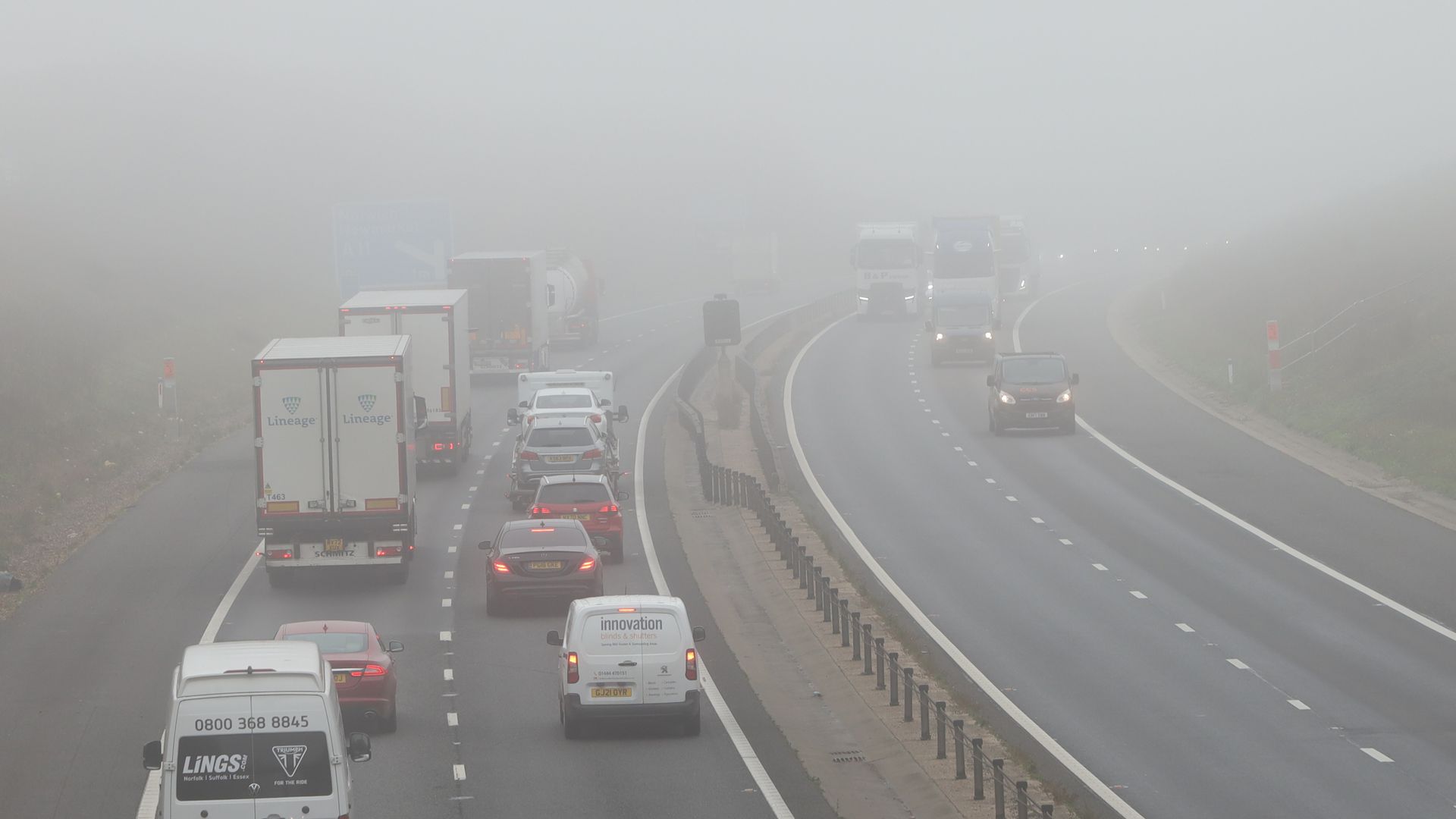
Consider a hypothetical scenario that plays out across British motorways every autumn and winter. Imagine a driver named Arthur, forty-two, heading north up the M6 before dawn with a thermos of coffee cooling in the cup holder and a delivery schedule running fifteen minutes behind. Outside his windshield, visibility has dropped below one hundred meters—the official threshold where the Met Office triggers a severe fog warning.
Arthur knows the rules, or at least he thinks he does. He switches on his dipped headlights. He eases off the accelerator.
Then comes the cognitive trap that catches thousands of seasoned drivers every year. Because the fog removes all peripheral visual cues—the blur of passing trees, the rhythm of streetlights, the distant horizon—Arthur's brain loses its primary instruments for gauging velocity. Psychologists who study spatial disorientation call this the "vection deficit." Without stationary objects rushing past the side windows, seventy miles per hour feels like forty. Forty feels like a crawl.
So Arthur's right foot presses down, just a fraction, chasing a sensation of normal speed inside a sensory vacuum. Ahead of him, a pair of red taillights glows faintly, suspended in the mist with no road surface visible beneath them. Because fog scatters light unevenly, those twin red dots appear much farther away than they actually are. By the time Arthur realizes the lorry in front of him has slowed to twenty miles per hour for a queue at the junction, the physics of wet asphalt and human reaction time have already sealed the outcome.
I have stood on the hard shoulder of an A-road in Wiltshire during a freezing November pea-souper, listening to the sickening, delayed echo of metal crumpling two hundred yards behind me in the whiteout. You cannot see the impact. You only hear the screech of tires fighting slick tarmac, followed by a dull thud, and then three seconds of terrifying quiet before the next set of brakes locks up. It is one of the most helpless sensations a human being can experience—standing on solid ground while invisible machines hurtle past at lethal speeds just feet away.
Why Day Two Hurts Worse
A single morning of fog is a novelty; a second consecutive day becomes an endurance test for both the infrastructure and the human nervous system.
To understand why a multi-day event compounds the risk, picture the atmosphere not as an empty sky, but as a heavy sponge resting directly on top of the British Isles. During radiation fog events—the most common culprit behind these stubborn warnings—clear night skies allow the earth's surface to radiate its daytime warmth rapidly back into space. The ground turns cold. The layer of moist air resting just above the soil cools down until it hits its dew point, forcing invisible water vapor to condense into billions of microscopic liquid droplets hovering just above the grass and tarmac.
Under normal conditions, the morning sun burns through this ceiling by mid-morning, warming the earth and lifting the mist.
When high pressure sits stubbornly overhead, however, it acts like a heavy iron lid clamped onto a boiling pot. The cold, dense air stays trapped in the valleys and river basins overnight, refusing to mix with the warmer air above. When the second night falls, the ground doesn't start cooling from a warm baseline—it starts from an already chilled, saturated state. The fog forms earlier, grows denser, and clings harder through the following morning.
For the people keeping the country running, the cumulative friction becomes exhausting.
Take air travel, where the invisible stakes translate directly into stranded families and billion-pound logistics bottlenecks. When visibility plunges at major hubs like Heathrow, Gatwick, or Manchester, air traffic controllers cannot simply rely on radar and let planes land at their usual sixty-second intervals. Under Low Visibility Procedures, aircraft must be spaced far wider apart on the tarmac and in the sky so ground radar beams aren't distorted by taxiing jets. Landing capacity can drop by thirty to fifty percent overnight.
On day one, airlines absorb the shock by shuffling crews and delaying afternoon departures. By day two, the entire timetable unravels. Planes are in the wrong cities, flight crews exceed their legal maximum working hours while sitting on misty aprons, and thousands of passengers end up sleeping on terminal floors beneath flickering departure boards.
The Calm Before the Whiplash
Just as travelers and commuters adjust their posture to the slow, claustrophobic rhythm of the fog, the meteorological script flips entirely.
This is the pivot point that makes the current Met Office forecast particularly treacherous: the arrival of wind and rain right on the heels of a prolonged whiteout.
Think of the weather transition like an uncoiling spring. Fog thrives on stagnation—calm winds below five miles per hour that allow water droplets to hang undisturbed in the air. The only force strong enough to scour a stubborn, two-day fog bank out of the valleys is an incoming Atlantic low-pressure system sweeping in with brisk winds and frontal rain.
In theory, wind and rain are the cure for fog. In practice, the transition zone between the two states creates a volatile cocktail of hazards on the ground.
Consider what happens next: for forty-eight hours, cold, moisture-laden air has been coating every exposed surface—rural lanes, bridge decks, cycle paths, and railway tracks—with a microscopic film of condensation and fallen leaves turned to slick pulp. Before the wind picks up enough speed to disperse the mist completely, the leading edge of the rain band arrives.
Suddenly, drivers who have spent two mornings peering nervously through a grey void are hit simultaneously by blinding spray kicked up by heavy goods vehicles, sudden crosswinds buffeting high-sided vans on exposed viaducts, and standing water pooling in clogged roadside drains.
The human brain struggles with rapid context switching. For two days, the primary threat was low visibility in calm air; within the span of an hour, the threat morphs into hydroplaning, fallen branches, and violent gusts tearing across saturated soil.
Trees are especially vulnerable during this exact sequence. After days of persistent dampness, the ground softens and loses its structural grip on root systems, while leaves and branches carry extra water weight. When brisk gusts slam into a woodland edge immediately following a prolonged wet fog, branches snap and shallow-rooted trees topple across power lines and rural rail tracks far more easily than they would during a dry gale.
Navigating the Blind Spot
Living through British winters teaches you a quiet humility toward the sky. I used to scoff at yellow weather warnings, treating them as bureaucratic overreaction designed to shield agencies from blame. That arrogance evaporated the night I missed a turning in rural Somerset, drove fifty yards down a flooded lane hidden by mist, and felt my front wheels drop off the submerged tarmac into a drainage ditch while rain began lashing the roof. Sitting there in the dark with hazard lights blinking faintly into a wall of white, waiting ninety minutes for a recovery truck that could barely find my postcode, strips away any illusion of control.
Surviving this two-stage weather pattern doesn't require panic, nor does it mean locking the front door and refusing to live your life. It requires trading autopilot for deliberate, mechanical awareness.
If you have to be on the road while the fog lingers and the wind begins to stir, abandon the dangerous habit of "latching on" to the taillights ahead of you. It feels comforting to follow a pair of red lights through the gloom, like holding someone's hand in a dark hallway, yet it is the fastest way to join a multi-car pileup if that driver drifts off the road or brakes suddenly. Instead, use the painted white lines on the road surface—the cats' eyes and edge markings—to anchor your lane position, and double your usual following distance.
Pay ruthless attention to your lighting setup, too. Automatic headlights are notoriously blind to daytime fog; because the ambient mist scatters bright daylight, your car's sensors often assume it is a sunny afternoon, leaving your rear lights completely dark while you vanish into the grey behind you. Switch your dipped headlights on manually. Use your fog lights only when visibility genuinely drops below one hundred meters, and turn them off the moment the mist clears—or the second rain starts falling—so you don't blind the drivers behind you with glaring red light refracted off wet windshields.
When the Sky Finally Breaks
There is a strange, electric relief when the transition finally completes.
You hear it before you see it: the sudden rattle of wind against the windowpane, the first sharp patter of heavy raindrops washing the grime off the glass, and the distant roar of gusts combing through the treetops. Within minutes, the suffocating grey curtain tears open. Distant hills reappear, sharper and darker than before, stripped of their ghostly veil as the Atlantic air sweeps the stagnant chill away.
Yet even as the horizon returns, the landscape carries the bruises of the shift—swollen streams, slick tarmac glistening under streetlights, and commuters gripping steering wheels a little tighter than usual.
A weather forecast is never just an abstract collection of pressure charts and satellite loops; it is an advance warning about how thousands of ordinary people are about to behave under pressure. Tomorrow morning, when the mist still clings to the valleys and the first squalls of rain begin rattling the rooftops, the difference between a routine commute and a tragedy won't be decided by the meteorologists in Exeter—it will be decided by the person sitting behind the wheel, choosing whether to trust their eyes or the instruments telling them to slow down.